Why Traditional NBA Defense vs. Position Rankings Miss the Point (And What Statyx's Matchup Engine Does Instead)
Defense vs. position rankings have been a prop betting staple for years. The logic is simple: find a team that ranks poorly against a given position, target a player at that position, and bet accordingly. Clean, fast, easy to explain. The problem is that the NBA stopped playing that way a long time…
 Statyx Staff
Defense vs. position rankings have been a prop betting staple for years. The logic is simple: find a team that ranks poorly against a given position, target a player at that position, and bet accordingly. Clean, fast, easy to explain.
The problem is that the NBA stopped playing that way a long time ago.
The Positionless Problem with Flat DVP Tables
Modern NBA rosters are built around versatility. A "small forward" might spend 60 percent of his minutes operating as a ball-handler in pick-and-roll actions. A "center" might defend more perimeter possessions than the team's listed shooting guard. Position labels on a box score are largely administrative at this point.
When you pull a flat DVP table showing that Team X ranks 28th against shooting guards, you are measuring a category that does not map cleanly onto how the game is actually played. That ranking averages together every player who touched the court against that team's shooting guard defenders, regardless of matchup context, lineup combinations, or where on the floor those possessions happened.
That is a lot of noise for a number that gets treated as a signal.
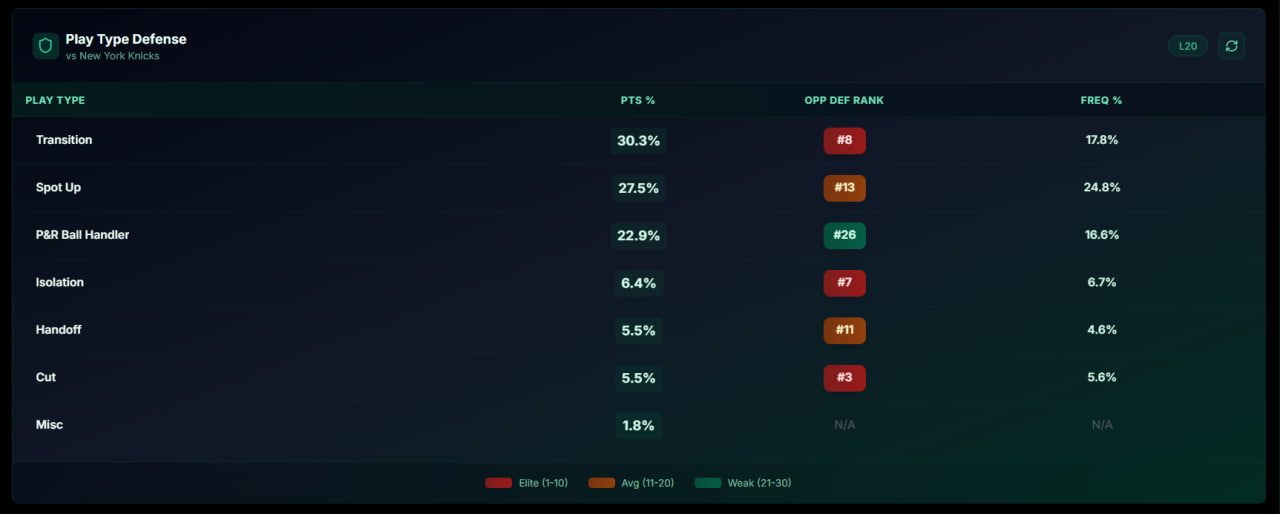
The deeper issue is granularity. Traditional DVP tables answer one question: how many points, rebounds, or assists does a team allow to a position on average? They do not answer the questions that actually matter for a specific prop. Who is guarding whom? What defensive scheme is the team running in those possessions? Is the damage coming from the paint, the mid-range, or the arc? Is the team surrendering catch-and-shoot looks or getting beaten in isolation?
Average stats allowed per position collapse all of that context into a single number. A single number is almost never enough.
What Real Matchup Data Should Actually Account For
Getting a clear picture of whether a player is in a good spot for a specific prop requires several layers working together.
Opponent-level context. Not just how a team defends a position, but how they defend the specific type of player you are researching. A team might rank well against traditional shooting guards but struggle badly against guards who initiate offense off the dribble. Those are different defensive problems. A flat DVP number blurs that distinction entirely.
Zone-level and shot-location data. Where a player does his damage matters. If a team gives up volume at the rim but defends the mid-range well, that is directly relevant to a big man's points prop. If a team concedes corner threes at an above-average rate, that shapes the outlook for any player whose shot chart leans heavily toward that zone.
Lineup and role context. Defensive assignments shift depending on which five are on the floor. Knowing the matchup at the starting lineup level is more useful than a team-wide average.
Trend direction. A team that ranked 20th against a position three weeks ago but has since tightened up is a different defensive opponent than their season-long number suggests. Recency matters.
None of this is exotic. It is just more precise than what a standard DVP table offers.
How Statyx's Matchup Engine Addresses This
The Statyx Matchup Engine is built on the premise that a useful defensive picture requires more than one column of data. Rather than showing a team's rank against a position label, it pulls together opponent-specific matchup context alongside zone-level shot data. You can see both where a team is vulnerable and whether the player you are researching is actually positioned to exploit that vulnerability.
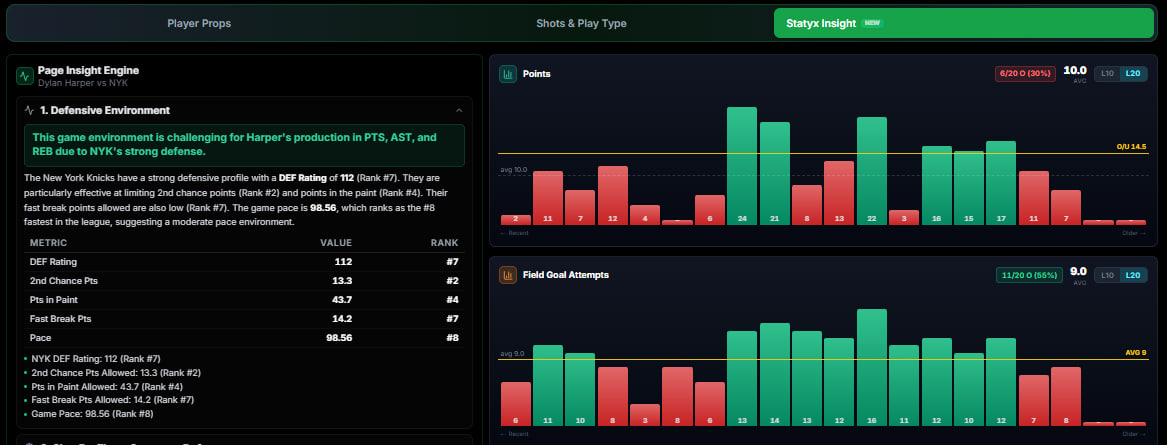
The AI layer handles the synthesis. Instead of manually cross-referencing a player's shot chart against a team's defensive zone tendencies, Statyx surfaces the relevant overlap and flags when conditions align for a meaningful edge. It highlights trends rather than snapshots, so you can distinguish between a team that has been consistently soft in a particular area and one that had a bad two-game stretch inflating their numbers.
That is the gap flat DVP tables cannot close. They tell you a team is weak. The Statyx Matchup Engine tells you whether the specific player you are looking at is set up to take advantage of that weakness, and why.
A Practical Example of Using It
Say you are looking at a wing player's points prop. A standard DVP table shows his opponent ranks poorly against small forwards. That is a starting point, not a conclusion.
Inside the Statyx Matchup Engine, you would look at where that team's defensive breakdowns actually occur. If their small forward struggles come from perimeter isolation situations and your player is primarily a catch-and-shoot scorer who does not create his own shot, the DVP ranking is less relevant than it appears. The team may be giving up points to a completely different type of small forward.
Flip the scenario: the zone-level data shows the team is weak defending the areas where your player generates the majority of his attempts, and the AI layer confirms that trend has held over the last ten games. Now you have a grounded basis for the bet, not just a ranking that pointed you in a general direction.
That is the difference between using a ranking and understanding a matchup.
The Bottom Line
DVP rankings are not useless. They are a reasonable first filter. The mistake is treating them as a final answer when they are really just a rough starting point.
The NBA's positionless reality means position-based averages will keep producing misleading signals for bettors who lean on them too heavily. Getting past that requires opponent-specific context, shot-location data, and a way to synthesize both quickly.
That is what the Statyx Matchup Engine is built to do. If you want to see how it works on your own research, explore it at statyx.io.
FAQs
What is a defense vs. position ranking in NBA betting? A defense vs. position (DVP) ranking measures how many statistics a team allows to players at a specific position on average. It is commonly used to identify favorable matchups for player props, but it does not account for matchup-specific context or shot-location data.
Why are traditional DVP rankings unreliable for prop betting? Because the NBA is positionless. Players do not operate strictly within their listed position's role, and DVP tables average together all possessions without distinguishing between player types, defensive schemes, or where on the floor the damage occurs.
What does "opponent-specific matchup context" mean? Rather than measuring how a team defends a position broadly, opponent-specific matchup context looks at how a team defends the particular style of player you are researching, including their tendencies in specific actions, zones, and lineup combinations.
How does zone-level shot data improve matchup analysis? Zone-level data shows where a team's defensive vulnerabilities actually exist on the floor. When a player's shot chart aligns with a team's weak defensive zones, that is a more precise signal than a position ranking alone.
What does the Statyx Matchup Engine do differently from a standard DVP table? The Statyx Matchup Engine combines opponent-specific matchup context with zone-level shot data and surfaces trend insights through an AI layer. You can see not just that a team is weak, but whether the specific player you are researching is positioned to benefit from that weakness.
Can I use the Statyx Matchup Engine for all NBA positions? Yes. The engine works across position types and is particularly useful for players whose role does not fit neatly into a traditional position label, which describes most modern NBA players.
How does the AI layer in Statyx add value on top of the raw data? The AI layer synthesizes raw matchup and shot-location data, highlights relevant trends, and flags when conditions align for a meaningful edge. It handles the manual cross-referencing work that would otherwise take significant time to do on your own.
Published for research and entertainment purposes. Not betting advice.

Discussion
Sign in to join the discussion.
Loading comments…