NFL Week 2 Fantasy Start/Sit: The Workload Behind Every Lineup Call
Every Sunday and Monday matchup, with clear fantasy starts, sits, injury pivots and a half PPR cheat sheet built from Statyx workload and matchup data.
 Statyx io
All 15 Sunday and Monday matchups. The starts, the difficult benches and the injury decisions that can change your lineup. September 20 and 21, 2026.
Week 1 left a few traps in the box scores. Christian Watson gained 147 yards, but Matthew Golden drew four more targets. Mike Gesicki produced 78 yards while playing less than a third of CIN's offensive snaps. Christian McCaffrey lost the carry count to Kaelon Black and still received eight targets.
Those are different lineup decisions. The useful question is what work remains available this week, and whether you have a better way to fill the same slot.
This guide covers every Sunday and Monday game, with TNF excluded. Calls assume a 12 team, half PPR league with one starting QB. WR3 and flex recommendations become more useful when lineups require three receivers. A downgrade means preferring a credible alternative, not dropping the player or benching him for an empty waiver wire promise.
All performance numbers are 2026 Week 1 observations, not Week 2 projections. Early defensive results help frame a decision; one game cannot establish the quality of a defense. Injury updates were checked September 18, with unresolved final reports identified in the relevant matchup.
Jump to a matchup or cheat sheet
The decisions that matter most
- Golden over Watson when you need the stronger volume case. Twelve targets and three red zone looks are easier to trust than a repeat of 147 yards.
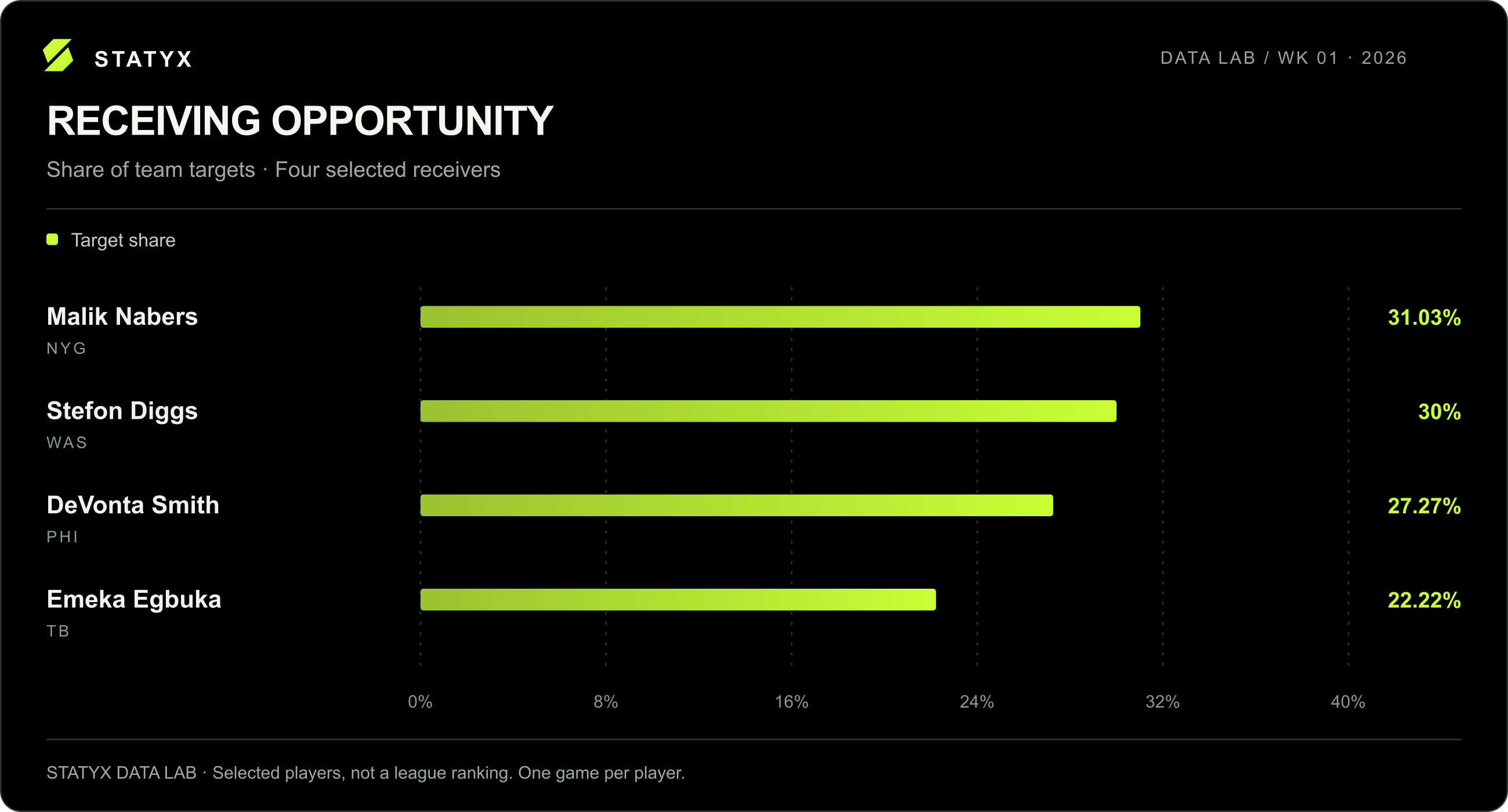
- Egbuka belongs in WR2 consideration. TB gave him substantial playing time and most of its downfield opportunity before this CLE matchup arrived.
- Schultz and Goedert are practical TE answers. Both have established involvement; HOU will also be without Nico Collins.
- Keep JSN, Jefferson and the heavily used RBs in. Quarterback changes and difficult matchups warrant adjustments, but do not erase concentrated opportunity.
- Make the injury pivots before kickoff. Olave and McConkey are questionable, Flowers and Bowers are doubtful, and Kamara's return changes the NO backfield.
Condensed cheat sheet: 12 team · half PPR
The tiers below are lineup recommendations, not a league wide ranking. Read the matchup for the tradeoff behind each call. Conditional players have their own table so an injury dependent start cannot be mistaken for clearance.
Start with confidence
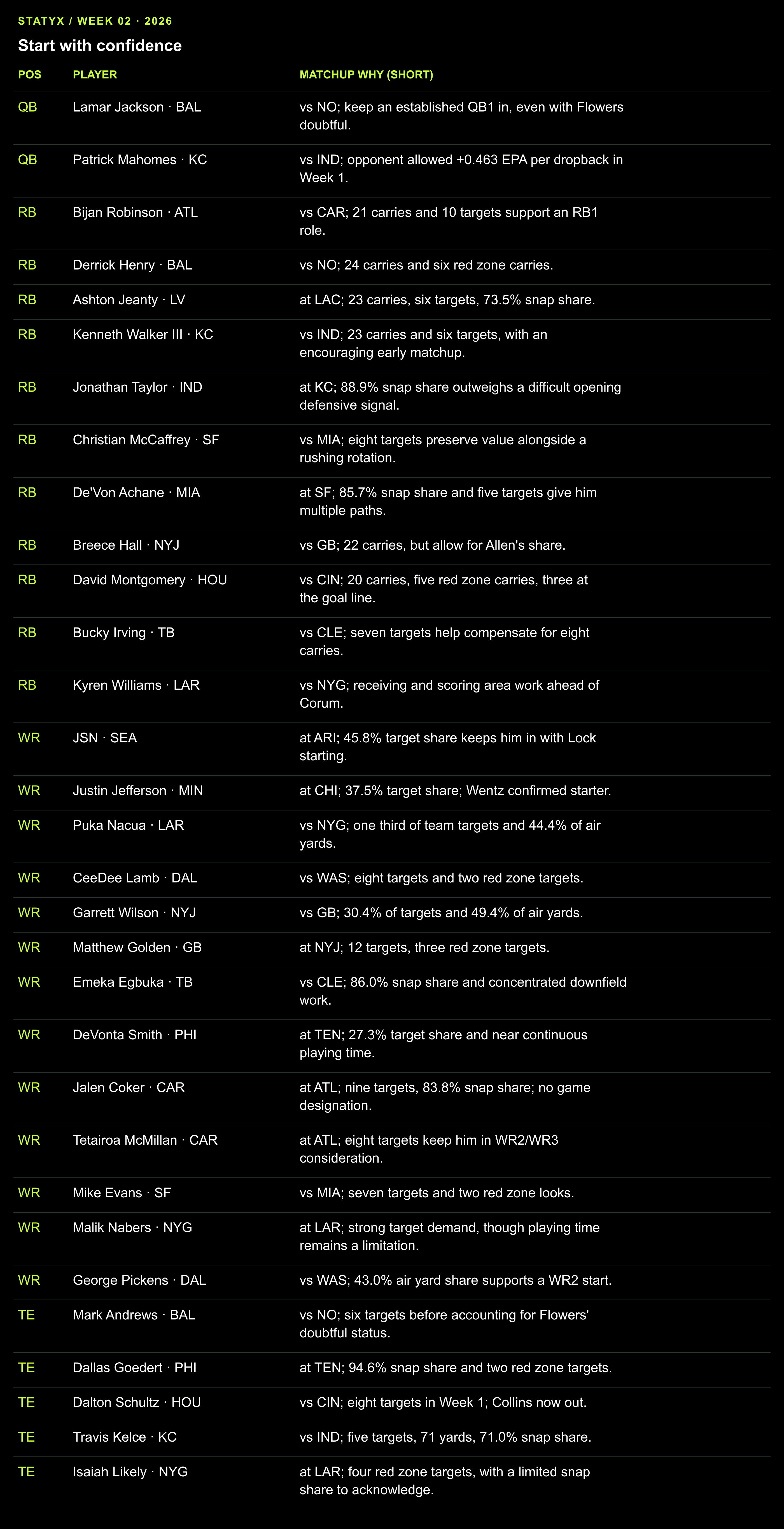
Read the start with confidence table as text
| Pos | Player | Matchup why (short) |
|---|---|---|
| QB | Lamar Jackson · BAL | vs NO; keep an established QB1 in, even with Flowers doubtful. |
| QB | Patrick Mahomes · KC | vs IND; opponent allowed +0.463 EPA per dropback in Week 1. |
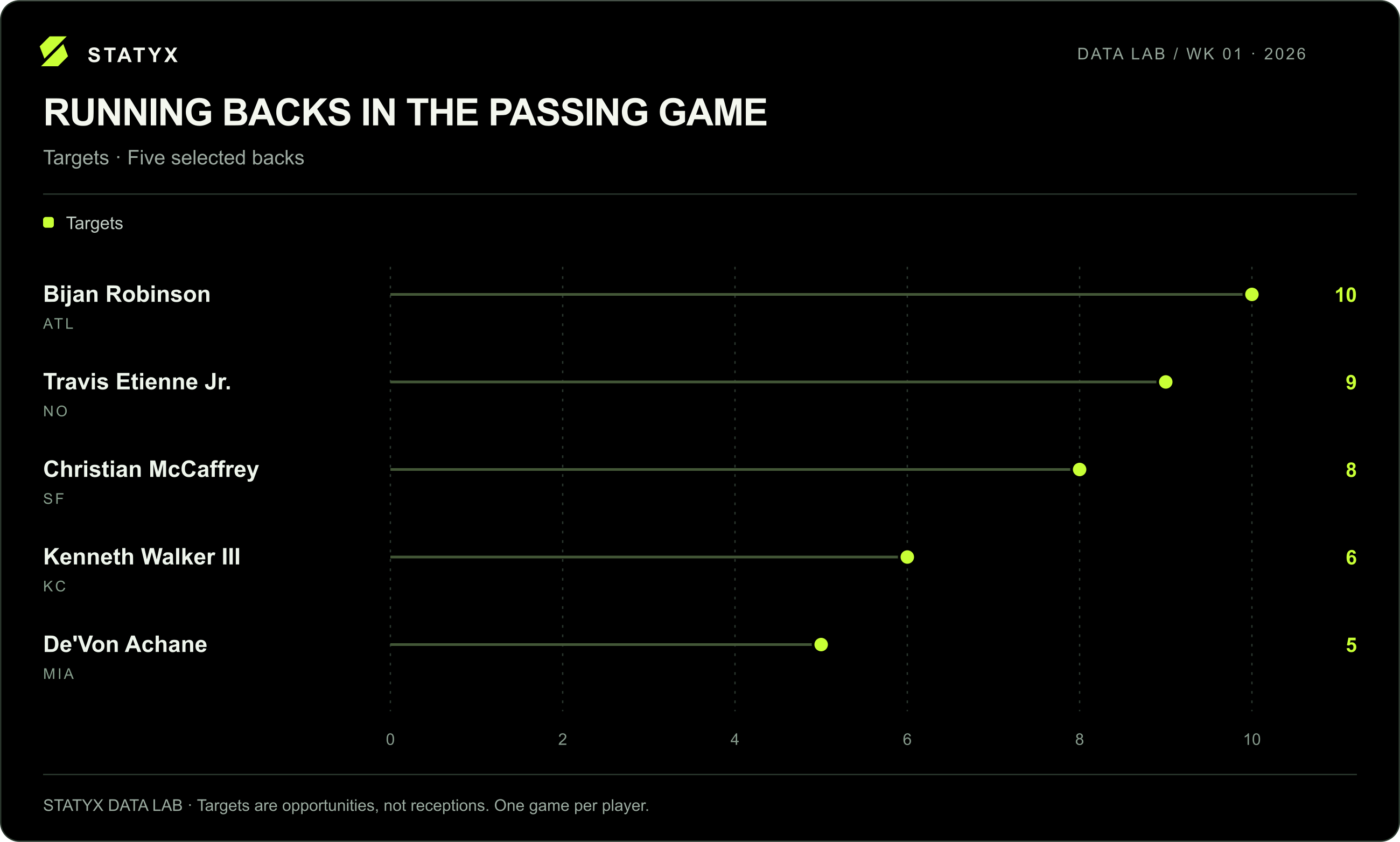
| RB | Bijan Robinson · ATL | vs CAR; 21 carries and 10 targets support an RB1 role. |
| RB | Derrick Henry · BAL | vs NO; 24 carries and six red zone carries. |
| RB | Ashton Jeanty · LV | at LAC; 23 carries, six targets, 73.5% snap share. |
| RB | Kenneth Walker III · KC | vs IND; 23 carries and six targets, with an encouraging early matchup. |
| RB | Jonathan Taylor · IND | at KC; 88.9% snap share outweighs a difficult opening defensive signal. |
| RB | Christian McCaffrey · SF | vs MIA; eight targets preserve value alongside a rushing rotation. |
| RB | De'Von Achane · MIA | at SF; 85.7% snap share and five targets give him multiple paths. |
| RB | Breece Hall · NYJ | vs GB; 22 carries, but allow for Allen's share. |
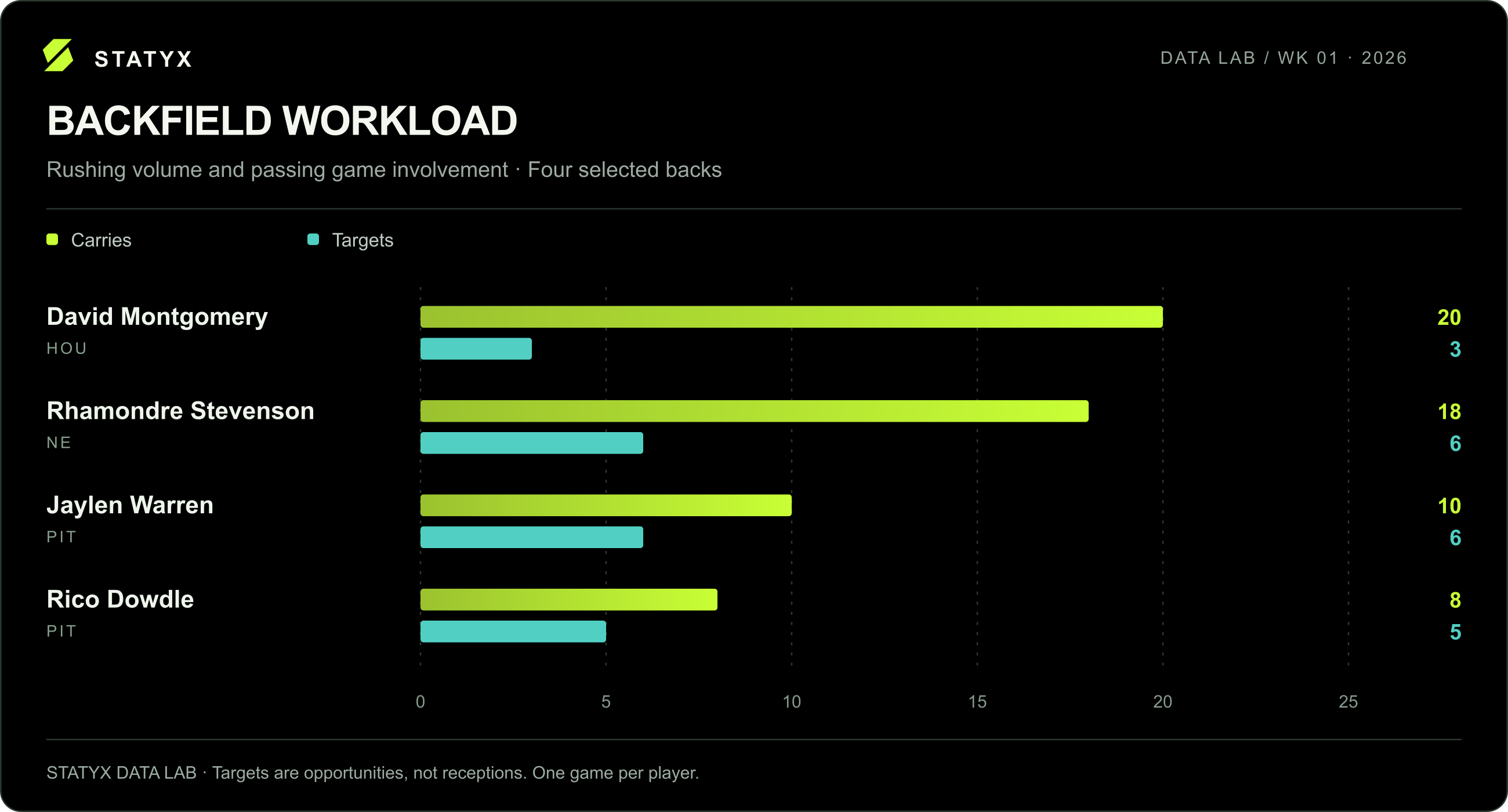
| RB | David Montgomery · HOU | vs CIN; 20 carries, five red zone carries, three at the goal line. |
| RB | Bucky Irving · TB | vs CLE; seven targets help compensate for eight carries. |
| RB | Kyren Williams · LAR | vs NYG; receiving and scoring area work ahead of Corum. |
| WR | JSN · SEA | at ARI; 45.8% target share keeps him in with Lock starting. |
| WR | Justin Jefferson · MIN | at CHI; 37.5% target share; Wentz confirmed starter. |
| WR | Puka Nacua · LAR | vs NYG; one third of team targets and 44.4% of air yards. |
| WR | CeeDee Lamb · DAL | vs WAS; eight targets and two red zone targets. |
| WR | Garrett Wilson · NYJ | vs GB; 30.4% of targets and 49.4% of air yards. |
| WR | Matthew Golden · GB | at NYJ; 12 targets, three red zone targets. |
| WR | Emeka Egbuka · TB | vs CLE; 86.0% snap share and concentrated downfield work. |
| WR | DeVonta Smith · PHI | at TEN; 27.3% target share and near continuous playing time. |
| WR | Jalen Coker · CAR | at ATL; nine targets, 83.8% snap share; no game designation. |
| WR | Tetairoa McMillan · CAR | at ATL; eight targets keep him in WR2/WR3 consideration. |
| WR | Mike Evans · SF | vs MIA; seven targets and two red zone looks. |
| WR | Malik Nabers · NYG | at LAR; strong target demand, though playing time remains a limitation. |
| WR | George Pickens · DAL | vs WAS; 43.0% air yard share supports a WR2 start. |
| TE | Mark Andrews · BAL | vs NO; six targets before accounting for Flowers' doubtful status. |
| TE | Dallas Goedert · PHI | at TEN; 94.6% snap share and two red zone targets. |
| TE | Dalton Schultz · HOU | vs CIN; eight targets in Week 1; Collins now out. |
| TE | Travis Kelce · KC | vs IND; five targets, 71 yards, 71.0% snap share. |
| TE | Isaiah Likely · NYG | at LAR; four red zone targets, with a limited snap share to acknowledge. |
Sit / downgrade if you have a real alternative
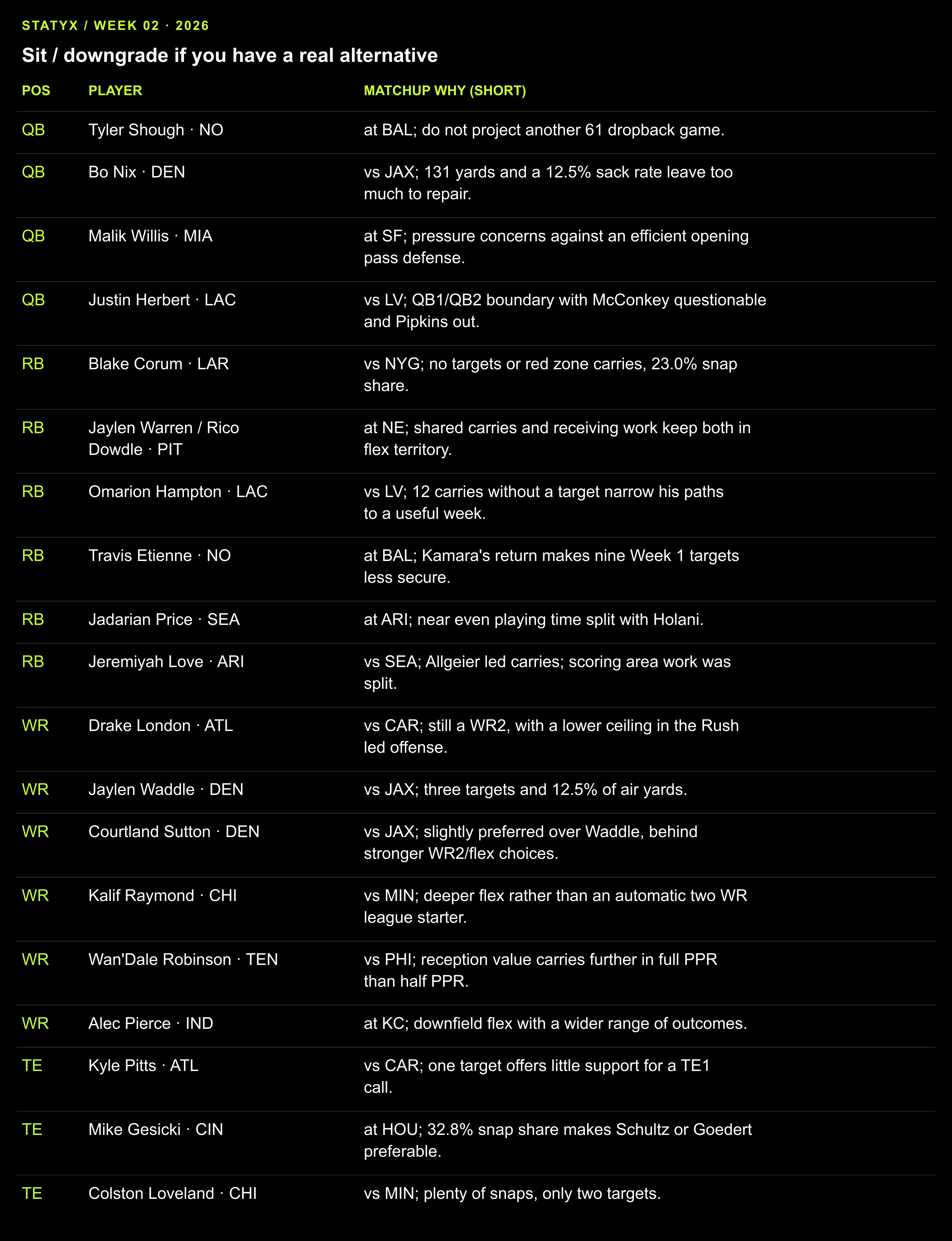
Read the sit or downgrade if you have a real alternative table as text
| Pos | Player | Matchup why (short) |
|---|---|---|
| QB | Tyler Shough · NO | at BAL; do not project another 61 dropback game. |
| QB | Bo Nix · DEN | vs JAX; 131 yards and a 12.5% sack rate leave too much to repair. |
| QB | Malik Willis · MIA | at SF; pressure concerns against an efficient opening pass defense. |
| QB | Justin Herbert · LAC | vs LV; QB1/QB2 boundary with McConkey questionable and Pipkins out. |
| RB | Blake Corum · LAR | vs NYG; no targets or red zone carries, 23.0% snap share. |
| RB | Jaylen Warren / Rico Dowdle · PIT | at NE; shared carries and receiving work keep both in flex territory. |
| RB | Omarion Hampton · LAC | vs LV; 12 carries without a target narrow his paths to a useful week. |
| RB | Travis Etienne · NO | at BAL; Kamara's return makes nine Week 1 targets less secure. |
| RB | Jadarian Price · SEA | at ARI; near even playing time split with Holani. |
| RB | Jeremiyah Love · ARI | vs SEA; Allgeier led carries; scoring area work was split. |
| WR | Drake London · ATL | vs CAR; still a WR2, with a lower ceiling in the Rush led offense. |
| WR | Jaylen Waddle · DEN | vs JAX; three targets and 12.5% of air yards. |
| WR | Courtland Sutton · DEN | vs JAX; slightly preferred over Waddle, behind stronger WR2/flex choices. |
| WR | Kalif Raymond · CHI | vs MIN; deeper flex rather than an automatic two WR league starter. |
| WR | Wan'Dale Robinson · TEN | vs PHI; reception value carries further in full PPR than half PPR. |
| WR | Alec Pierce · IND | at KC; downfield flex with a wider range of outcomes. |
| TE | Kyle Pitts · ATL | vs CAR; one target offers little support for a TE1 call. |
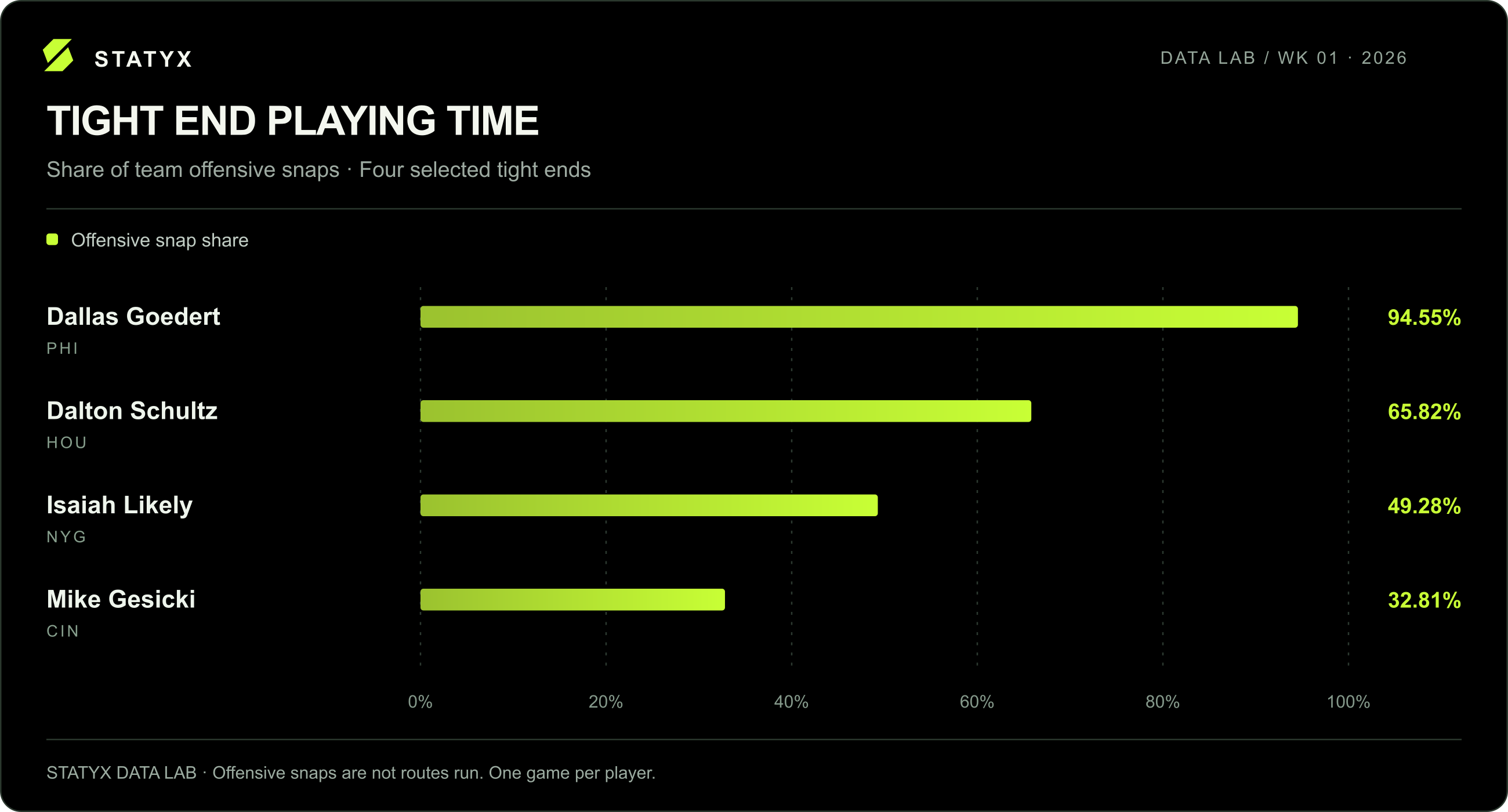
| TE | Mike Gesicki · CIN | at HOU; 32.8% snap share makes Schultz or Goedert preferable. |
| TE | Colston Loveland · CHI | vs MIN; plenty of snaps, only two targets. |
Conditional starts and useful streamers
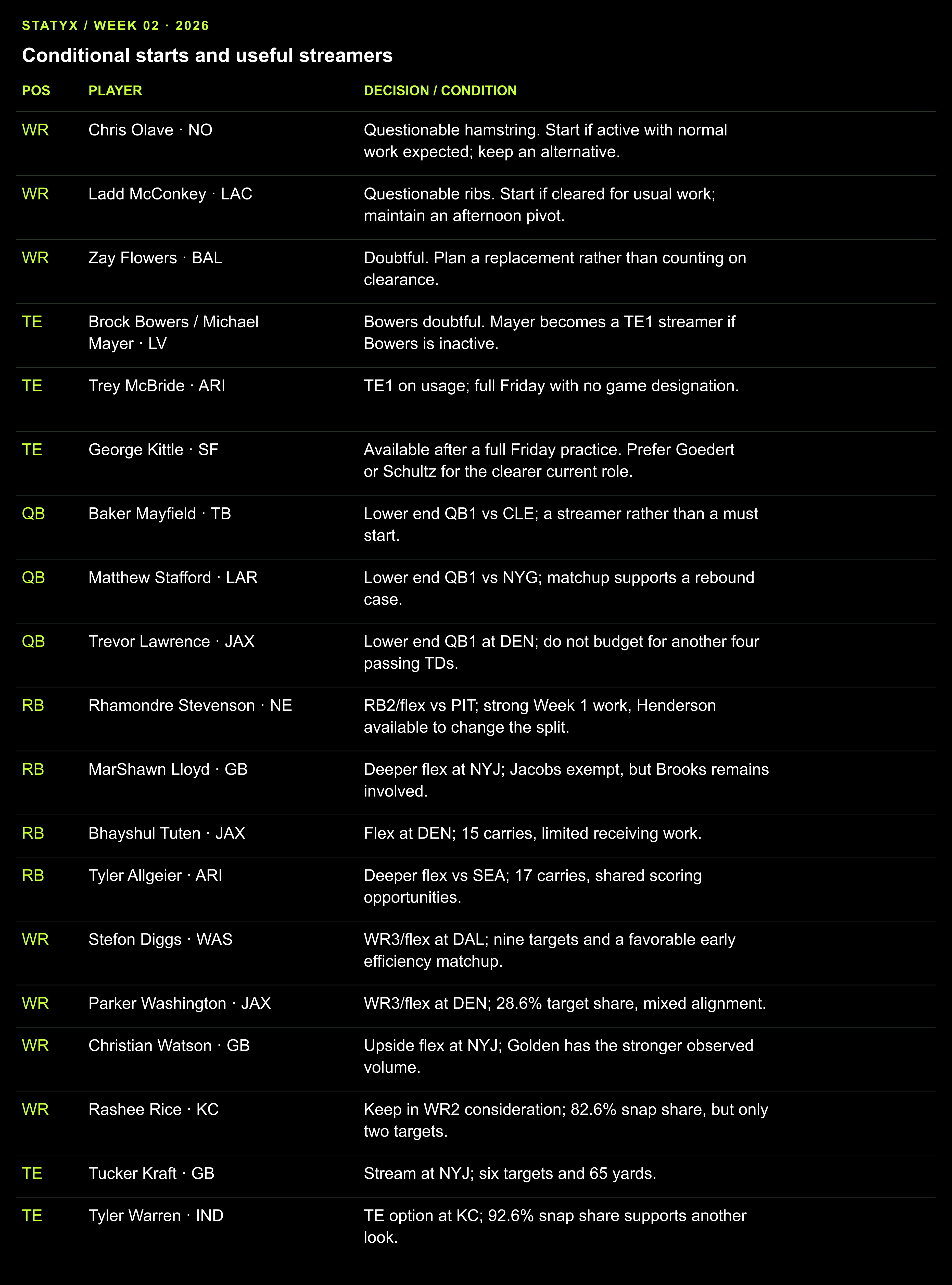
Read the conditional starts and useful streamers table as text
| Pos | Player | Decision / condition |
|---|---|---|
| WR | Chris Olave · NO | Questionable hamstring. Start if active with normal work expected; keep an alternative. |
| WR | Ladd McConkey · LAC | Questionable ribs. Start if cleared for usual work; maintain an afternoon pivot. |
| WR | Zay Flowers · BAL | Doubtful. Plan a replacement rather than counting on clearance. |
| TE | Brock Bowers / Michael Mayer · LV | Bowers doubtful. Mayer becomes a TE1 streamer if Bowers is inactive. |
| TE | Trey McBride · ARI | TE1 on usage; full Friday with no game designation. |
| TE | George Kittle · SF | Available after a full Friday practice. Prefer Goedert or Schultz only if you want the clearer current role. |
| QB | Baker Mayfield · TB | Lower end QB1 vs CLE; a streamer rather than a must start. |
| QB | Matthew Stafford · LAR | Lower end QB1 vs NYG; matchup supports a rebound case. |
| QB | Trevor Lawrence · JAX | Lower end QB1 at DEN; do not budget for another four passing TDs. |
| RB | Rhamondre Stevenson · NE | RB2/flex vs PIT; strong Week 1 work, Henderson available to change the split. |
| RB | MarShawn Lloyd · GB | Deeper flex at NYJ; Jacobs exempt, but Brooks remains involved. |
| RB | Bhayshul Tuten · JAX | Flex at DEN; 15 carries, limited receiving work. |
| RB | Tyler Allgeier · ARI | Deeper flex vs SEA; 17 carries, shared scoring opportunities. |
| WR | Stefon Diggs · WAS | WR3/flex at DAL; nine targets and a favorable early efficiency matchup. |
| WR | Parker Washington · JAX | WR3/flex at DEN; 28.6% target share, mixed alignment. |
| WR | Christian Watson · GB | Upside flex at NYJ; Golden has the stronger observed volume. |
| WR | Rashee Rice · KC | Keep in WR2 consideration; 82.6% snap share, but only two targets. |
| TE | Tucker Kraft · GB | Stream at NYJ; six targets and 65 yards. |
| TE | Tyler Warren · IND | TE option at KC; 92.6% snap share supports another look. |
All 15 matchups
Each matchup starts with the lineup call, then the workload and opponent evidence that support it.
01. CAR @ ATL: Coker's targets deserve respect; London's ceiling needs help
Start: Bijan Robinson, RB1; Jalen Coker and Tetairoa McMillan, WR2/WR3. Downgrade: Drake London to a volume dependent WR2. Sit: Kyle Pitts if a stronger TE option is available.
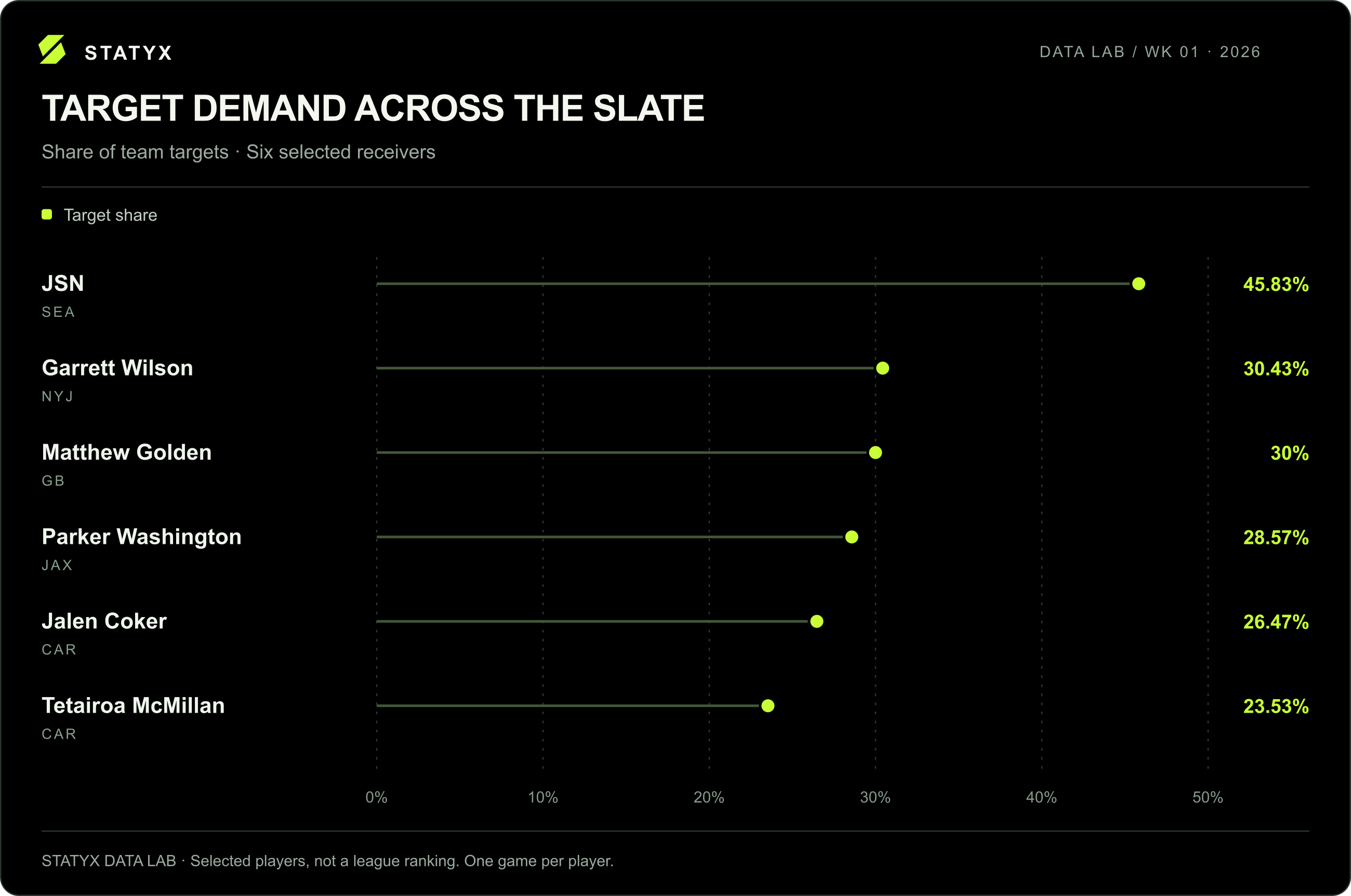
Coker's 138 yards are the attention grabber. His nine targets, 26.5% target share and 83.8% offensive snap share are the stronger reasons to keep him in the lineup. McMillan was close behind: eight targets, 23.5% of the targets and 82.4% of snaps. One receiver's big day did not come at the expense of the other's involvement.
I would treat both as viable starters rather than chase a supposed change at the top of the depth chart. Coker has the slightly stronger Week 1 opportunity case; McMillan's work was substantial enough that benching him for an uncertain waiver pickup would be an overreaction. ATL held opponents to 34.9% passing success in its opener, so neither needs to be sold as a certain repeat of last week's production. Coker practiced fully Friday and carries no game designation.
London presents the opposite problem. He played 98.3% of offensive snaps but received only four targets. Participation cannot manufacture an efficient passing offense. Cooper Rush is set to start again, and his first outing produced 143 passing yards with a 15.4% sack rate. London remains usable because the role is large; expectations should sit below his usual ceiling.
Bijan's 21 carries and 10 targets give him more ways to survive that environment. Keep him in as an RB1. Pitts had one target on a 63.3% snap share. A TE streamer needs a more convincing reason to expect the ball. I would start Goedert, Schultz or Likely ahead of him. ATL injury report · CAR injury report
02. NO @ BAL: the receiver injury decisions come first
Start: Lamar Jackson, QB1; Derrick Henry, RB1; Mark Andrews, TE1. Conditional start: Chris Olave if active without a reported workload restriction. Downgrade: Travis Etienne to RB2/flex. Plan to replace: Zay Flowers, doubtful.
Olave's opening workload was excellent: 13 targets, 24.5% of team targets and 50.3% of air yards. His 182 yards were supported by opportunity, not just a couple of fortunate catches. The immediate issue is his questionable hamstring designation. If active and expected to handle his normal work, I would start him. If reports point to a managed workload, Egbuka or Diggs becomes a sensible alternative.
BAL allowed negative 0.441 EPA per dropback in its opener. That is a reason to temper expectations, although it is still one opponent and one game. Tyler Shough needed 61 dropbacks to reach 410 passing yards. That level of passing volume should not become the default projection. In a one QB league, I prefer Mayfield or Stafford to chasing Shough's opening yardage total.
Etienne's nine carries and nine targets kept him involved even when the running game did not. Alvin Kamara's expected season debut now complicates that usage. Etienne is still a reasonable RB2/flex, particularly in PPR, but last week's receiving work is less secure with another experienced receiving back available. Avoid assuming all nine targets survive unchanged.
Flowers' doubtful designation calls for a replacement plan. Andrews already drew six targets, a 25% share, while playing 72.1% of snaps. He is the clearer established receiving option to trust, without pretending every missing Flowers target goes to him. Henry's 24 carries, six red zone carries and 144 rushing yards support the obvious RB1 call; Jackson remains a QB1. NO injury report · BAL injury report
03. GB @ NYJ: Golden has the volume; Watson has the volatility
Start: Matthew Golden, WR2; Garrett Wilson, WR2; Breece Hall, RB2. Flex: Christian Watson. Stream: Tucker Kraft. Flex: MarShawn Lloyd, with a shared backfield ceiling.
Golden's 12 targets and 30.0% share are a stronger basis for a Week 2 lineup than simply following the biggest yardage total. He played 82.4% of offensive snaps and received three red zone targets. Watson gained more yards, 147 to Golden's 95, but did so on eight targets and a 20.0% share. Both have a case; Golden has the better observed volume. NYJ has ruled Minkah Fitzpatrick and Joseph Ossai out, adding personnel concerns to a defense whose opening numbers otherwise look respectable.
NYJ allowed negative 0.124 EPA per dropback and no explosive passes in the Week 1 table. That makes an automatic replay of Watson's big day less attractive. I still like him as a flex for a lineup that can accept a wider range of outcomes. If the choice is Golden versus Watson in half PPR, I lean Golden.
Wilson's 30.4% target share and 49.4% air yard share make him a comfortable WR2 on the other side. Hall handled 22 carries, but Braelon Allen had 10 and played 40.3% of offensive snaps. Hall's volume supports starting him; the shared work argues against treating him as the entire offense.
Lloyd's 13 carries on 44.1% of snaps were less decisive than the carry total looks. Chris Brooks played more snaps, and Lloyd had just one target. Josh Jacobs remains on the Commissioner Exempt list on the current official roster. That leaves opportunity, but Brooks' involvement prevents a workhorse assumption. Lloyd is a deeper flex rather than an automatic RB2. GB roster Kraft, with six targets and 65 yards, is a reasonable TE streamer, though his lack of a red zone target in the opener makes a touchdown an added benefit rather than the basis of the recommendation. GB injury report · NYJ injury report
04. CLE @ TB: Egbuka is the cleaner call than Mayfield
Start: Egbuka, WR2; Bucky Irving, RB2. Stream: Baker Mayfield, lower end QB1.
Egbuka's six targets and 63 yards were respectable. The more interesting detail was the distribution: he accounted for 63.6% of TB's air yards while playing 86.0% of its offensive snaps. Air yards measure the distance the ball travels toward a receiver before the catch, including incompletions. That share tells us how heavily TB's downfield passing leaned on him, even in a modest volume game.
CLE allowed +0.793 EPA per dropback in its opener, the highest figure in the Statyx Week 1 defensive table. EPA measures how much a play changes an offense's expected points. That performance gives the passing game a favorable starting point for this matchup, although CLE has had only one chance to establish its 2026 level.
Route IQ adds a useful distinction. CLE allowed an explosive gain on 19.05% of receptions, but only 3.39 yards after the catch per reception. Those figures describe a defense hurt by larger gains without being equally vulnerable after every catch. Egbuka is attractive because of his involvement and opportunity downfield, rather than an expectation of repeated gains after the catch. His weighted target area grade is still unqualified, and the man/zone receiving samples are too small to establish a reliable advantage. Statyx Route IQ
Mayfield requires more restraint. He threw for 216 yards without a touchdown and took sacks on 12.5% of his dropbacks. QB Hub's depth table shows 11 attempts behind the line of scrimmage and just one measured deep attempt. There is a plausible rebound here, but a favorable opponent does not guarantee enough passing volume to make him a top tier fantasy quarterback. I would use him over Aaron Rodgers or an emergency replacement starter; I would not bench an established upper tier QB for him. Statyx QB Hub
Irving's eight carries and seven targets explain why he remains an RB2 despite a light rushing workload. Receiving involvement gives him another way to contribute if TB does not feed him 18 carries. Jalen McMillan's possible return adds uncertainty to the target distribution, so Egbuka's Week 1 share should not be treated as a weekly entitlement.
05. CIN @ HOU: Schultz's role matters before the missing targets
Start: Montgomery, RB2; Schultz, TE1 option. Sit: Gesicki if Schultz or Goedert is available.
Collins' absence removes the receiver who drew 10 targets and 27.0% of HOU's target volume in Week 1. It does not tell us where every one of those opportunities will go. Schultz's appeal is that we do not have to begin with that guess: he already received eight targets, a 21.6% share, against BUF.
Four catches for 35 yards made that involvement easy to overlook. For a tight end decision, eight targets are more useful evidence than the disappointing yardage total. Collins being out improves Schultz's opportunity to remain central to the passing game. It also removes a player who helps the offense function, so the adjustment is not all upside. HOU has ruled starting guard Ed Ingram out as well. HOU's Friday report
Montgomery is a separate decision. Twenty carries, five red zone carries and three goal line carries make a credible RB2 workload. His 49.4% snap share also tells us Woody Marks remains involved. We should expect a shared backfield with valuable work for Montgomery, rather than describe him as an every down back.
Rush IQ shows half of Montgomery's carries going inside, where CIN's early grouped lane grade was Balanced. Thirty percent went right, where the panel graded CIN Softer. The right side is worth watching, but it is only part of the picture, and these grades come from one game. His own Week 1 rushing success rate was 40%; this is a workload led start with scoring potential, not a forecast of effortless efficiency. Statyx Rush IQ
Across the field, Gesicki's seven targets and 78 yards came while playing 32.8% of offensive snaps. Snaps are not routes, and a receiving specialist can be productive in limited playing time. Still, that is a narrower role than Schultz's 65.8% participation. If Chase and Higgins command a larger share of the passing game, Gesicki could be left with fewer chances. He is a defensible deeper league option, but I would choose Schultz or Goedert first.
Burrow's Friday improvement supports keeping Ja'Marr Chase and Tee Higgins in their usual starting consideration, subject to his active status. Have an alternative ready if that changes on Sunday morning.
06. PHI @ TEN: Smith and Goedert have the playing time
Start: Smith, WR2; Goedert, TE1. Downgrade: Wan'Dale Robinson in half PPR.
Smith's six targets and 53 yards did not demand much attention. His 27.3% target share and 94.6% offensive snap share deserve it. There is a substantial role underneath the ordinary receiving total.
TEN allowed +0.350 EPA per dropback and an explosive pass on 15.4% of opponent dropbacks in Week 1. Route IQ separately records 17.39% of receptions becoming explosive gains. The denominators differ, but both indicate that larger completions were a problem in that opening sample.
Smith lined up wide on 94% of his recorded alignment sample. That makes the perimeter worth examining, but Route IQ still labels much of the target area evidence unqualified. The case is straightforward: a receiver with substantial playing time and target demand faces a defense that just allowed meaningful passing gains. There is not enough evidence to promise that a particular route or cornerback matchup will decide the game. Statyx Route IQ
Goedert's case is similarly straightforward: five targets, 77 yards, two red zone targets and a 94.6% snap share. A five target game is not exceptional in isolation. Combined with near continuous playing time and scoring area involvement, it is enough to favor him over a tight end whose appeal depends on repeating a single long catch.
Robinson is a more format sensitive play on TEN's side. His six targets represented 21.4% of team targets, and Route IQ showed 80% slot alignment. That gives him a plausible reception role. PHI, however, allowed only 3.94 yards after the catch per reception in the opening sample. Short catches can keep a full PPR lineup moving without producing a particularly useful half PPR score. I would prefer Egbuka, Smith or Diggs; Robinson belongs in the deeper flex conversation.
07. MIN @ CHI: Jefferson stays in; Raymond needs context
Start: Justin Jefferson, WR1. Sit: Raymond in ordinary two WR lineups; consider him in deeper formats.
The quarterback question has an answer: Wentz will start, and Murray is out. Brian O'Neill remains questionable, so MIN's protection is still worth monitoring. MIN announcement · Friday injury report
Jefferson drew nine targets, a 37.5% share, and three red zone targets in the opener. His involvement is strong enough to keep him in the lineup despite the change under center. CHI allowed 6.78 yards after the catch per reception, which adds a favorable element, but Route IQ's target area grade remains unqualified. The broad defensive result supports the start without proving that every part of the matchup is inviting.
Raymond's nine targets and 34.6% target share create a real question on the other side. So does the fact that he played 60.0% of CHI's offensive snaps, compared with 73.3% for Luther Burden III. Burden received only five targets. Playing time and target demand pointed in different directions.
That is a reason to keep watching, rather than declare either number irrelevant. Raymond could remain heavily involved. He could also be the Week 1 beneficiary of a distribution that changes from opponent to opponent. In a two WR league, I would use Egbuka or Diggs ahead of him. In a deeper league, nine targets are enough to make him a viable flex. Burden's larger snap share earns attention, not an automatic promotion over him.
Colston Loveland is another case where participation beats the box score, but only up to a point. He played 86.7% of offensive snaps, yet finished without a catch on two targets. That playing time keeps him in deeper TE consideration; it does not move him ahead of Goedert, Schultz or Likely this week. A snap count cannot score fantasy points until the ball follows it.
08. PIT @ NE: avoid paying for work nobody owns
Start: Rhamondre Stevenson as an RB2/flex. Downgrade: Jaylen Warren and Rico Dowdle to flex options.
The PIT split is difficult because both backs have a case, and neither has all the work. Warren had 10 carries and six targets; Dowdle had eight carries and five targets. Dowdle played 58.2% of offensive snaps, Warren 37.3%. Choosing one does not give you the combined receiving role or the whole rushing workload.
That matters against a NE defense that held opponents to a successful rushing play on 33.3% of carries in Week 1. One game cannot establish that NE will keep doing it, but there is little reason to upgrade a split workload on matchup grounds alone.
Stevenson's opening usage was much clearer: 18 carries, six targets and an 84.5% snap share. His 51 rushing yards were unimpressive. The opportunity was not. I prefer that combination to guessing which PIT back benefits from this week's rotation.
There is an obvious qualification: TreVeyon Henderson practiced fully throughout the week and has no game designation. Stevenson's Week 1 dominance is evidence of what happened, not proof of what the staff will allocate on Sunday. He is an RB2/flex on the available information, with workload risk. PIT NE injury report
09. WAS @ DAL: Diggs earns a place in the flex
Start: CeeDee Lamb, WR1; George Pickens, WR2; Stefon Diggs, WR3/flex, with WR2 appeal in deeper leagues.
Diggs received nine targets, 30.0% of WAS's total, and 32.4% of its air yards. That is enough involvement to take seriously even though his 62.9% snap share leaves room for the workload to fluctuate.
DAL allowed +0.667 EPA per dropback, with opponents generating positive EPA on 69.7% of dropbacks. It nevertheless recorded zero explosive passes allowed in that same table. The interesting possibility is therefore sustained passing production rather than an assumption that Diggs will hit a long touchdown.
A defense can allow an offense to move efficiently without giving up a string of deep completions. Diggs' Week 1 demand makes him a useful way to pursue that opportunity.
Friday's news adds context: WAS ruled tight end Chig Okonkwo out, and DAL confirmed linebacker DeMarvion Overshown will miss the game. Both teams must adjust personnel. Those changes strengthen the reason to examine the passing matchup, but they do not tell us which receiver inherits an extra target. WAS update · DAL update
I would start him ahead of Raymond or Robinson in half PPR. I would not move him ahead of established WR1s on the strength of one game with WAS.
Lamb and Pickens remain starts on the other side. Lamb drew eight targets, a 26.7% share and two red zone targets. Pickens had six targets and 43.0% of DAL's air yards, compared with Lamb's 37.2%. Their receiving totals of 44 and 28 yards were poor; their roles were more encouraging. Lamb is the stronger weekly play, while Pickens offers a WR2 route to downfield production. Do not mistake one disappointing box score for a lack of involvement.
10. LV @ LAC: Jeanty's work travels; Mayer depends on the injury report
Start: Ashton Jeanty, RB1. Conditional: Michael Mayer if Brock Bowers remains unavailable; Ladd McConkey if cleared for his usual workload. Downgrade: Justin Herbert to the QB1/QB2 boundary; Omarion Hampton to RB2/flex.
Jeanty's 23 carries, six targets and 73.5% snap share give him one of the sturdier opportunity profiles in the article. LAC allowed positive EPA on 56.4% of opposing dropbacks and 41.9% of rushes in Week 1. Those are broad team measures, not RB specific receiving grades, but they provide no strong reason to back away from Jeanty's workload.
Mayer's seven targets and 80.9% snap share are attractive at TE. Bowers is doubtful, according to Friday's coach report. The condition is whether the same role remains available. Bowers update If Bowers returns, Mayer cannot be projected from the previous week's participation as though nothing changed. If Bowers is out again, Mayer belongs in the TE1 streaming discussion; his six catches for 32 yards show how a modest average gain can still be useful when the targets keep coming.
McConkey is questionable with a rib injury. He had seven targets and a 25.9% target share in Week 1, making his availability important to Herbert as well as to his own lineup slot. Herbert was sacked on 10.0% of dropbacks, while LV generated sacks on 13.5% of opposing dropbacks. LAC has also ruled Trey Pipkins out. The protection and receiver questions make Herbert a less comfortable one QB start than his name alone suggests.
Hampton received 12 carries but no targets. That gives him a narrower recovery path if rushing efficiency disappoints. He remains usable in an RB2/flex slot, but I prefer Montgomery's scoring area work or Stevenson's observed receiving involvement when those are the alternatives. LV injury report · LAC injury report
11. JAX @ DEN: Washington's role is more interesting than a cornerback headline
Start: Trevor Lawrence as a lower end QB1; Parker Washington, WR3/flex. Flex: Bhayshul Tuten. Downgrade: Bo Nix, Jaylen Waddle and Courtland Sutton.
Washington drew six targets, 28.6% of team targets and 46.4% of air yards. Route IQ recorded 50% slot alignment, 44% wide and 6% backfield. He was not confined to one spot, which is a more useful starting point than assigning him to a single opposing corner for the entire game.
DEN allowed 11.07 yards after the catch per reception in Week 1. Washington himself produced only 0.8 YAC per reception in the Route IQ sample. The defensive number describes a possible opening; it does not establish that Washington has already shown the skill or usage to exploit it. His target demand is the firmer reason to start him in a flex. Jakobi Meyers and Brian Thomas Jr. were limited in the inspected Thursday report; neither is treated here as a confirmed absence or a source of guaranteed extra targets. The weighted target area grade remains unqualified. Statyx Route IQ
Lawrence's four passing touchdowns came on 24 dropbacks. The efficiency was outstanding, but repeating that touchdown rate would be an aggressive expectation against DEN. I would use him as a lower end QB1 and resist promoting the entire JAX offense on the assumption that another four score game is coming.
Tuten had 15 carries and one target, with no goal line carries. DEN's +0.366 EPA per rush allowed is encouraging for the matchup, but Tuten's 49.1% snap share and limited receiving work leave him in the flex tier.
For DEN, Waddle's three targets and Sutton's five were both disappointing. Sutton had the larger air yard share, 38.5% versus 12.5%. That makes him the slight preference if forced to choose, not a player to start over Egbuka or Diggs. Nix's 131 passing yards and 12.5% sack rate leave too much to repair before I would trust him in a standard one QB lineup. JAX injury report · DEN injury report
12. SEA @ ARI: the receiving volume is concentrated; the backfields are not
Start: JSN, WR1; Trey McBride, TE1. Downgrade: Jadarian Price and Jeremiyah Love to flex options. Consider: Tyler Allgeier in deeper leagues.
JSN commanded 11 targets, a 45.8% share and three red zone targets in Week 1. That is almost half of the team's targets. Sam Darnold is out and Drew Lock will start. Lock already handled 23 of SEA's 26 dropbacks in the opener, so JSN's heavy involvement largely came with this quarterback playing. Keep JSN in the lineup rather than treating the quarterback change as a reason to abandon that role.
McBride's opportunity was similarly hard to improve upon: 13 targets, a 35.1% share, nine catches and four red zone targets. SEA's defense allowed positive EPA on 52.4% of dropbacks in the opener. McBride practiced in full Thursday and Friday after a rest/back listing and carries no game designation. His usage supports a TE1 start.
The running backs require more patience. Price had 10 carries, two targets and 48.0% of snaps. George Holani had eight carries and 46.0% of snaps, along with two red zone carries to Price's zero. Zach Charbonnet remains on PUP. The available work is still being shared: Price is a flex, not a secure RB2 based on an assumed lead role. SEA roster context
Love's 11 carries and four targets offer more receiving involvement, but Allgeier led ARI with 17 carries and 58.7% of snaps. Both had three red zone carries and one goal line carry. That split makes Love a flex with receiving upside and Allgeier a deeper option for rushing volume. Neither should be credited with owning the scoring work after one evenly divided red zone sample. SEA injury report · ARI injury report
13. MIA @ SF: receiving work protects the RBs; Kittle has to earn back trust
Start: Christian McCaffrey and De'Von Achane, RB1/RB2 options; Mike Evans, WR2. Downgrade: George Kittle if Goedert or Schultz is available. Sit: Malik Willis in one QB formats.
McCaffrey's 10 carries were fewer than Kaelon Black's 14. His eight targets are why those carry counts do not settle the fantasy decision. Black was limited Thursday with a groin issue. If available, he can absorb rushing work while McCaffrey remains involved in the passing game; the final SF report should settle that part of the rotation. McCaffrey's 55.4% snap share is a workload note worth retaining, but the combined opportunity still supports starting him.
Achane had 11 carries and five targets while playing 85.7% of offensive snaps. The 36 rushing yards were disappointing. His participation was substantial. A player who remains on the field and receives targets has more ways to recover than one dependent on a handful of early down carries.
That does not make the matchup easy. SF allowed negative 0.352 EPA per dropback in its opener, while Willis took sacks on 15.6% of his dropbacks. I would avoid Willis in a one QB lineup. Achane remains a start because of the workload, with expectations adjusted for an offense that may struggle to sustain drives.
Evans drew seven targets, 36.9% of SF's air yards and two red zone targets. That is a useful WR2 profile. Kittle's five targets, 12 yards and 46.2% snap share leave a less reassuring combination. Kittle practiced in full Friday after two limited sessions and carries no game designation. Availability is settled, but a manager holding Goedert or Schultz has a defensible alternative with clearer current opportunity. MIA injury report · SF injury report
14. IND @ KC: Walker's workload is real; 173 rushing yards need not repeat
Start: Kenneth Walker III and Jonathan Taylor, RB1s; Patrick Mahomes, QB1; Travis Kelce, TE1. Hold in starting consideration: Rashee Rice, WR2. Downgrade: Alec Pierce to a volatile flex.
Walker gained 173 rushing yards, but the start recommendation does not need another number like that. Twenty three carries, six targets and a 68.1% snap share are sufficient. IND allowed +0.280 EPA per rush in Week 1, which adds a favorable early signal without proving every run will be productive.
Taylor's 19 carries, four targets and 88.9% snap share make the opposing backfield even less ambiguous. KC allowed a successful rushing play on only 30.8% of opponent carries. That lowers the efficiency expectation; it is not a good reason to bench a player with Taylor's concentration of work. Both backs stay in.
Mahomes' 184 passing yards were ordinary, but IND allowed +0.463 EPA per dropback. That is enough matchup support to keep him in QB1 consideration. Kelce's five targets, 71 yards and 71.0% snap share also justify a TE1 start. Neither requires a claim that the opening game was better than it was.
Rice's two targets are uncomfortable. His 82.6% snap share is the reason to give him more than one game before making a drastic lineup change. He practiced fully and has no game designation. Keep him in WR2 consideration, while recognizing that playing time has to turn into targets for that decision to pay off.
Pierce owned 54.5% of IND's air yards on six targets. That is meaningful downfield involvement, but it can create uneven weekly production. KC recorded no explosive passes allowed in its opening table and generated sacks on 12.1% of dropbacks. Pierce is an upside flex, not a safer play than Egbuka or Diggs. Tyler Warren's 92.6% snap share and five targets keep him in the TE discussion despite 13 yards; I prefer him to Pitts if choosing between those two. IND injury report · KC injury report
15. NYG @ LAR: Likely has earned the second look
Start: Puka Nacua, WR1; Kyren Williams, RB2; Malik Nabers, WR2; Isaiah Likely, TE1 option; Matthew Stafford, lower end QB1. Sit: Blake Corum outside deeper flex slots.
Likely's eight catches for 78 yards were impressive. The better reason to consider him again is the 27.6% target share and four red zone targets behind them. That scoring area demand gives him a second route to a useful week if eight for eight receiving efficiency does not repeat.
He played 49.3% of offensive snaps, so this is not an every down workload. Even with that limitation, I prefer his observed role to Gesicki's: more team target share, more red zone targets and more playing time. I would still favor Goedert's steadier participation and Schultz's opportunity with Collins out.
Nabers received nine targets and 31.0% of NYG's targets despite a 52.2% snap share. That tells us NYG looked for him frequently when he was involved; it does not establish a full workload. LAR allowed positive EPA on 58.3% of opposing dropbacks in Week 1, which gives his receiving opportunity a favorable backdrop.
Stafford is a reasonable rebound choice against a NYG defense that allowed +0.314 EPA per dropback. His own 155 yard, zero touchdown opener keeps the recommendation in the lower end QB1 range. The matchup earns him consideration over Rodgers; it does not justify chasing last season's reputation without regard to current production.
Nacua's nine targets, 33.3% target share and 44.4% air yard share keep him in WR1 territory even after LAR's quiet passing opener. Williams' 11 carries, three targets and four red zone carries provide the more valuable backfield role. His 63.9% snap share does not eliminate a rotation, but his opportunities are easier to start than Corum's.
Corum's 54 rushing yards on 10 carries can tempt a manager looking for a flex. The less attractive details were zero targets, zero red zone carries and a 23.0% snap share. Kyren Williams had three targets and four red zone carries. Corum can help LAR without receiving the opportunities a fantasy lineup needs. I would choose Montgomery or Stevenson first.
Monday's final injury designations were not available at the research cutoff. The inspected reports contained several defensive back practice limitations; none is treated here as a confirmed absence. LAR report · NYG report
Before lineups lock
The immediate decisions are Olave, McConkey, Flowers and Bowers. Keep a usable replacement for each injury dependent lineup slot. Recheck Burrow's active status, Jalen McMillan's clearance and O'Neill's availability. McBride and Kittle both finished the week with full practices and no game designation. JAX's limited receivers also require a final report check.
For NYG @ LAR, review the Monday game final report and retain a viable late replacement if a designation changes. An early inactive player can be replaced from the full slate; an uncertain Monday player cannot. HOU report · TB report · Burrow update
How much weight should Week 1 receive?
Enough to identify opportunity, not enough to assume permanence. Carries, targets and participation describe what a team chose to do. Touchdowns and long gains explain the score, but need more context before they become a weekly expectation. Early defensive ranks are especially sensitive to the opponent and a handful of plays.
Where do the numbers come from?
Player and team statistics were retrieved from Statyx Data Lab, explicitly filtered to 2026 regular season Week 1. Receiving context was checked in Route IQ, rushing context in Rush IQ, and passing depth context in QB Hub. Unqualified coverage and target area samples are not presented as established matchup edges. Injury information reflects team reports checked September 18, supplemented by the linked Friday coach report for Bowers. Editorial calls are our interpretation of that evidence, not model generated projections.
Published for research and entertainment purposes. Not betting advice.


Discussion
Sign in to join the discussion.
Loading comments…