Why Whiff Rate Alone Won't Win You Strikeout Props: Inside Statyx's K Engine Pitcher Board
Whiff rate is the first number most bettors reach for when sizing up a strikeout prop. That makes sense. A pitcher who misses bats racks up Ks. But if whiff rate were enough on its own, sportsbooks would have a much harder time setting lines. They don't. The issue is that whiff rate tells you how o…
 Statyx Staff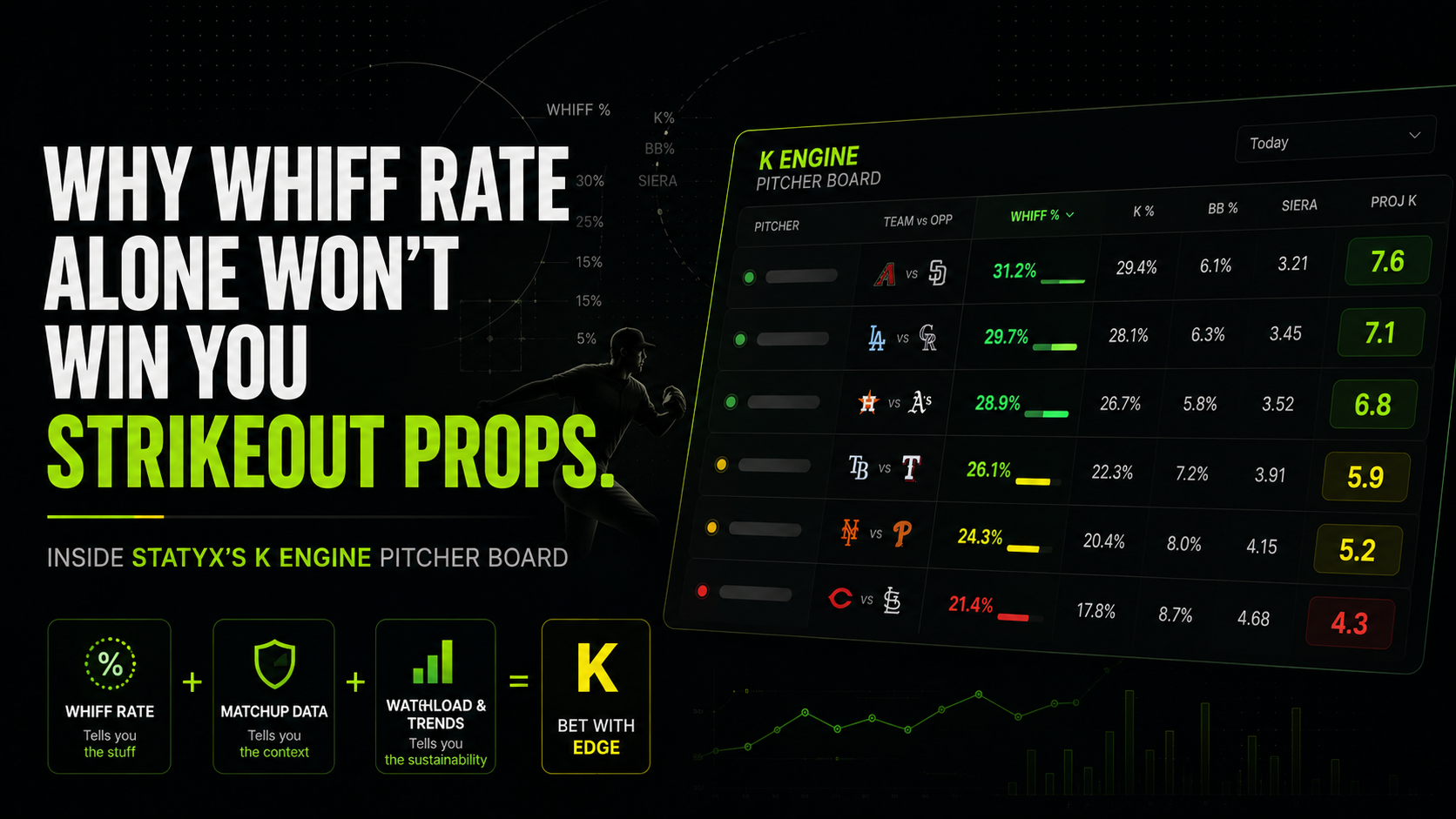
Whiff rate is the first number most bettors reach for when sizing up a strikeout prop. That makes sense. A pitcher who misses bats racks up Ks. But if whiff rate were enough on its own, sportsbooks would have a much harder time setting lines. They don't.
The issue is that whiff rate tells you how often a pitcher generates swings and misses, not how often he actually converts those misses into strikeouts. There's a real gap between "misses bats" and "records a third strike," and that gap is where prop bettors consistently leave money on the table.
The K Engine Pitcher Board at Statyx was built to close that gap. Here's how it works.
What Whiff Rate Actually Measures (And What It Doesn't)
Whiff rate measures swings that produce no contact, expressed as a percentage of total swings. A pitcher sitting at 35% is generating a miss on more than one in three swings. That's elite contact avoidance.
But a strikeout requires three strikes, and not all of them come from whiffs. A called strike on a borderline pitch counts too. A foul ball extends the count but doesn't end it. A pitcher who pounds the zone and generates called strikes can pile up Ks even with a modest whiff rate. On the flip side, a high-whiff pitcher who struggles to throw early strikes may never get to the counts where that whiff rate actually matters.
Whiff rate is a component of strikeout production. It is not a proxy for it.
The Metrics the K Engine Combines
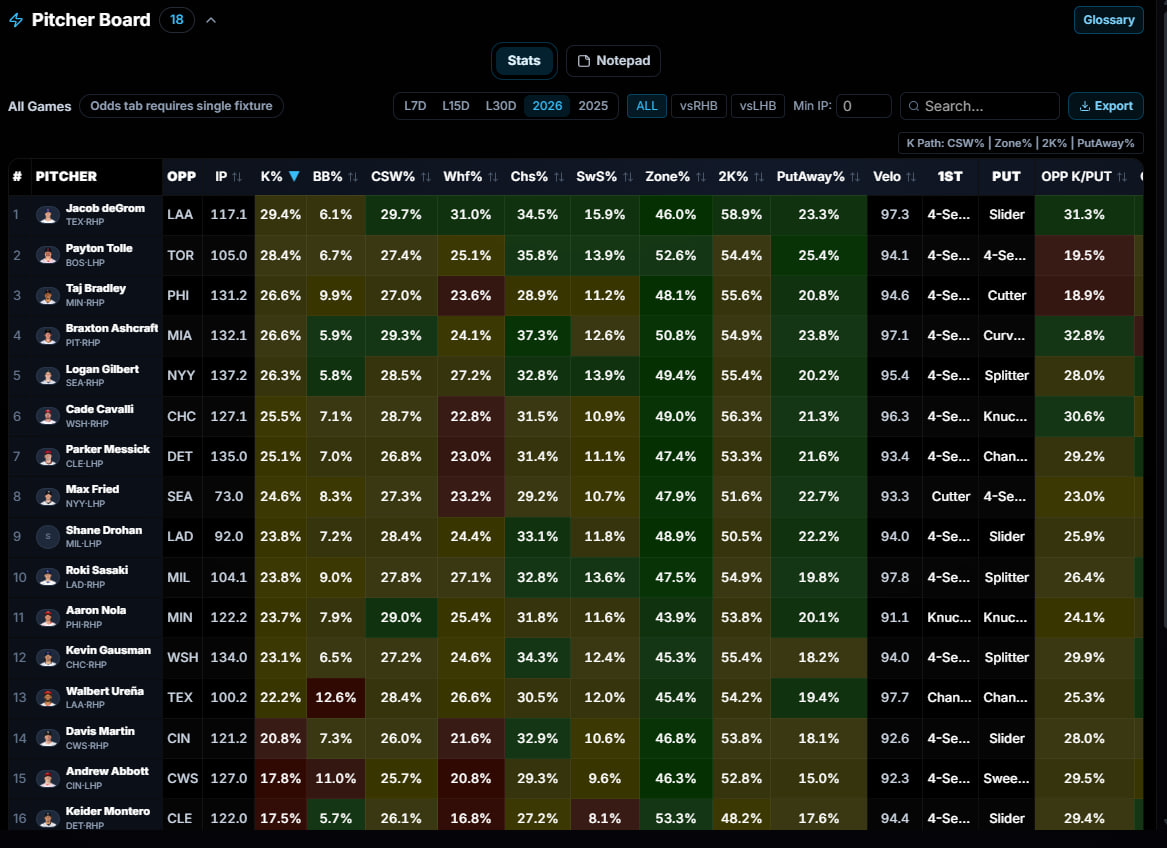
The K Engine Pitcher Board pulls six core inputs alongside whiff rate to build a complete picture of a pitcher's strikeout probability in a given start.
CSW% (Called Strike Plus Whiff Rate)
CSW% is the single most predictive individual strikeout metric in modern pitching analysis. It counts both called strikes and swings and misses as a share of total pitches, capturing the full range of ways a pitcher can advance a count toward a strikeout. A pitcher with a high CSW% is generating favorable counts consistently, which is the precondition for everything else.
Whiff rate captures one half of that equation. CSW% captures both.
Zone% and Chs% (Chase Rate)
These two metrics work in tension. Zone% tells you how often a pitcher throws in the strike zone. Chase rate tells you how often batters swing at pitches outside it.
Throwing in the zone forces batters to protect, which creates swing decisions. Generating high chase rates outside the zone gets batters swinging at pitches they can't hit cleanly. The best strikeout pitchers do both. The K Engine reads the combination, not each number in isolation.
SwS% (Swing Strike Percentage)
Swing strike percentage is the share of total pitches that produce swings and misses. It's related to whiff rate but uses total pitches as the denominator rather than total swings, which makes it less sensitive to how often batters choose to attack a given pitcher. A pitcher generating swing strikes at a high rate relative to total pitches is creating misses efficiently, regardless of whether batters are being aggressive.
PutAway%
PutAway% measures how often a pitcher converts a two-strike count into a strikeout. This is where the prop actually lives. You can have excellent CSW%, elite chase rates, and a high whiff rate and still underperform on Ks if you can't finish hitters when you have them set up.
PutAway% is the closing metric. It tells you whether the pitcher can execute when it counts.
Velocity
Velo feeds into the projection as a contextual anchor. Velocity changes within a start, or relative to a pitcher's seasonal baseline, can signal fatigue or mechanical issues that suppress strikeout production even when underlying metrics look strong. The K Engine flags meaningful deviations so you're not projecting off a profile that no longer reflects the pitcher's current state.
How the K Projection Is Built
The K Engine combines those inputs into a single K Projection: a probability-weighted estimate of how many strikeouts a pitcher is likely to record in a given start.
This isn't a simple average of the metrics. Each input carries a different weight depending on how predictive it has been for that pitcher's specific profile and the context of the start. A pitcher who generates strikeouts primarily through elite chase rates will have that metric weighted more heavily than one who relies on high Zone% and PutAway% efficiency.
The projection also accounts for the opposing lineup. A pitcher's whiff rate against a lineup full of high-contact hitters is worth less than the same whiff rate against a lineup that swings and misses frequently. The matchup layer adjusts accordingly.
The result is a K Projection expressed as a number, directly comparable to the sportsbook's strikeout line.
The Diff% Edge Signal
Once the K Projection is set, the K Engine compares it against the current sportsbook K Line and surfaces a Diff% figure. This is the gap between what the model projects and what the book is pricing.
A positive Diff% means the model projects more strikeouts than the line implies. A negative Diff% means the opposite. The size of the gap tells you how much edge, if any, exists relative to the market.
This is the step most bettors skip when they rely on whiff rate alone. They find a pitcher with a high whiff rate, see a line that looks reasonable, and take the over. The K Engine forces a comparison between the projection and the price. A great strikeout pitcher at a bad price is still a bad bet.
ParkIQ: The Secondary Layer
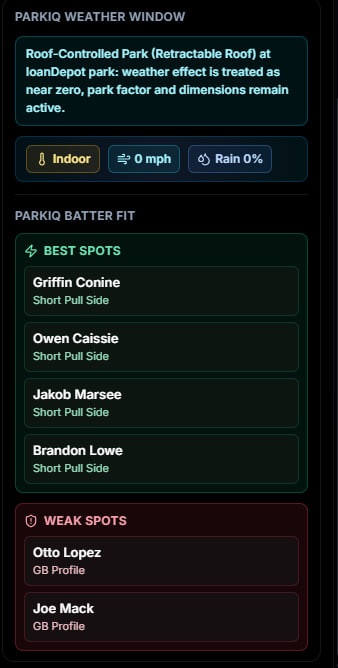
The K Projection is further refined by ParkIQ, which feeds in park factor and weather context for the specific start. Ballpark dimensions affect how pitchers approach hitters, which affects pitch selection, which affects whiff and chase rates in ways that raw metrics don't capture. Wind and temperature influence pitch movement and velocity, particularly for pitchers who rely on breaking balls.
ParkIQ doesn't override the core projection. It refines it. A pitcher who profiles as a strong strikeout candidate at a neutral park may look meaningfully different pitching in a hitter-friendly environment with wind blowing out, and the K Engine accounts for that.
Putting It Together
Whiff rate is a useful signal. It's just not a complete one. A pitcher who misses bats but can't throw early strikes, can't generate chases, and can't close out two-strike counts will underperform his whiff rate on the K line, consistently.
The K Engine Pitcher Board at Statyx reads the full picture: CSW%, Zone%, chase rate, swing strike percentage, PutAway%, and velocity, combined into a K Projection and measured against the sportsbook line to surface a real Diff% edge. ParkIQ adds the environmental context that flat metrics miss.
No model removes all uncertainty from a strikeout prop. Pitchers get pulled early, lineups change, and baseball is unpredictable. What the K Engine does is give you a more complete basis for your decision than a single number ever could.
Try Statyx free for 3 days!
Frequently Asked Questions
What is whiff rate in baseball, and why does it matter for strikeout props? Whiff rate measures the percentage of swings that produce no contact. It indicates how often a pitcher misses bats, which is relevant to strikeout production. However, it only captures one component of strikeouts and needs to be read alongside other metrics like CSW%, chase rate, and PutAway% to be useful for prop betting.
What is CSW% and why is it more predictive than whiff rate alone? CSW% (called strike plus whiff rate) counts both called strikes and swings and misses as a share of total pitches. Because strikeouts require three strikes, not just swings and misses, CSW% captures a fuller picture of how often a pitcher is advancing counts toward a strikeout.
What is PutAway% and how does it affect strikeout prop outcomes? PutAway% measures how often a pitcher converts a two-strike count into a strikeout. It's the closing metric in strikeout analysis. A pitcher with strong whiff and chase rates but a weak PutAway% will consistently underperform his strikeout line because he can't finish hitters when he has them in a two-strike count.
How does the K Engine Pitcher Board on Statyx generate a K Projection? The K Engine combines CSW%, Zone%, chase rate (Chs%), swing strike percentage (SwS%), PutAway%, and velocity into a probability-weighted K Projection. It adjusts for the opposing lineup's tendencies and applies ParkIQ context for park factors and weather conditions to produce a projected strikeout total for a given start.
What does Diff% mean on the Statyx K Engine board? Diff% is the gap between the K Engine's K Projection and the sportsbook's strikeout line. A positive Diff% indicates the model projects more strikeouts than the market is pricing, which may represent a betting edge. A negative Diff% indicates the market is pricing in more strikeouts than the model projects.
Does park factor actually affect strikeout props? Yes. Ballpark dimensions influence how pitchers approach hitters and what pitches they rely on, which affects whiff and chase rates. Weather conditions, particularly wind and temperature, affect pitch movement and velocity. Statyx's ParkIQ layer feeds these factors into the K Projection to refine the estimate beyond what raw metrics capture.
Can the K Engine guarantee strikeout prop wins? No model can guarantee outcomes in sports betting. Pitchers get pulled early, lineups shift, and individual games are unpredictable. The K Engine is designed to give you a more complete, data-driven basis for your decisions, not to eliminate uncertainty.
Published for research and entertainment purposes. Not betting advice.

Discussion
Sign in to join the discussion.
Loading comments…