Where Every Week 3 Defense Can Be Tested
Every Sunday defense has a question to answer. Statyx examines two pressure points per team and whether the opponent can actually exploit them.
 Statyx io
IND has allowed 429 receiving Yds to WRs and 294 rushing Yds to RBs. MIA has yet to record a sack and has given up more EPA per dropback than any other defense playing Sunday. Those are easy openings to spot. The more interesting questions live elsewhere: can PIT use its TEs against a CIN defense that has been excellent overall? What does SEA's pass coverage look like without both starting safeties? Can ARI take advantage of SF's missing edge rushers?
This is a defense-first matchup file, not a ranking of 28 teams from best to worst. Each team has two pressure points and an assessment of whether Sunday's opponent has the personnel and game plan to use them. A strong defense's relative opening can still be a difficult matchup. All Statyx numbers are from 2026 Weeks 1 and 2, before Sunday's games. The only Week 3 result already played, ATL at GB, is excluded.
The four reads worth carrying into kickoff
- IND offers the broadest two-way opening. Its defense has allowed +0.343 EPA per opponent dropback and +0.221 per rush. HOU's missing Nico Collins reduces the clean WR path, but the ground game remains available.
- MIA has to disrupt KC somehow. Opponents have produced +0.476 EPA per dropback against MIA, and the Dolphins have recorded no sacks. KC's missing OT Josh Simmons is the reason not to call it automatic.
- DAL's run defense gives BAL a direct plan. Opponents have succeeded on 52.3% of rushes and DAL has stuffed just 6.2%. That matters more than a generic “weak defense” label when the opponent can threaten designed QB runs and RB carries.
- SEA is the injury exception. Its first two games show strong pass results, but both starting safeties are out. WAS has an opening that the existing defensive stats cannot measure, although Marcus Mariota starting for Jayden Daniels limits confidence in the offensive response.
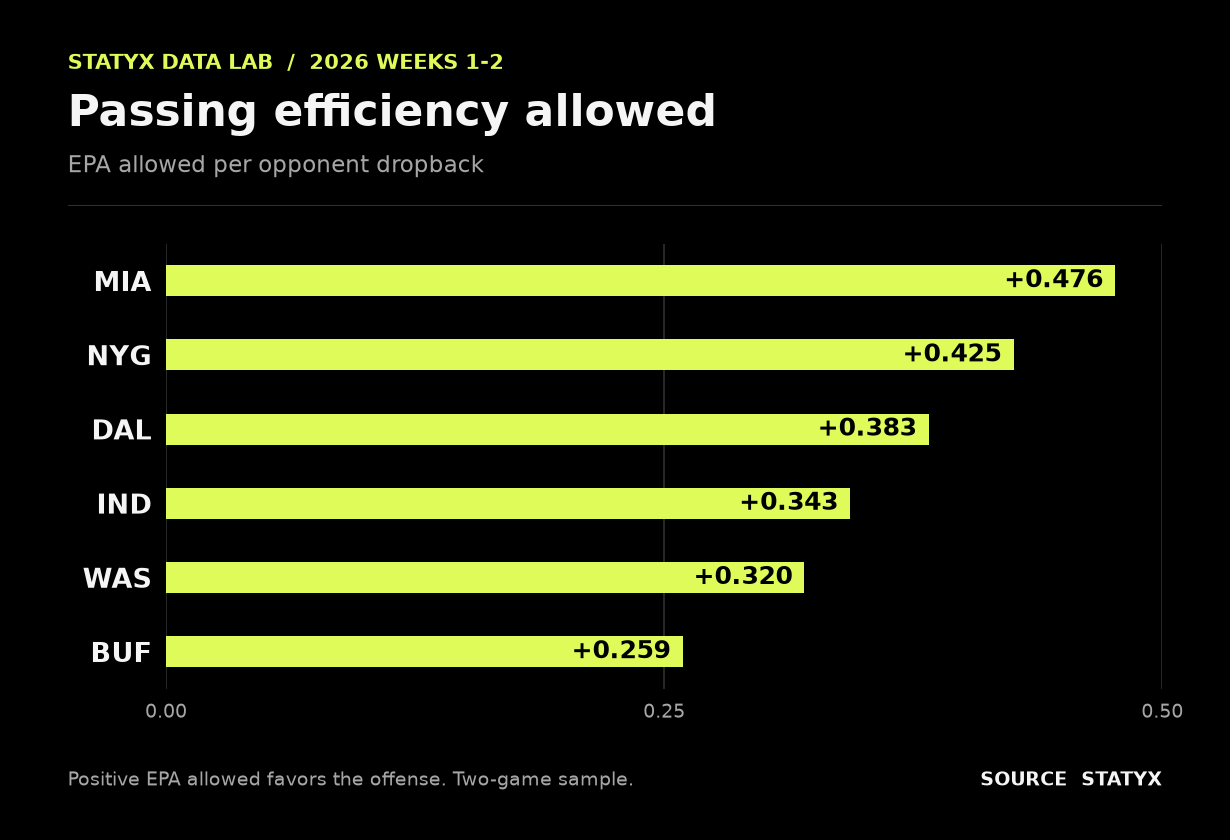
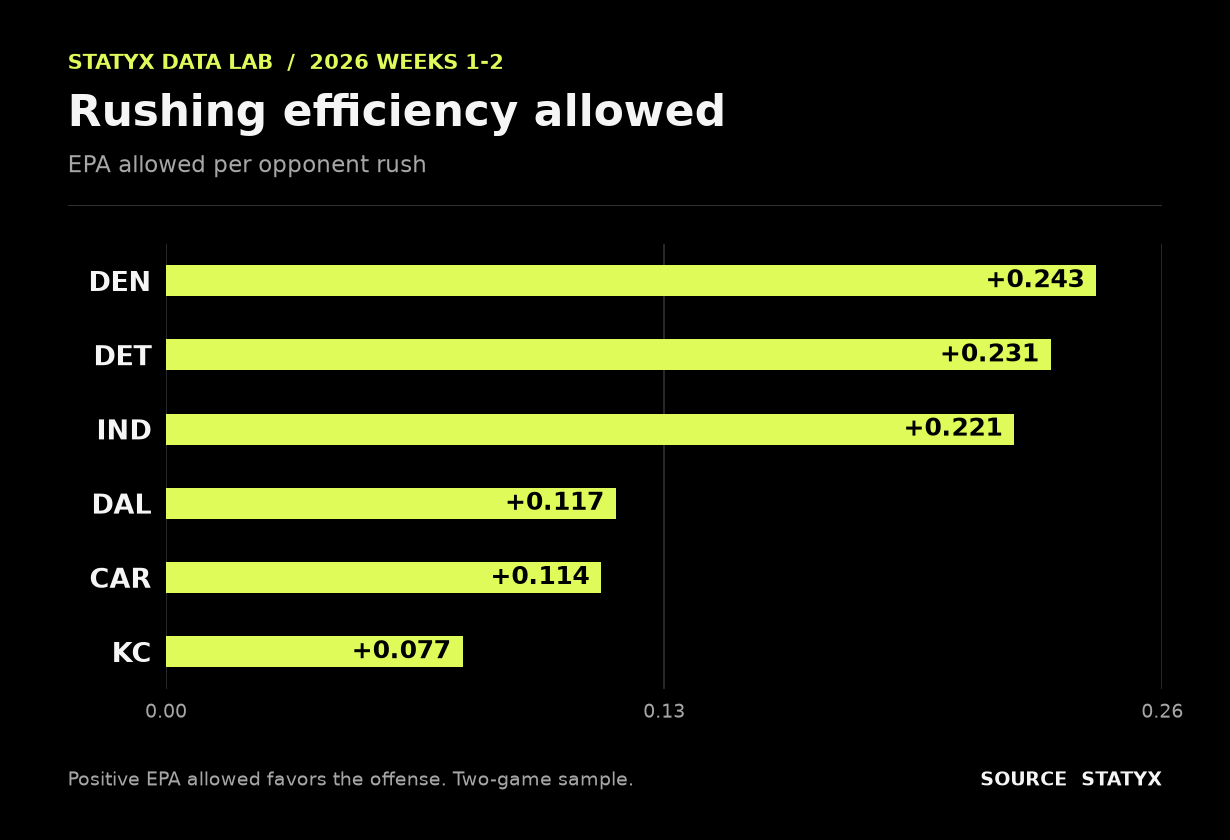
Positive EPA allowed favors the offense. Statyx Data Lab, 2026 Weeks 1 and 2.
CAR at CLE
When CLE has the ball: CAR's run fits and third downs
Opponent RBs have rushed for 347 Yds and 4 TD on 55 carries against CAR. The underlying +0.114 EPA per rush says this is more than one long run distorting the yardage. CLE can keep its offense on schedule by returning to the ground game. CAR will also be without LB Devin Lloyd and S Nick Scott, which puts more pressure on the replacement tackling structure. Opponents have converted 51.9% of third downs, the second pressure point: CLE does not need to live on low-probability shots to extend possessions. CAR's final availability update.
When CAR has the ball: CLE's explosive runs and WR scoring
CLE has allowed an explosive gain on 16.7% of rushes and a 50.0% rushing success rate. That is an inviting combination for a CAR offense that can keep working the run even without a perfect opening script. The passing route is different: WRs have gained 321 Yds and scored 4 TD on 32 targets, 10.0 Yds per target. CAR's receivers can test CLE downfield, but Jalen Coker and Xavier Legette were questionable on the final report. Confirm the active route group before treating the WR total as a player-specific matchup. CAR game center.
NYJ at DET
When DET has the ball: NYJ's occasional run break and red-zone finish
NYJ has been one of the better early defenses. Its relative pressure point is the 12.5% explosive-rush rate it has allowed, not routine down-to-down failure. DET's multiple-back approach can exploit one poor fit without needing NYJ to be soft all afternoon. Opponents have also finished 75% of red-zone drives with TDs, though that rests on very few trips. DET can vary RB and TE scoring looks there. Do not translate either number into a blanket pass-defense downgrade: NYJ has allowed just 4.25 QB passing Yds per attempt.
When NYJ has the ball: DET's TE coverage and run efficiency
TEs have produced 16 catches, 187 Yds and 4 TD against DET in two games. NYJ has a middle-of-field route if it can protect and sustain possessions. The sturdier finding is on the ground: DET has allowed +0.231 EPA per rush, a 50.9% rushing success rate and a 17.5% explosive-rush rate. NYJ does not have to win a pure dropback contest to keep pace.
KC at MIA
When MIA has the ball: KC's ground-game efficiency and TE scoring
KC has allowed +0.077 EPA per rush and an 11.1% explosive-rush rate. That makes the ground game a more plausible starting point for MIA than a pure passing duel against a defense allowing only 5.41 QB passing Yds per attempt. TEs have managed just 74 receiving Yds against KC but have scored twice on 16 targets. This is a possible short-field scoring route, not evidence that KC is giving up easy TE yardage.
When KC has the ball: MIA's lack of sacks and RB receiving leak
MIA has no sacks through two games and has allowed +0.476 EPA per dropback. That is the weakest passing efficiency figure among Sunday's defenses. If Mahomes is comfortable, KC can build the drive without needing one miraculous throw. The important counter is that OT Josh Simmons is out, so the protection matchup cannot be waved away. Opposing RBs have also caught all 12 targets for 115 Yds and 3 TD, giving KC an underneath answer if MIA backs off to protect the deep field. KC's Week 3 preview and injury notes.
TEN at NYG
When NYG has the ball: TEN's WR efficiency and limited pressure
Opposing WRs have caught 29 of 36 targets for 407 Yds, an 80.6% catch rate and 11.31 Yds per target. TEN has also finished only 4.4% of opponent dropbacks with a sack, with a 10.3% QB-hit rate. That combination offers NYG a real passing opportunity. It is not a straight carryover from the first two weeks: Jameis Winston starts for the injured Jaxson Dart, so the QB-to-WR distribution changes. TEN CB Cor'Dale Flott is questionable, another reason to check the final coverage rotation. NYG QB update · TEN injury report.
When TEN has the ball: NYG's pass defense and drive extension
NYG has allowed +0.425 EPA per dropback, 502 QB passing Yds and 6 passing TD. Cam Ward should find a more forgiving environment than TEN's record suggests. NYG has also allowed an explosive run on 16.3% of carries and a 65.0% opponent third-down conversion rate. That gives TEN more than one way to stay balanced, provided the backfield is healthy enough to use it. Tyjae Spears is questionable and Tony Pollard was limited with an ankle issue. TEN injury report.
CIN at PIT
When PIT has the ball: CIN's TE volume and RB checkdowns
CIN ranks first in defensive EPA per play through two weeks, so this is not a broad attack recommendation. The notable exception is positional: TEs have 17 catches for 200 Yds on 21 targets. Pat Freiermuth has a clearer path to targets than PIT's receivers have to an easy downfield game. RBs have also caught 15 of 16 targets for 92 Yds, while CIN has allowed only 78 RB rushing Yds. The checkdown route may beat forcing carries, but Rico Dowdle is out and Jaylen Warren is questionable. The recipient matters. PIT injury report.
When CIN has the ball: PIT's YAC and RB receiving
PIT has allowed just one QB passing TD and a strong overall pass EPA, yet opponents are gaining 7.19 YAC per completion. CIN's short passing game can make defenders tackle after the catch if the ball comes out before PIT's 13.2% sack rate takes over. RBs have added 10 catches for 97 Yds on 14 targets. Andrei Iosivas is out, which could shift some shorter opportunities, but a positional leak is not a promise of one player's target count. CIN and PIT injury report.
NE at JAX
When JAX has the ball: NE's light stuff rate and RB outlets
NE is fifth in defensive EPA per play. The better route around that defense is on the ground: it has stuffed only 9.1% of carries, allowing JAX to avoid some long-yardage downs. RBs have also caught 8 passes for 82 Yds on 11 targets, and 11.4% of rushes against NE have been explosive. These are relative attack points, not evidence that the entire defense is weak. The pass defense has held QBs to 5.53 Yds per attempt.
When NE has the ball: JAX's chunk passes and RB receiving
JAX has yielded an explosive pass on 13.1% of dropbacks, 8.50 QB Yds per attempt and 10.26 Yds per WR target. NE can test the defense vertically instead of assuming it must win through a slow drive. If JAX adjusts by protecting deep space, RBs have already caught 11 passes for 91 Yds against it. That gives NE a second way to stretch the defense horizontally.
LAC at BUF
When BUF has the ball: LAC's WR and TE concessions
WRs have caught 25 passes for 368 Yds and 3 TD on 34 targets against LAC, 10.82 Yds per target. BUF can test intermediate and outside space, although DJ Moore and Keon Coleman were game-time questions on Friday. If receiver availability is thin, the TE route is real: TEs have 13 catches for 129 Yds on 18 targets against LAC, and Dalton Kincaid gives BUF a way to stress the middle. LAC has allowed +0.243 EPA per dropback overall. BUF injury report.
When LAC has the ball: BUF's WR volume and RB receiving
BUF has allowed 27 WR catches for 394 Yds and 3 TD on 43 targets. Ladd McConkey's slot and wide usage gives LAC more than one entry point; Statyx Route IQ projects Dee Alford as his primary field-area CB, with Christian Benford a possible rotation, rather than a guaranteed shadow matchup. BUF DB Jordan Hancock is out. RBs have also caught 11 passes for 91 Yds and 2 TD, and BUF has allowed TDs on 87.5% of red-zone drives. Those scoring rates will move with more games, but they give LAC's short game a reason to stay involved. BUF injury report · LAC injury report.
HOU at IND
When IND has the ball: HOU's explosive passes and TE efficiency
HOU has allowed an explosive pass on 13.0% of dropbacks and +0.237 EPA per dropback. IND's usual vertical route is narrower with Alec Pierce and Ashton Dulin out, so the 2026 defensive number needs an availability adjustment. TEs have also caught 8 passes for 142 Yds on 10 targets against HOU. Tyler Warren offers a credible way to test the space behind the linebackers, though 14.2 Yds per TE target is unlikely to remain that high. HOU and IND injury report.
When HOU has the ball: IND's two-way defensive leak
WRs have gained 429 Yds and 3 TD on 33 targets against IND, a startling 13.0 Yds per target, and the defense has allowed 7.94 YAC per completion. Nico Collins is out, so HOU cannot simply assign his normal role to another receiver. IND CB Charvarius Ward is questionable, while Sauce Gardner practiced fully. The second pressure point may be more dependable: RBs have rushed for 294 Yds and 3 TD on 56 carries, with IND allowing +0.221 EPA per rush and a 15.9% explosive-rush rate. HOU has a way to avoid a replacement-WR-only game. HOU and IND injury report.
SEA at WAS
When WAS has the ball: SEA's new safety pairing and short-field scoring
The first two weeks say SEA's pass defense is strong: only 126 WR Yds and no WR TD allowed. Sunday's secondary is different. Starting safeties Julian Love and Ty Okada are out, so WAS can test the replacement pairing with crossers and routes behind it. That is an injury-created question, not a weakness proven by the existing stats. WAS also changes QB, with Marcus Mariota starting for Jayden Daniels. Opponents have scored on two-thirds of red-zone drives against SEA and TEs have 2 TD, but WAS TE Chig Okonkwo is out, limiting the obvious positional route. SEA and WAS injury report · WAS QB update.
When SEA has the ball: WAS's middle and WR coverage
TEs have caught 8 of 9 targets for 120 Yds and 4 TD against WAS. Four TD on nine targets cannot be treated as a stable rate, but the middle and short-field coverage need a response. WRs have added 27 catches for 337 Yds and 3 TD on 37 targets, while WAS has allowed +0.320 EPA per dropback. Sam Darnold is confirmed back for SEA, and WAS is missing LB Frankie Luvu and S Nick Cross. This is a materially different offensive and defensive personnel picture from Week 2. SEA and WAS injury report.
ARI at SF
When SF has the ball: ARI's outside depth and underneath completions
Opposing WRs have 329 Yds and 4 TD against ARI. CB Will Johnson is out for the season, and Max Melton's toe injury has affected preparation. That makes the outside rotation a live issue, although SF may be limited in exploiting it: Mike Evans is questionable and Demarcus Robinson is out. TEs have caught all 10 targets for 105 Yds against ARI, an alternative chain-moving route that does not require a full-strength WR room. Ten targets are too few to declare a settled TE matchup. ARI injury context · SF final report.
When ARI has the ball: SF's missing edge rushers and early-down efficiency
Nick Bosa and Romello Height are out, along with DL James Thompson Jr. SF's first two weeks of pressure data cannot fully predict how the replacement front will play. ARI can find out whether it has more time to reach its receivers. SF has also allowed a 48.2% rushing success rate and 6.23 YAC per completion. Neither makes an otherwise top-10 EPA defense easy, but both give ARI a practical early-down plan. SF final report.
MIN at TB
When TB has the ball: MIN's WR yardage and selective run breaks
WRs have 27 catches for 387 Yds on 45 targets against MIN, and opponents have gained 7.07 YAC per completion. TB can test space after the catch rather than ask for contested shots on every series. The ground numbers need more care: MIN has allowed -0.297 EPA per rush, yet 13.7% of carries have gone for explosive gains. TB can hunt a chunk run, but the evidence does not support assuming steady rushing success.
When MIN has the ball: TB's TE production and third downs
TEs have 15 catches for 172 Yds and 2 TD on 19 targets against TB, an attractive short-to-intermediate channel for MIN. Opponents have also converted 48.2% of third downs. TB has allowed only 104 RB rushing Yds, so MIN's more credible route to long drives is through timely completions rather than a simple run-volume bet. MIN injury report.
BAL at DAL
When DAL has the ball: BAL's rushing efficiency and drive finish
BAL has allowed +0.059 EPA per rush and an explosive gain on 13.0% of rushes. DAL can keep its ground game involved instead of treating this as a pass-only matchup. Opponents have converted 44.0% of third downs and scored TDs on two-thirds of red-zone drives. Those situational rates come from few possessions, but they show how DAL could turn sustained drives into points.
When BAL has the ball: DAL's run control and third-down defense
DAL has allowed a 52.3% rushing success rate, +0.117 EPA per rush and a 6.2% stuff rate. BAL's combination of RB carries and designed QB movement attacks precisely that problem. DAL has also allowed opponents to convert 68.0% of third downs, with +0.383 EPA per dropback and sacks on only 2.7% of dropbacks. Its secondary has dealt with injuries, so the final active DB group matters, but the early-down run leak is already clear. DAL injury context.
LV at NO
When NO has the ball: LV's YAC and red-zone finish
LV is second in overall defensive EPA. The opening is specific: opponents have gained 6.67 YAC per completion. NO can make LV tackle after short throws if it avoids the Raiders' 11.8% sack rate. Opponents have also turned 75% of red-zone trips into TDs. That is a handful of drives, not a settled defensive defect, but finishing matters when a defense makes long drives difficult elsewhere.
When LV has the ball: NO's routine and explosive rushing leaks
NO has allowed successful gains on 61.1% of rushes. RBs have produced 237 rushing Yds and 3 TD in two games. On top of that, 16.7% of rushes against NO have been explosive. These are related but different problems: LV can stay ahead of the chains with ordinary carries and still have a path to a chunk play. It need not rely on low-percentage downfield throws to create offense.
LA at DEN
When DEN has the ball: LA's run-game consistency and low sack rate
Opponents have a 43.1% rushing success rate against LA, which has stuffed only 9.8% of carries. RJ Harvey returns for DEN and J.K. Dobbins has no game designation, so the home team has options to test that. LA has also finished only 2.9% of opponent dropbacks with a sack. DEN can extend plays if protection holds. S Kam Kinchens is doubtful, which may alter LA's coverage, though the first two games show strong overall pass results. DEN injury report · LA injury report.
When LA has the ball: DEN's rushing yards and TE space
DEN has allowed +0.243 EPA per rush and 286 RB rushing Yds on 53 carries. That is a better statistical route for LA than forcing contested throws against DEN's stronger pass defense. TEs have caught 8 of 10 targets for 109 Yds, 10.9 Yds per target. It is a small sample, but the middle field could matter more if Puka Nacua, listed doubtful, cannot play. LA injury report.
What the numbers can and cannot tell us
Every Sunday defense has only two completed 2026 games in this sample. Rates built from a few third downs or red-zone trips will move sharply. Positional totals describe what opponents have done collectively; they do not predict that one RB, WR or TE will inherit the whole opportunity. Personnel can also break a trend: SEA's safety absences create a new question, while HOU's missing Nico Collins makes IND's WR concession harder to exploit in the usual way.
Statyx Data Lab supplies the defense EPA, success, explosive-play and position-allowed figures. Route IQ adds receiver alignment and potential CB field-area context where relevant. For a player-first Week 3 perspective, read Statyx's WR man vs zone study and start/sit guide. The numbers here were checked September 27, before the Sunday games. Final inactives can change the player-level interpretation 90 minutes before kickoff.
Week 3 defensive matchup questions
Which Week 3 defense has the broadest statistical opening? IND has allowed +0.343 EPA per dropback and +0.221 EPA per rush, with 429 WR receiving Yds and 294 RB rushing Yds conceded through two games. HOU's missing Nico Collins changes the WR side of that matchup.
Does a strong defense still have a usable pressure point? Yes. CIN has led in overall EPA allowed while conceding 17 TE catches for 200 Yds. That is a specific PIT route, not a reason to call the entire CIN defense weak.
Which matchup changed most because of injuries? SEA's pass defense has been strong, but both starting safeties are out. WAS will test a new secondary pairing with Marcus Mariota starting in place of Jayden Daniels.
See the matchup behind the number.
Statyx brings player usage, opponent tendencies, Route IQ and advanced stats for major sports into one research workspace. Start a 7-day free trial and build your own read before kickoff.
Published for research and entertainment purposes. Not betting advice.

Discussion
Sign in to join the discussion.
Loading comments…