NFL Week 4 Defensive Matchups: Where Every Remaining Defense Can Be Tested
All 15 remaining Week 4 games, with two defensive openings for every team. Explore coverage, explosive plays, run fits and updated injury context through Statyx data.
Get the tools behind this post. Free Statyx account, no card needed.
Sign up free Statyx io
Miami has not recorded a sack. Dallas has allowed successful plays on 60.8% of opponent dropbacks. Washington has conceded 11 passing touchdowns while remaining considerably harder to run against. Those are three different defensive problems, and they call for three different offensive responses.
The most useful Week 4 question is where an offense can create an advantage, and whether its available players can reach it. That means separating a tight end scoring opening from a tight end yardage opening, a high rushing success rate from explosive runs, and a season pressure number from the personnel taking the field this week.
This guide covers all 15 remaining games on October 4 and 5, 2026, including Indianapolis versus Washington in London. Thursday’s Pittsburgh versus Cleveland game is excluded. Statyx defensive efficiency is restricted to Weeks 1 to 3. Position tables contain three games for each of the 30 featured defenses.
Four matchups that set the shape of the slate
- Washington’s passing weakness is distinct from its run defense. The Commanders have conceded 11 passing touchdowns while stuffing 25.8% of opposing runs. Indianapolis has a clearer reason to pass than a generic favorable matchup suggests.
- Denver gives San Francisco a ground game opening. Opposing backs have averaged 5.26 yards per carry. Rush IQ also identifies a perimeter leak at the left end.
- Detroit’s tight end results remain a problem. Opposing tight ends have 351 yards and six touchdowns on 39 targets. Carolina’s actual receiving personnel determine who can use that opening.
- Seattle and Minnesota require narrower plans. Both have held opposing backs below three and a quarter yards per carry. Their relative openings must be weighed against strong overall results.
Explore the matchups
Passing weakness and rushing weakness are different reads
Every remaining defense, sorted by EPA allowed per dropback. Both bar panels share the same scale. Positive values favor the offense.
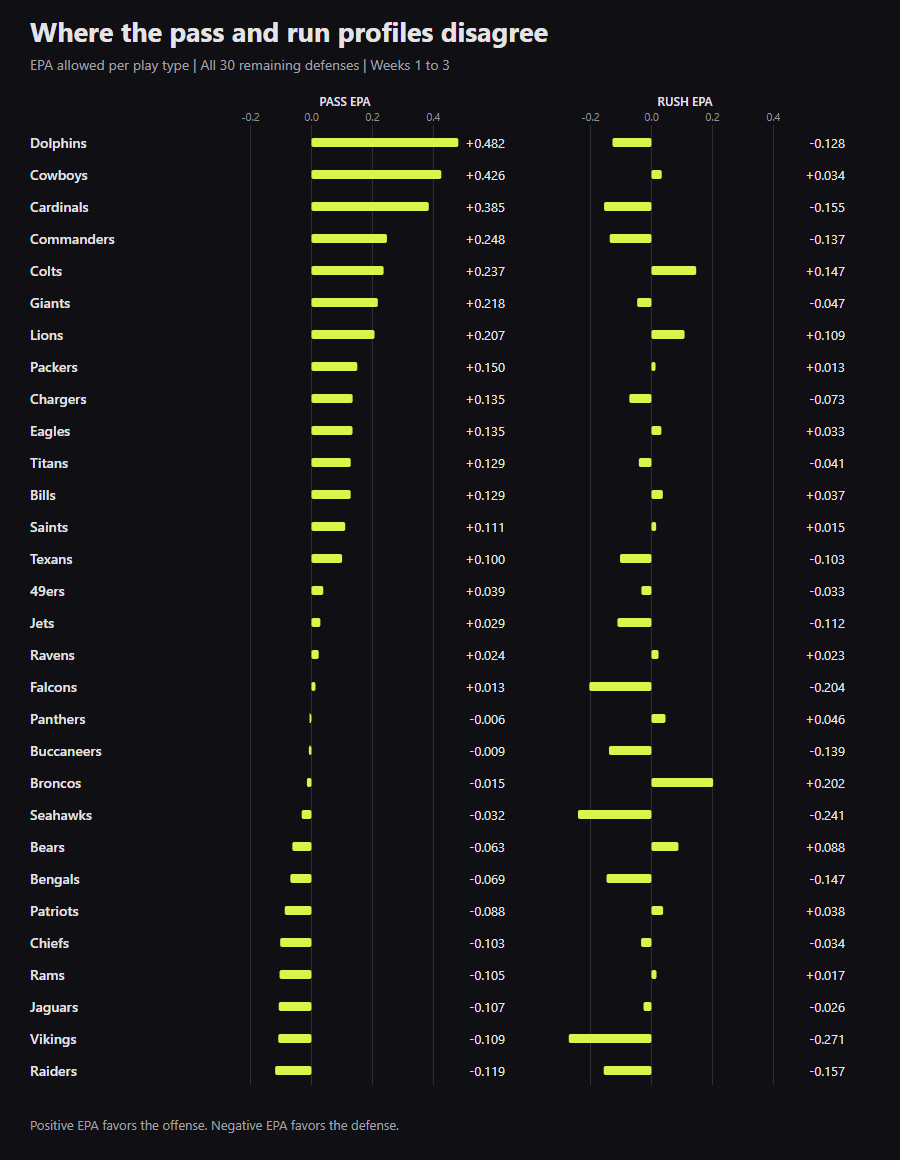
Source: Statyx Data Lab and Defense vs Position. 2026 Weeks 1 to 3.
Colts at Commanders
Sunday · 9:30 AM ETCommanders: Passing efficiency and tight end scoring
| WR CATCH ALLOWED | TE TD ALLOWED | RUN STUFF RATE | RED ZONE TD ALLOWED |
| 74.2% | 5 | 25.8% | 75.0% |
Washington has allowed receivers to catch 74.2% of targets at 9.24 yards per target. Josh Downs’ 24 targets make him a credible route into that coverage. The second opening is tight end scoring: five touchdowns on 20 targets. Nick Cross is ruled out. Indianapolis should distinguish those receiving chances from a front stuffing 25.8% of runs, rather than treating every offensive role as equally attractive.
Colts: Receiver gains and run consistency
| WR YARDS / TARGET | RUSH SUCCESS ALLOWED | RUN STUFF RATE | RB YARDS / CARRY |
| 11.21 | 48.8% | 10.7% | 4.75 |
Receivers have generated 11.21 yards per target against Indianapolis, putting Terry McLaurin’s route efficiency in focus. The ground defense has also allowed success on 48.8% of rushes while stuffing only 10.7%. That gives Washington’s available backs a way to stay ahead of the chains. Jacory Croskey Merritt’s opportunity depends on his workload; the defensive opening is broader than one deep completion.
Personnel check. Washington has ruled out Nick Cross and Sam Cosmi. Jayden Daniels remained limited in the latest posted Washington report. Indianapolis lists Keenan Allen questionable. Grover Stewart returned to full practice Friday without a game designation, so his Thursday rest absence should not be treated as an interior defensive downgrade.
Sources: Statyx Data Lab · Official availability 1 · Official availability 2 · Latest official injury report
Jaguars at Bengals
Sunday · 1:00 PM ETBengals: Tight ends and receiving backs
| TE YARDS / TARGET | TE CATCH ALLOWED | RB YARDS / TARGET | RUN STUFF RATE |
| 9.97 | 76.7% | 7.05 | 22.4% |
Tight ends have caught 23 of 30 targets against Cincinnati for 299 yards. Brenton Strange has only ten targets himself, so the matchup supports efficiency more clearly than guaranteed volume. Receiving backs have caught 90% of targets at 7.05 yards each, giving Bhayshul Tuten another path. Cincinnati’s 22.4% run stuff rate makes those receiving alternatives particularly relevant.
Jaguars: Explosive passes and backfield outlets
| EXPLOSIVE PASS ALLOWED | WR YARDS / TARGET | RB CATCH ALLOWED | RB YARDS / CARRY |
| 13.3% | 9.76 | 94.1% | 3.15 |
Jacksonville has allowed explosive passes on 13.3% of dropbacks and 9.76 yards per receiver target. Ja’Marr Chase can challenge that weakness. Backfield passing is the second route: opposing backs have caught 16 of 17 targets for 122 yards. Jacksonville holds backs to 3.15 yards per carry, making touches in space more attractive than assuming its rushing front will break.
Personnel check. Cincinnati has ruled out Kyle Dugger. Bryan Cook and B.J. Hill are questionable, while Jordan Battle returned to full practice Friday. Jacksonville lists corners Christian Braswell and Montaric Brown questionable. Those are specific secondary and interior questions rather than a blanket downgrade of either defense.
Sources: Statyx Data Lab · Official availability · Latest official injury report
Packers at Buccaneers
Sunday · 1:00 PM ETBuccaneers: Tight ends and backfield receiving
| TE YARDS / TARGET | RB CATCH ALLOWED | RB CATCHES ALLOWED | RB YARDS / CARRY |
| 7.96 | 86.4% | 19 | 2.89 |
Tampa Bay holds backs to 2.89 yards per carry and a 32.9% rushing success rate. Green Bay’s receiving alternatives are more inviting: tight ends have 17 catches on 23 targets for 183 yards and two scores; backs have 19 catches on 22 targets. Tucker Kraft and Jonnu Smith can probe the first channel, while Jordan Love can use backfield releases to avoid predictable runs.
Packers: Drive extension and receiving efficiency
| THIRD DOWN ALLOWED | RED ZONE TD ALLOWED | WR YARDS / TARGET | RB YARDS / TARGET |
| 54.5% | 76.9% | 8.34 | 9.10 |
Green Bay permits third down conversions on 54.5% of attempts and touchdowns on 76.9% of red zone possessions. Those are meaningful possession and finishing tests for first time starter Jalon Daniels. Emeka Egbuka has 20 targets against coverage allowing receivers 8.34 yards per target. Bucky Irving’s receiving opportunity also matters after his full Friday practice: backs have caught nine of ten targets for 91 yards.
Personnel check. Baker Mayfield is ruled out, with Jalon Daniels preparing for his first NFL start. Jalen McMillan remains on injured reserve. Bucky Irving practiced fully Friday without a game designation. Green Bay has ruled out Aaron Banks and Jacob Monk, keeping offensive protection in the receiving discussion. Tampa Bay is also without Rueben Bain Jr. and Benjamin Morrison.
Sources: Statyx Data Lab · Official availability 1 · Official availability 2 · Latest official injury report
Cardinals at Giants
Sunday · 1:00 PM ETGiants: Pocket disruption and run resistance
| SACK RATE | QB HIT RATE | RB YARDS / CARRY | RUN STUFF RATE |
| 0.9% | 6.7% | 5.05 | 9.4% |
The Giants have produced sacks on 1.0% of dropbacks and quarterback hits on 6.7%. Brian Burns’ ACL injury removes another important rusher. Marvin Harrison Jr. and Trey McBride can benefit from time to complete routes, although New York limits tight ends to 6.00 yards per target. The rushing weakness is clearer: 5.05 yards per backfield carry and just a 9.4% stuff rate.
Cardinals: Passing efficiency and tight end access
| TE CATCH ALLOWED | TE YARDS / TARGET | RED ZONE TD ALLOWED | THIRD DOWN ALLOWED |
| 88.9% | 10.39 | 72.7% | 48.3% |
Arizona has conceded eight passing touchdowns and 8.82 yards per attempt. Its available outside coverage gives Malik Nabers a plausible efficiency opening. Tight ends are a separate concern, catching 16 of 18 targets for 187 yards. The Cardinals also allow touchdowns on 72.7% of red zone possessions. Jameis Winston’s protection must hold before the Giants can exploit those passing and finishing weaknesses.
Personnel check. Jameis Winston is the Giants quarterback in the current matchup research. Andrew Thomas missed both reported practices. Arizona safety Rabbit Taylor Demerson also remained absent, while Budda Baker returned to full participation after rest.
Sources: Statyx Data Lab · Official availability 1 · Official availability 2
Rams at Eagles
Sunday · 1:00 PM ETEagles: Receiver efficiency and rushing success
| QB HIT RATE | WR YARDS / TARGET | RUSH SUCCESS ALLOWED | SACK RATE |
| 8.2% | 8.45 | 47.9% | 3.1% |
Philadelphia generates quarterback hits on only 8.2% of dropbacks and sacks on 3.1%. Rams receivers have a chance to complete routes against coverage allowing 8.45 yards per target and four touchdowns. Kyren Williams offers a separate route through a 47.9% rushing success rate allowed. Tight ends average just 5.56 yards per target here, so their matchup deserves a lower priority.
Rams: Run disruption and red zone finishing
| RUN STUFF RATE | RED ZONE TD ALLOWED | EXPLOSIVE PASS ALLOWED | RUSH SUCCESS ALLOWED |
| 10.5% | 62.5% | 4.7% | 40.8% |
The Rams allow explosive passes on only 4.7% of dropbacks and 4.97 yards per opposing quarterback attempt. Philadelphia’s stronger test is Saquon Barkley against a front stuffing just 10.5% of runs. Finishing is the second opening: opponents have scored touchdowns on 62.5% of red zone trips. Barkley and Jalen Hurts can challenge different rushing gaps without requiring an easy passing afternoon.
Personnel check. Puka Nacua remained limited, so his return does not yet establish a full route workload. Philadelphia’s DeVonta Smith and Dallas Goedert missed both reported practices. The Rams’ Aaron Donald and Jaylen Watson also remained absent. Each status affects a different part of the matchup.
Sources: Statyx Data Lab · Official availability 1 · Official availability 2
Cowboys at Texans
Sunday · 1:00 PM ETTexans: Tight end access and explosive passes
| TE CATCH ALLOWED | TE YARDS / TARGET | EXPLOSIVE PASS ALLOWED | SACK RATE |
| 85.7% | 10.14 | 11.8% | 10.0% |
Houston’s 10.0% sack rate does not close every receiving route. Tight ends have caught 18 of 21 targets for 213 yards, giving Jake Ferguson an underneath alternative to the outside corners. Explosive passes occur on 11.8% of opposing dropbacks, creating a second test when Dallas protects well enough. Azeez Al Shaair’s practice absence adds uncertainty to middle coverage without confirming a game absence.
Cowboys: Passing success and explosive runs
| THIRD DOWN ALLOWED | RUSH SUCCESS ALLOWED | EXPLOSIVE RUSH ALLOWED | SACK RATE |
| 58.8% | 48.5% | 14.6% | 2.1% |
Dallas allows successful plays on 60.8% of dropbacks and sacks on just 2.1%. Houston can therefore test sustained passing possessions without relying on repeated deep completions. The run defense has two additional problems: 48.5% rushing success allowed and a 14.6% explosive rate. A 58.8% third down conversion rate reinforces the concern that opponents can keep drives alive.
Personnel check. Nico Collins remained limited for Houston. Dallas corners Cobie Durant and Shavon Revel remained absent, alongside linebacker DeMarvion Overshown. Houston’s Will Anderson Jr. and Calen Bullock returned to full participation, so Wednesday’s report should not be used to imply its pressure personnel are all missing.
Sources: Statyx Data Lab · Official availability
Titans at Ravens
Sunday · 1:00 PM ETRavens: Explosive runs and inside receiving
| EXPLOSIVE RUSH ALLOWED | TE YARDS / TARGET | WR CATCH ALLOWED | RB YARDS / TARGET |
| 13.2% | 7.67 | 65.7% | 2.12 |
Baltimore allows explosive runs on 13.2% of rushing plays, giving Tennessee a chance for chunk gains even if ordinary carries remain difficult. Tight ends average 7.67 yards per target with two scores, while wideouts catch 65.7% of targets. Elic Ayomanor and Wan’Dale Robinson offer receiving routes. Backfield checkdowns are less promising for yardage: 14 catches have gained only 36 yards.
Titans: Receiver efficiency and third downs
| WR CATCH ALLOWED | WR YARDS / TARGET | THIRD DOWN ALLOWED | TE YARDS / TARGET |
| 79.2% | 9.83 | 40.5% | 2.82 |
Tennessee allows receivers to catch 79.2% of targets at 9.83 yards each. Zay Flowers’ 234 yards and four explosive receptions in two appearances give Baltimore a direct way to test that weakness if he plays. Third downs offer a secondary possession test at 40.5% converted. Tight ends average only 2.82 yards per target and backs 3.76 per carry, making receiver efficiency the stronger angle.
Personnel check. Lamar Jackson and Zay Flowers improved to full participation Thursday. Tony Pollard also improved to full for Tennessee. Trey Hendrickson remained absent in practice, but Baltimore reports that he has managed the finger problem without missing a game.
Sources: Statyx Data Lab · Official availability 1 · Official availability 2
Patriots at Bills
Sunday · 1:00 PM ETBills: Explosive passes and backfield receiving
| EXPLOSIVE PASS ALLOWED | WR YARDS / TARGET | RB CATCHES ALLOWED | QB HIT RATE |
| 11.3% | 9.29 | 18 | 21.8% |
Buffalo has allowed explosive passes on 11.3% of dropbacks and 9.29 yards per receiver target. Mack Hollins’ 16 targets and four red zone targets give New England an established role to test it. Backfield receiving is another opening: 18 catches and three touchdowns allowed. A 21.8% quarterback hit rate makes protection essential for Drake Maye’s deeper routes.
Patriots: Run disruption and backfield outlets
| RUN STUFF RATE | RB YARDS / TARGET | RUSH SUCCESS ALLOWED | RED ZONE TD ALLOWED |
| 6.8% | 6.75 | 39.2% | 62.5% |
New England has stuffed only 6.8% of opposing runs, giving James Cook a useful early down test. Receiving backs have also earned 6.75 yards per target. Those are different ways to use the backfield, not an invitation to force outside throws: opposing quarterbacks average only 5.69 yards per attempt. The Patriots’ personnel absences could affect both run fits and receiver coverage.
Coverage detail. Buffalo has played 67.9% zone. Hollins has 86 yards on 38 charted zone routes, or 2.26 yards per route. His separate two high sample has 126 yards on 42 routes. These are different tracking subsets, not totals to add together.
Personnel check. New England has ruled out Christian Gonzalez and Christian Barmore. Morgan Moses is questionable after returning to limited practice Friday. Buffalo lists Christian Benford and Keon Coleman questionable, and T.J. Sanders doubtful. Drake Maye practiced fully throughout the week.
Sources: Statyx Data Lab · Official availability · Latest official injury report
Jets at Bears
Sunday · 1:00 PM ETBears: Run efficiency and receiving backs
| RB YARDS / CARRY | EXPLOSIVE RUSH ALLOWED | RB YARDS / TARGET | RED ZONE TD ALLOWED |
| 4.85 | 13.2% | 9.50 | 71.4% |
Chicago has allowed 4.85 yards per running back carry and explosive gains on 13.2% of rushes. Receiving backs have produced 9.50 yards per target, creating a second opening through screens and releases. With Breece Hall ruled out, the opportunity shifts to the available Jets backs. Garrett Wilson retains the established receiver workload, but Chicago’s 40.8% pass success allowed argues for targeting the backfield weakness first.
Jets: Run success and red zone finishing
| RUSH SUCCESS ALLOWED | RED ZONE TD ALLOWED | RB RECEIVING TD | EXPLOSIVE PASS ALLOWED |
| 48.3% | 77.8% | 2 | 3.7% |
New York allows explosive passes on just 3.7% of dropbacks, making patient backfield work more convincing than repeated deep shots. Opposing rushes have succeeded 48.3% of the time. Finishing is the second concern: opponents have scored touchdowns on 77.8% of red zone possessions, with two receiving scores by backs. Swift returned to full practice Friday without a game designation, so his established role is the starting point; Monangai remains a workload alternative.
Personnel check. Breece Hall, Adonai Mitchell, Mason Taylor and Dylan Parham are ruled out for the Jets. Kenyon Sadiq and Kingsley Enagbare are questionable. Chicago has ruled out Caleb Williams, Braxton Jones, Kyler Gordon, Noah Sewell and Shemar Turner; Cam Lewis is doubtful. Swift returned to full practice Friday without a game designation. Minkah Fitzpatrick also practiced fully without a designation.
Sources: Statyx Data Lab · Official availability · Latest official injury report
Dolphins at Vikings
Sunday · 4:05 PM ETVikings: Selective receiving gains under pressure
| TE CATCH ALLOWED | WR YARDS / TARGET | SACK RATE | QB HIT RATE |
| 43.5% | 8.16 | 10.4% | 25.4% |
Minnesota’s 10.5% sack rate and 25.4% quarterback hit rate make these selective openings. Receivers have still gained 522 yards on 64 targets; the ten completed tight end targets produced 183 yards. Greg Dulcich’s route access gives Miami an outlet candidate, but the 43.5% tight end catch rate shows completion is the obstacle. Pressure can also pull an inline tight end into protection.
Dolphins: Pocket comfort and tight end efficiency
| TE YARDS / TARGET | TE CATCH ALLOWED | RED ZONE TD ALLOWED | SACK RATE |
| 12.35 | 88.2% | 78.6% | 0.0% |
Miami has recorded no sacks, while opposing passes succeed 59.3% of the time. That creates a pocket and chain moving opening for Minnesota. Tight ends have caught 15 of 17 targets for 210 yards and two scores, making T.J. Hockenson’s role particularly relevant with Justin Jefferson ruled out. Miami stuffs 23.8% of rushes, so the passing and tight end weaknesses deserve priority.
Coverage detail. Minnesota has played 92.2% zone. Dulcich has five catches on seven targets across 53 charted zone routes, a modest 13.2% target rate per route. The coverage fit creates a possible path; it does not erase Minnesota’s 43.5% catch rate allowed to tight ends.
Personnel check. Minnesota has ruled out Justin Jefferson, making Hockenson and the other available receivers more relevant against Miami. The Dolphins have ruled out Rob Beal Jr., Storm Duck and Caleb Douglas. Miami is preparing with Malik Willis, while Minnesota returned to Kyler Murray in Week 3. Achane’s season absence continues to change Miami’s backfield distribution.
Sources: Statyx Data Lab · Official availability 1 · Official availability 2 · Latest official injury report
Where tight ends have created yards
Yards per target identifies efficiency. Target totals show the size of the sample. Touchdowns are displayed separately because scoring and yardage can point in different directions.
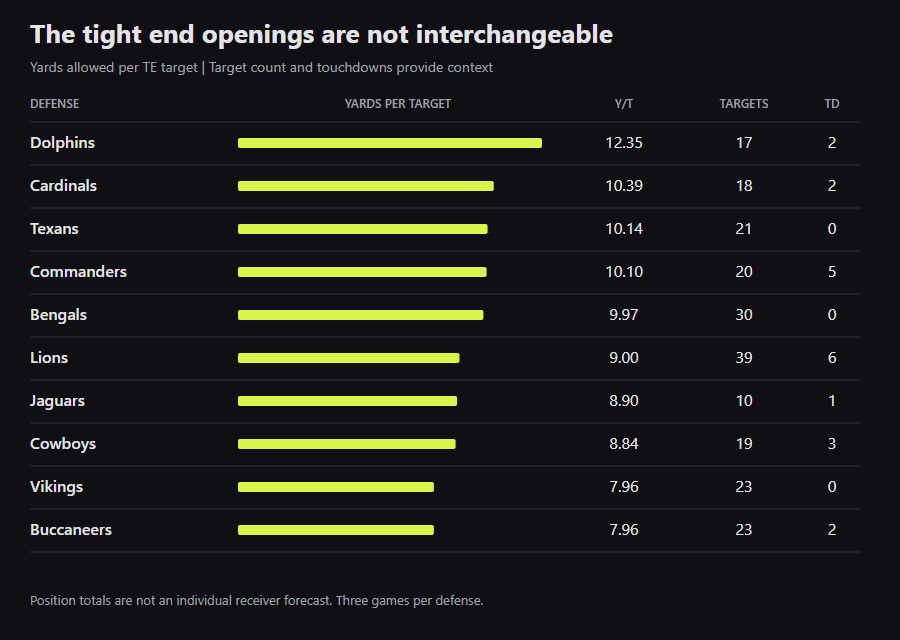
Source: Statyx Data Lab and Defense vs Position. 2026 Weeks 1 to 3.
Broncos at 49ers
Sunday · 4:25 PM ET49ers: Rushing consistency without explosives
| RUSH SUCCESS ALLOWED | THIRD DOWN ALLOWED | EXPLOSIVE RUSH ALLOWED | QB HIT RATE |
| 51.8% | 42.9% | 3.6% | 15.3% |
San Francisco allows successful rushes on 51.8% of attempts but explosives on just 3.6%. Rush IQ captures the distinction: 32nd for preventing rushing success, first for preventing explosive runs. Denver can test ordinary carries and manageable second downs. A 42.9% third down conversion rate offers a separate possession angle. This supports sustained workload more clearly than a forecast of one huge run.
Broncos: Perimeter rushes and third downs
| RB YARDS / CARRY | THIRD DOWN ALLOWED | RUN STUFF RATE | EXPLOSIVE RUSH ALLOWED |
| 5.26 | 47.8% | 12.2% | 11.0% |
Denver allows 5.26 yards per running back carry. Rush IQ locates a notable perimeter leak: eight left end attempts gained 99 yards. The lane sample is small, but it gives San Francisco a concrete test beyond its usual rushing plan. Third downs offer another opening at 47.8% converted. Extended possessions can matter as much as a single highlight run.
Coverage detail. San Francisco has played 78.3% zone. Harvey has six catches on six targets across 19 charted zone routes, a 31.6% target rate per route. That is an additional receiving route for Denver, although the small sample and partial route participation limit the ceiling.
Personnel check. San Francisco’s Bosa, Greenlaw and Keion White missed both reported practices. Denver’s Dobbins and receivers Jaylen Waddle and Marvin Mims practiced fully. These are practice observations, not final game absences.
Sources: Statyx Data Lab · Official availability
Chargers at Seahawks
Sunday · 4:25 PM ETSeahawks: Receiving backs and red zone finishing
| RB CATCH ALLOWED | RED ZONE TD ALLOWED | RB YARDS / CARRY | EXPLOSIVE PASS ALLOWED |
| 93.3% | 66.7% | 2.93 | 1.8% |
Seattle permits explosive passes on only 1.9% of dropbacks and 2.93 yards per backfield carry. The Chargers’ better outlet is receiving backs, who have caught 14 of 15 targets. The second test is finishing: touchdowns on 66.7% of opposing red zone possessions. That small sample identifies a relative weakness, not easy access to the goal line against a strong defense.
Chargers: Receiver efficiency and tight end outlets
| WR YARDS / TARGET | TE CATCH ALLOWED | TE YARDS / TARGET | QB HIT RATE |
| 9.76 | 69.6% | 7.48 | 19.6% |
Chargers coverage allows receivers 9.76 yards per target, giving Seattle a receiver efficiency test. Tight ends have also caught 16 of 23 targets for 172 yards. AJ Barner is a plausible outlet because his route access preceded the recent target spike. Los Angeles still hits quarterbacks on 19.6% of dropbacks, so those receiving opportunities depend on protection and available coverage personnel.
Coverage detail. The Chargers have played 75.3% zone, against which Barner has six catches for 73 yards on 39 charted routes. There is a counterweight in the safety split: Los Angeles has allowed only 4.08 yards per tight end target against two high looks, which it uses 61.3% of the time.
Personnel check. Ladd McConkey and Derwin James moved from limited to absent Thursday. Seattle’s Julian Love remained limited while Nick Emmanwori practiced fully. Seattle therefore cannot be described as already missing both starting safeties.
Sources: Statyx Data Lab · Official availability
Chiefs at Raiders
Sunday · 4:25 PM ETRaiders: Tight end scoring and perimeter runs
| RED ZONE TD ALLOWED | TE TD ALLOWED | TE YARDS / TARGET | SACK RATE |
| 77.8% | 5 | 6.61 | 8.8% |
Las Vegas allows touchdowns on 77.8% of red zone possessions. Tight ends have scored five times on 23 targets, giving Travis Kelce a specific finishing angle despite otherwise strong defensive results. Perimeter rushing is a smaller second test: nine left end carries gained 46 yards. Kansas City should separate those scoring and lane openings from a broad claim that every rushing matchup is favorable.
Chiefs: Occasional run breaks and tight end access
| EXPLOSIVE RUSH ALLOWED | TE CATCH ALLOWED | SACK RATE | QB HIT RATE |
| 11.8% | 73.9% | 3.7% | 9.3% |
Kansas City limits explosive passes to 4.6%, but its disruption is modest: a 3.7% sack rate and 9.3% quarterback hit rate. Kirk Cousins can test patient tight end work, with 17 catches on 23 targets and two scores allowed. The second opening is occasional ground explosiveness, allowed on 11.8% of rushes. That differs from assuming every carry will be productive.
Personnel check. Kirk Cousins is Las Vegas’ current starting quarterback. The Raiders have ruled out Jackson Powers Johnson, and Kansas City is without tackle Josh Simmons. Mahomes, Rice and Chris Jones practiced fully without game designations. Bowers was limited Friday without a game designation; that supports availability more clearly than a guaranteed full workload.
Sources: Statyx Data Lab · Official availability 1 · Official availability 2 · Latest official injury report
Lions at Panthers
Sunday · 8:20 PM ETPanthers: Interior runs and red zone finishing
| RB YARDS / CARRY | RUN STUFF RATE | RED ZONE TD ALLOWED | EXPLOSIVE RUSH ALLOWED |
| 5.86 | 9.1% | 85.7% | 13.1% |
Carolina has surrendered 434 yards on 74 backfield carries, or 5.86 per attempt, while stuffing only 9.1% of all rushes. Rush IQ places 127 yards and three touchdowns on 22 middle carries. Detroit can challenge those interior fits and an 85.7% red zone touchdown rate allowed. Rushing production supports the concern beyond the small sample of goal line possessions.
Lions: Tight ends and drive continuation
| TE YARDS / TARGET | TE TD ALLOWED | THIRD DOWN ALLOWED | SACK RATE |
| 9.00 | 6 | 57.5% | 8.1% |
Detroit allows third down conversions on 57.5% of attempts. Tight end coverage is the more striking weakness: 29 catches, 351 yards and six touchdowns on 39 targets. Carolina can test both sustained completions and scoring chances through Darren Waller. Brycen Tremayne offers a separate downfield angle if his role persists. Detroit’s 8.1% sack rate remains an obstacle to either route.
Coverage detail. Detroit has played 74.8% zone. Tremayne has 52 yards on 23 charted zone routes, while his only current usage game showed an 18 yard average target depth. Detroit’s broader downfield allowance is 16.31 yards per target on throws of at least ten air yards; that is separate from its tight end leak.
Personnel check. Carolina has ruled out Xavier Legette and guard Damien Lewis. Jalen Coker, Monroe Freeling, Lee Hunter and Cam Jackson are questionable. Darren Waller, Bryce Young and Chuba Hubbard practiced fully Friday without game designations. Detroit’s latest posted report still showed Thursday participation, including Reed limited and Wonnum full.
Sources: Statyx Data Lab · Official availability · Latest official injury report
Falcons at Saints
Monday · 8:15 PM ETSaints: Run success and wider interior lanes
| RUSH SUCCESS ALLOWED | EXPLOSIVE RUSH ALLOWED | THIRD DOWN ALLOWED | RUN STUFF RATE |
| 50.6% | 13.9% | 47.1% | 12.7% |
New Orleans allows success on 50.6% of rushes and explosive runs on 13.9%. Rush IQ adds direction: ten right guard carries gained 72 yards, compared with 69 on 22 middle attempts. Bijan Robinson can test those wider interior fits. A 47.1% third down conversion rate offers another possession opening, while the absent defenders’ final status could affect both lanes and underneath coverage.
Falcons: Receiver volume and tight end scoring
| TE TD ALLOWED | WR YARDS / TARGET | SACK RATE | QB HIT RATE |
| 3 | 8.05 | 3.7% | 17.6% |
Atlanta limits backs to 3.13 yards per carry, making the receiving alternatives more interesting. Wideouts have accumulated 604 yards and tight ends three touchdowns on 24 targets. Juwan Johnson gives New Orleans a scoring route without forcing every throw outside. Atlanta’s 3.7% sack rate leaves another test in finishing passing downs, although a 17.6% quarterback hit rate confirms the rush still reaches passers.
Personnel check. Kaden Elliss, Pete Werner and Carl Granderson missed Thursday for New Orleans. Their eventual status matters to coverage underneath and the edges of the front. The Saints play Monday, so their final report arrives on a different timetable.
Sources: Statyx Data Lab · Official availability
Reading the numbers correctly
EPA is expected points added. Positive EPA allowed means opponents increased their expected scoring value. Success rate records the share of plays with positive EPA. An explosive rate measures chunk plays under the Statyx metric definition; it is not the same as success rate.
Position totals cover all opposing players at that position. A defense allowing 200 tight end yards does not imply one tight end will receive that workload. Coverage use describes what a defense plays, while player production against that coverage describes a separate sample. Those samples are kept separate here.
Which games does this guide cover?
Every Sunday and Monday Week 4 game in the Statyx schedule, including the London opener and Atlanta at New Orleans on Monday. The completed Thursday game is excluded.
Which defenses offer the clearest passing openings?
Miami’s lack of sacks, Jacksonville’s explosive pass allowance and Houston’s tight end coverage are different ways to test a defense. Available quarterbacks, protection and route distribution determine which opening is reachable.
How current is the injury information?
Official reports were refreshed October 2. Friday game designations are included where posted. Reports still showing Thursday participation are identified as such; practice absences are not treated as confirmed game absences. Monday’s report follows its own timetable.
Explore Data Lab, Route IQ, Coverage Engine and Rush IQ to compare the role, the defense and the underlying numbers behind each read.
Create your Statyx accountStatyx Editorial · Research checked October 2, 2026 · Efficiency data through Week 3. Read the Week 3 defensive matchup guide.Published for research and entertainment purposes. Not betting advice.


Discussion
Sign in to join the discussion.
Loading comments…