Sunday Player Outlook: Yardage Ladders and Touchdown Candidates
Six player selections, three yardage ladders and six touchdown candidates for Sunday, with Statyx coverage splits, role changes and injury context.
Get the tools behind this post. Free Statyx account, no card needed.
Sign up free Statyx io
Six player selections, three yardage ladders and six touchdown candidates. Coverage fit and role changes explain the paths to catches, yards and scoring.
Statyx pulled October 3, 2026. Performance: Weeks 1 to 3. Sunday injuries and weather checked.


Wilson has 27 targets, 21 catches and a 27.8% target share across three games. Hall, Adonai Mitchell and Mason Taylor are out; Sadiq is questionable. Those absences give the passing game fewer outlets, with Wilson already commanding 41.9% of the air yards.
Chicago uses 49% man and 51% zone. Wilson earned targets on 7 of 16 classified man routes, versus 17 of 73 zone routes. The man opportunity is attractive, but 16 routes is a small sample. Cover 3 is the more permissive shell: Chicago allows WRs 9.5 yards per target there and uses it on 25% of classified dropbacks.
His slot alignment reached 31% in Week 3. Gordon is out and Lewis doubtful, making interior access relevant without pretending Wilson avoids Jaylon Johnson outside. Dry weather supports normal passing. Chicago’s backup QB could reduce drive count, so a shootout is not required for the case.

Likely has 23 targets and 15 catches over three games. Arizona plays 83% zone; he has seven catches on 11 classified zone targets. His 73% slot alignment brings him into the short middle and left areas where Arizona grades softer.
The shell detail keeps this a reception opportunity. Arizona’s Cover 4 use is 27%, and its TE defense there ranks second toughest by yards per target. Its Cover 3 TE defense ranks softest, but Likely has not caught either of his two targets against that shell. Demerson is out; increasing afternoon rain is worth monitoring.
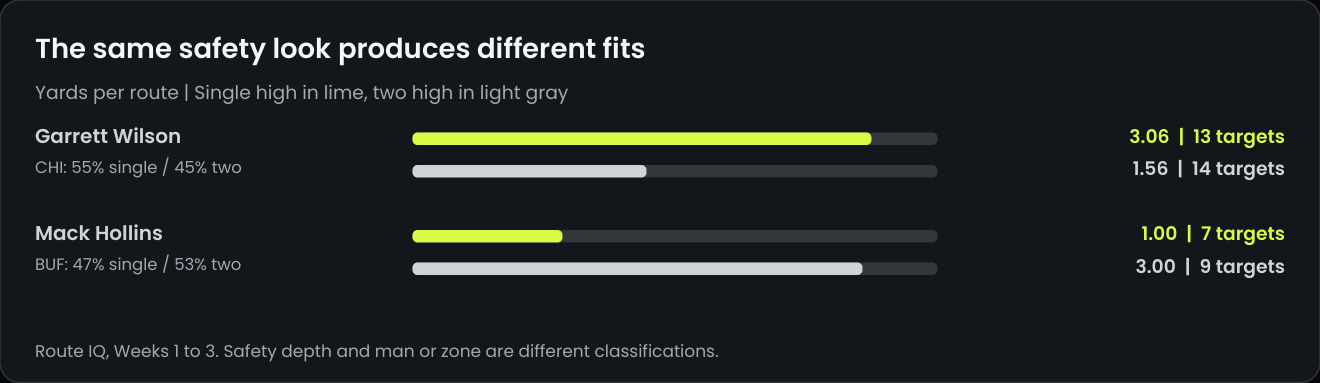


Hollins has receiving totals of 51, 18 and 87 yards. The strongest matchup evidence goes beyond the recent yardage totals: Route IQ shows 3.00 yards per route against two high looks, compared with 1.00 against single high. Buffalo uses two high on 53% of its classified dropbacks.
Against zone, he has six catches for 86 yards on eight classified targets. Buffalo’s 68% zone tendency creates a plausible fit. Cover 4 accounts for 25% of its classified dropbacks and allows WRs 6.8 yards per target, ranking 22nd. Cover 3 and Cover 2 are tougher, so the shell mix is not a free pass.
Hollins has nine catches on nine two high targets in this small sample; that is evidence of a fit, not a sustainable 100% catch forecast. Benford is questionable, not confirmed out. Hollins and Maye are clear, while Moses’ status matters for protection. Light wind and minimal rain risk support the receiving outlook.

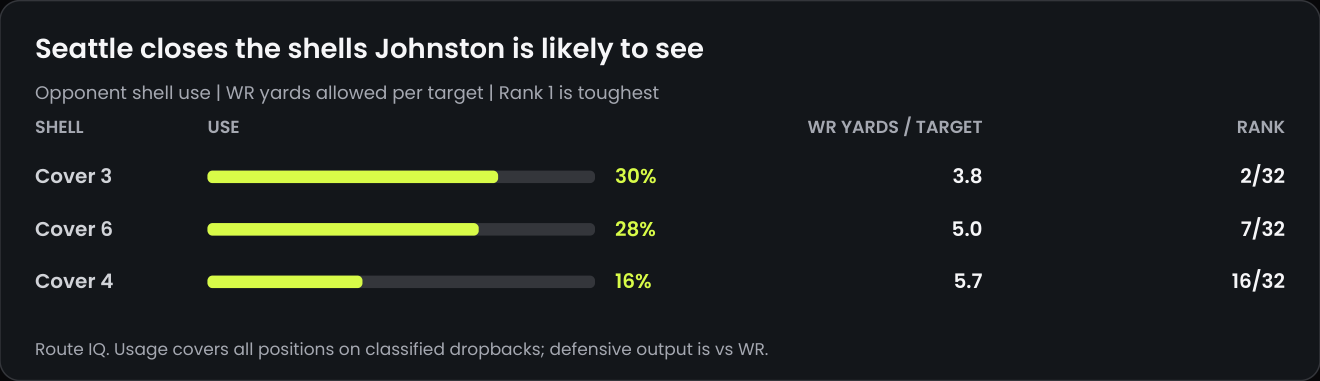
Johnston’s classified zone sample is four catches for 34 yards on 57 routes. Seattle uses 79% zone. That pairing matters more than treating a receiver with substantial routes as an automatic yardage candidate.
Seattle uses Cover 3 on 30% and Cover 6 on 28% of classified dropbacks. Its WR yards allowed per target rank second toughest in Cover 3 and seventh in Cover 6. Route IQ also grades its relevant explosive reception prevention and downfield defense strongest. Projected areas include Jobe and Witherspoon; a fixed shadow assignment is not established.
This limited yardage outlook requires McConkey active with his usual role. If he sits or is clearly limited, additional Johnston targets weaken the thesis. Seattle’s dry forecast offers little weather help to a limited yardage outlook; the coverage and limited conversion must do the work.


Hall is out and Allen took the majority of the practice repetitions. That is the clearest confirmed change in this main section. Fourteen carries can reach the target without an explosive run or efficient finishing drive, which makes attempts the cleaner expression of the opportunity.
Chicago has allowed RBs 4.8 yards per carry, but only 19.7 opposing RB attempts per game. Allen would need roughly 71% of that opponent backfield volume to reach 14. That is a useful workload test, not a projection: Isaiah Davis can still receive work, and the Jets have not confirmed exclusive ownership.
Allen’s prior 19 carries and 3.21 yards per carry do not establish a new efficiency breakout. Parham’s absence can hurt execution. Chicago’s QB and left tackle absences make a competitive, conservative game plausible, but also threaten possession count. Dry conditions are neutral. The opportunity comes from Allen’s changed allocation.

Monangai has received 10 carries in each of the first three games. He needs 4.0 yards per carry on the same allocation to reach 40 yards. New York has allowed successful runs on 48.3% of rushes and stuffed only 10.0%, creating a route to routine gains rather than requiring one long carry.
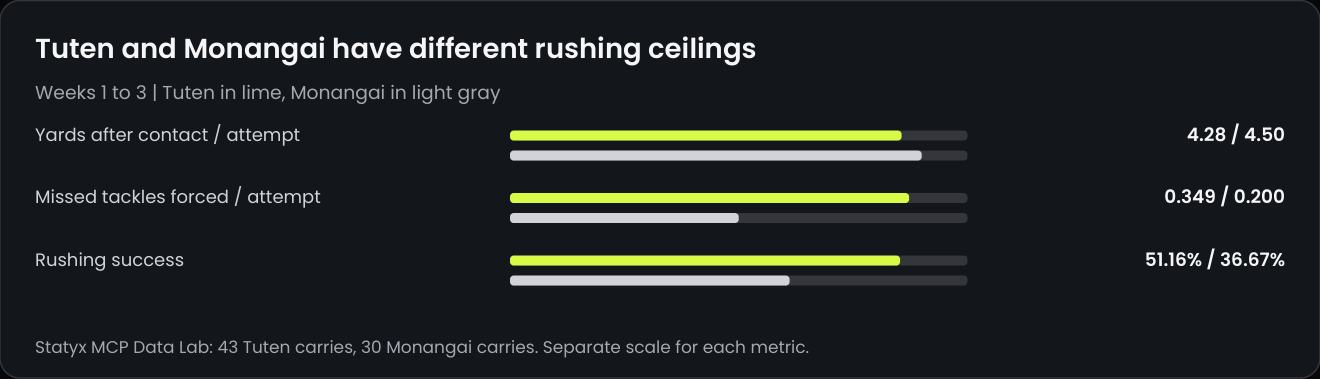
The underlying runner profile includes 4.50 yards after contact per attempt and an 80% zone run rate. The second number describes Chicago’s usage; it does not prove the Jets are weak in a specific zone concept. Swift is healthy, so there is no injury windfall to sell.
His 100 yard opener inflates season efficiency. The next two games produced 47 and 31 yards on 20 combined carries. Chicago’s backup QB could encourage runs, while missing Braxton Jones can reduce their quality. This is a modest yardage target with a stable rotation, not a claim that Monangai has taken over.
Published for research and entertainment purposes. Not betting advice.



Discussion
Sign in to join the discussion.
Loading comments…