NFL Week 6 Fantasy Start/Sit: Follow the Opportunity
21 Week 6 fantasy start/sit calls for PPR lineups, with Friday injury updates, player usage, matchup evidence and weather checks.
Get the tools behind this post. Free Statyx account, no card needed.
Sign up free Kaz
Kaz
By Kaz · October 16, 2026. PPR, four-point passing touchdowns. Data through Week 5. Statyx metrics pulled 11:13-11:18 a.m. PDT; injury news refreshed 12:18 p.m. PDT.
Carolina's game in Philadelphia has changed. Jalen Hurts is out, Tanner McKee will start, and the Panthers will be without A.J. Dillon. That strengthens the case for Chuba Hubbard's workload, but it does not erase Carolina's injuries up front or turn a 39-point game total into a scoring bonanza.
The same discipline applies across Week 6. An attractive fantasy points allowed number starts the research; the player's role, the specific defensive opening and the latest availability news decide whether the start holds up. This refreshed board covers the remaining Sunday and Monday games in PPR formats with four-point passing touchdowns. Thursday's Denver-Seattle calls have been removed from the actionable recommendations.
What changed on Friday
Hubbard stays an RB2 with Dillon ruled out. Coker has no Friday injury designation. Hurts' absence changes the opposing offense; Carolina's line remains the counterweight.
The Jets have confirmed Breece Hall will not play. Allen's recent lead-back work now supports a start without an unresolved Hall condition.
Olave returned to limited practice Friday and is questionable with illness. Shough practiced fully all week with no game designation. The stream still requires Olave to be active.
DJ Moore missed both practices and Joshua Palmer remained limited. Shakir and Kincaid stay usable without assigning either teammate a confirmed absence.
The forecast has eased to 13-14 mph sustained wind and 30-33 mph gusts. Keep earlier alternatives available rather than discovering the problem at Sunday night kickoff.
The decision board
21 remaining-game calls. Conditional labels apply to the board and the full analysis below. Starts and sits are comparisons, not projections.
| POS | PLAYER | MATCHUP | LINEUP CALL |
| QB | Matthew Stafford | LA vs ARI | Start QB1 |
| QB | Brock Purdy | SF vs WAS | Start; monitor receivers QB1 |
| QB | Tyler Shough | NO vs NYG | Stream only if Olave plays Conditional QB stream |
| QB | Jacoby Brissett | ARI vs LAR | Sit in one-QB leagues QB2 |
| QB | Daniel Jones | IND vs TEN | Sit in one-QB leagues QB2 |
| WR | Khalil Shakir | BUF vs LV | Start as PPR flex PPR flex |
| WR | Jalen Coker | CAR vs PHI | Start as flex PPR flex |
| WR | Carnell Tate | TEN vs IND | Start as flex Volume-led flex |
| WR | Matthew Golden | GB vs DAL | Start only with wind plan Conditional WR2 / flex |
| WR | Tre Tucker | LV vs BUF | Start as upside flex Higher-variance flex |
| WR | Quentin Johnston | LAC vs KC | Sit Deep-league fallback |
| RB | Kyren Williams | LA vs ARI | Start RB2 or better |
| RB | Chuba Hubbard | CAR vs PHI | Start RB2 |
| RB | Cam Skattebo | NYG vs NO | Start RB2 |
| RB | Tony Pollard | TEN vs IND | Start RB2 / flex |
| RB | Braelon Allen | NYJ vs NE | Start RB2 / flex |
| RB | Quinshon Judkins | CLE vs BAL | Sit; monitor availability Bench unless options are thin |
| TE | Isaiah Likely | NYG vs NO | Start TE1 |
| TE | Dalton Kincaid | BUF vs LV | Start TE1 with weekly variance |
| TE | Tucker Kraft | GB vs DAL | Start with weather check Lower-end TE1 |
| TE | Colston Loveland | CHI vs ATL | Sit TE2 |
THE QB DECISIONS
Quarterbacks
Matthew Stafford LA vs ARI

Start
| Attempts / game 43.2 | CPOE 2.0 pp | EPA / dropback 0.142 | Opp. QB FPA 22.6 / game |
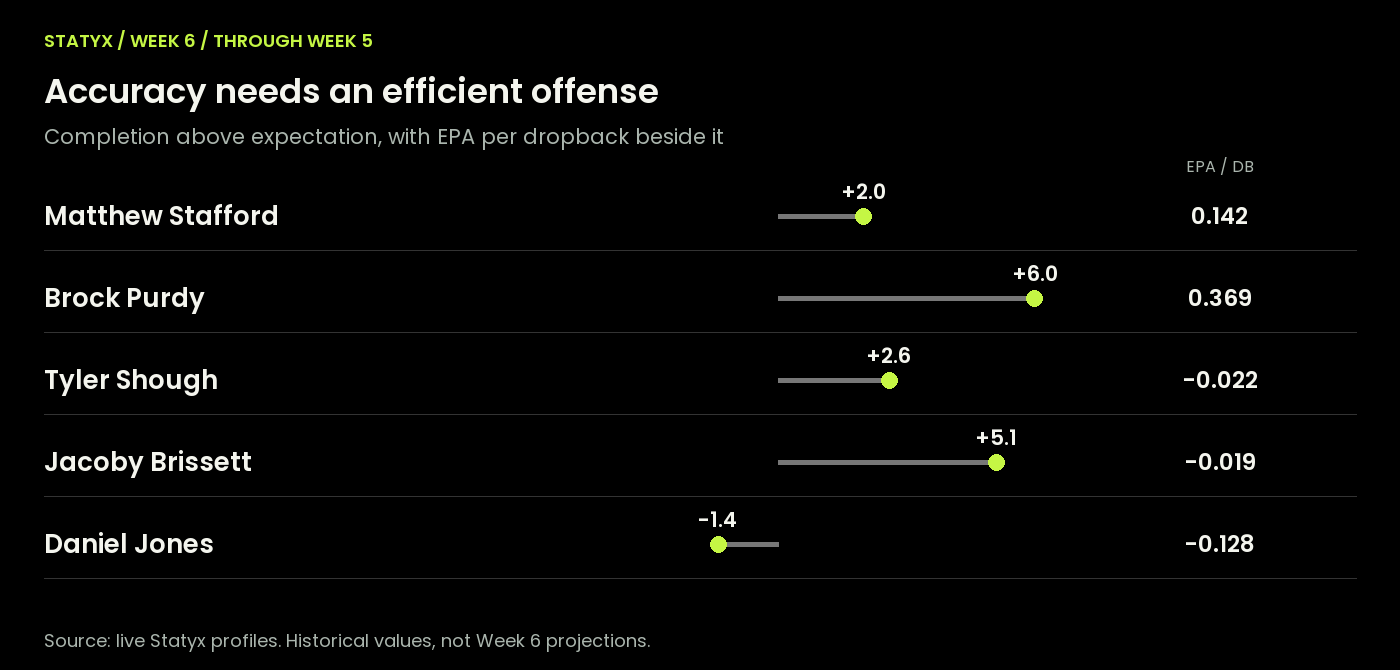
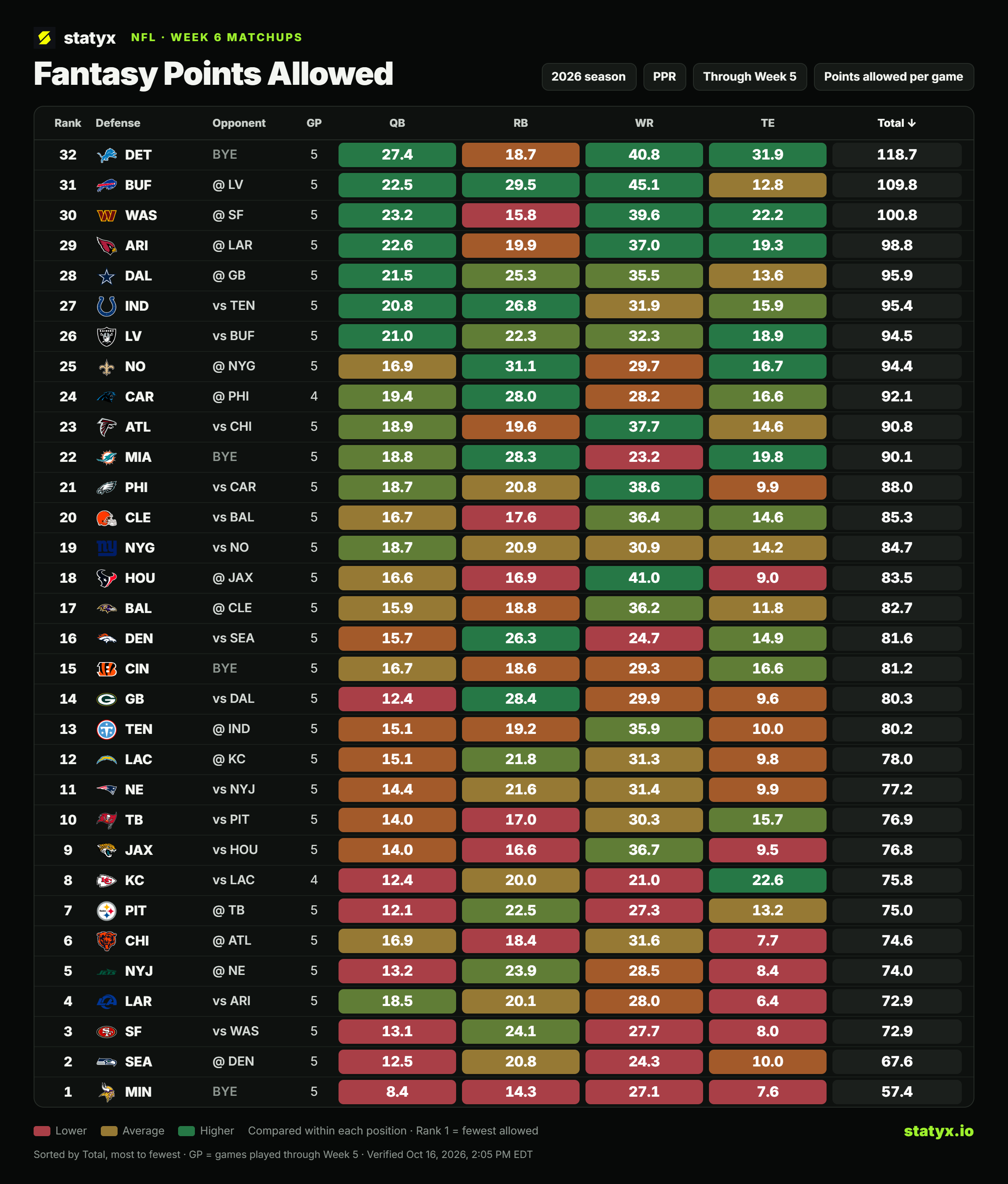
Stafford's 43.2 attempts per game give this recommendation its foundation. His +2.0 completion percentage over expectation and +0.142 EPA per dropback show that the volume has not been empty. Arizona has allowed +0.358 EPA per dropback through Week 5, and the supplied matchup chart lists 22.6 quarterback fantasy points allowed per game.
The risk is how quickly Los Angeles takes control. The fresh Pinnacle line makes the Rams 13.5-point favorites, so Stafford may not need his usual workload late. Start him for the combination of established opportunity and defensive weakness; do not build the decision around an assumption of four quarters of aggressive passing.
The call: Prefer Stafford to Brissett, Jones and the conditional Shough stream.
Check: No special availability condition in the checked reports.
Brock Purdy SF vs WAS

Start; monitor receivers
| Attempts / game 28.4 | CPOE 6.0 pp | EPA / dropback 0.369 | Opp. QB FPA 23.2 / game |
Purdy supplies the strongest efficiency profile on this board: +6.0 completion percentage over expectation, +0.369 EPA per dropback and a 72.6% catchable throw rate. Washington has allowed a successful play on 49.5% of opponent dropbacks. Its 23.2 quarterback points allowed in the supplied chart supports the matchup without becoming Purdy's projection.
His 28.4 attempts per game leave less room for lost weapons. San Francisco's receiving situation needs a fresh check: Mike Evans missed Thursday practice with ribs and Achilles soreness, while Deebo Samuel is dealing with a hamstring problem. The coach's Thursday list describes practice availability, not a final Monday designation for Evans. Purdy remains a start, but resolve that uncertainty before giving up a viable Sunday option.
The call: Start over Brissett or Jones; reassess if San Francisco loses more receiving options.
Check: Check Mike Evans and San Francisco's receiving group before the earlier Sunday alternatives lock.
Tyler Shough NO vs NYG
Stream only if Olave plays
| Attempts / game 41.0 | CPOE 2.6 pp | EPA / dropback -0.022 | Opp. QB FPA 18.7 / game |
Shough's 41.0 attempts per game keep him in the streaming pool even with -0.022 EPA per dropback. The Giants have allowed +0.064 EPA per dropback and hit quarterbacks on 11.6% of dropbacks. The supplied chart's 18.7 quarterback points allowed describes a playable matchup rather than an exceptional one.
Chris Olave returned to limited practice Friday after missing Wednesday and Thursday with illness, and the Saints officially listed him as questionable. Shough practiced fully all three days with a left-hand listing and has no game designation. The return is progress, but it does not clear Olave for Sunday. With roughly 7-8 mph stadium wind and a 46-point total at the checked snapshot, availability carries more weight than weather. Keep this a conditional stream until Olave is active.
The call: Use behind Stafford and Purdy; if Olave is inactive, choose another verified starter instead of forcing this stream.
Check: Olave returned limited Friday and is questionable with illness. Shough was full all week with no game designation. Confirm Olave is active.
Jacoby Brissett ARI vs LAR

Sit in one-QB leagues
| Attempts / game 39.8 | CPOE 5.1 pp | EPA / dropback -0.019 | Opp. QB FPA 18.5 / game |
Brissett has volume: 39.8 attempts per game and a +5.1 completion percentage over expectation. The concern is that those throws have still produced -0.019 EPA per dropback, while his completion rate under pressure is 40.5%. The Rams have allowed a 43.6% passing success rate and approximately neutral EPA per dropback.
Arizona being a 13.5-point underdog creates a possible catch-up workload, but a high attempt count can coexist with failed drives. The supplied 18.5 quarterback points allowed is not restrictive enough to make the matchup the whole sit argument. This is a preference for the better offensive cases above, while Brissett remains usable when a superflex roster needs a starting quarterback.
The call: Prefer Stafford or Purdy. Shough is an alternative only if his Olave condition clears.
Check: A trailing script can create attempts without creating efficient drives.
Daniel Jones IND vs TEN
Sit in one-QB leagues
| Attempts / game 35.2 | CPOE -1.4 pp | EPA / dropback -0.128 | Opp. QB FPA 15.1 / game |
Jones faces a mixed defensive picture. Tennessee has allowed +0.218 EPA per dropback, but the supplied chart puts its quarterback allowance at only 15.1 points per game. Neither a team's total allowance nor its passing EPA tells the whole fantasy story. Jones has produced -0.128 EPA per dropback and a -1.4 completion percentage over expectation across five games.
His last two CPOE readings were -9.9 and -3.8 percentage points. Those are completed-game observations, not a forecast, but they weaken the case that a friendly opponent is all he needs. Indianapolis is favored by seven in a game with a 44-point total, which also leaves a route to winning without a large passing score. Keep him for QB2 requirements rather than promoting him ahead of the stronger starts.
The call: Use Stafford or Purdy ahead of Jones; Tennessee's weak passing EPA does not erase his own efficiency trend.
Check: Do not upgrade solely from Tennessee's overall fantasy points allowed row.
THE WR DECISIONS
Wide receivers
Khalil Shakir BUF vs LV
Start as PPR flex
| Target share 20.0% | Air-yards share 13.3% | Targets / route 21.4% | Opp. WR FPA 32.3 / game |
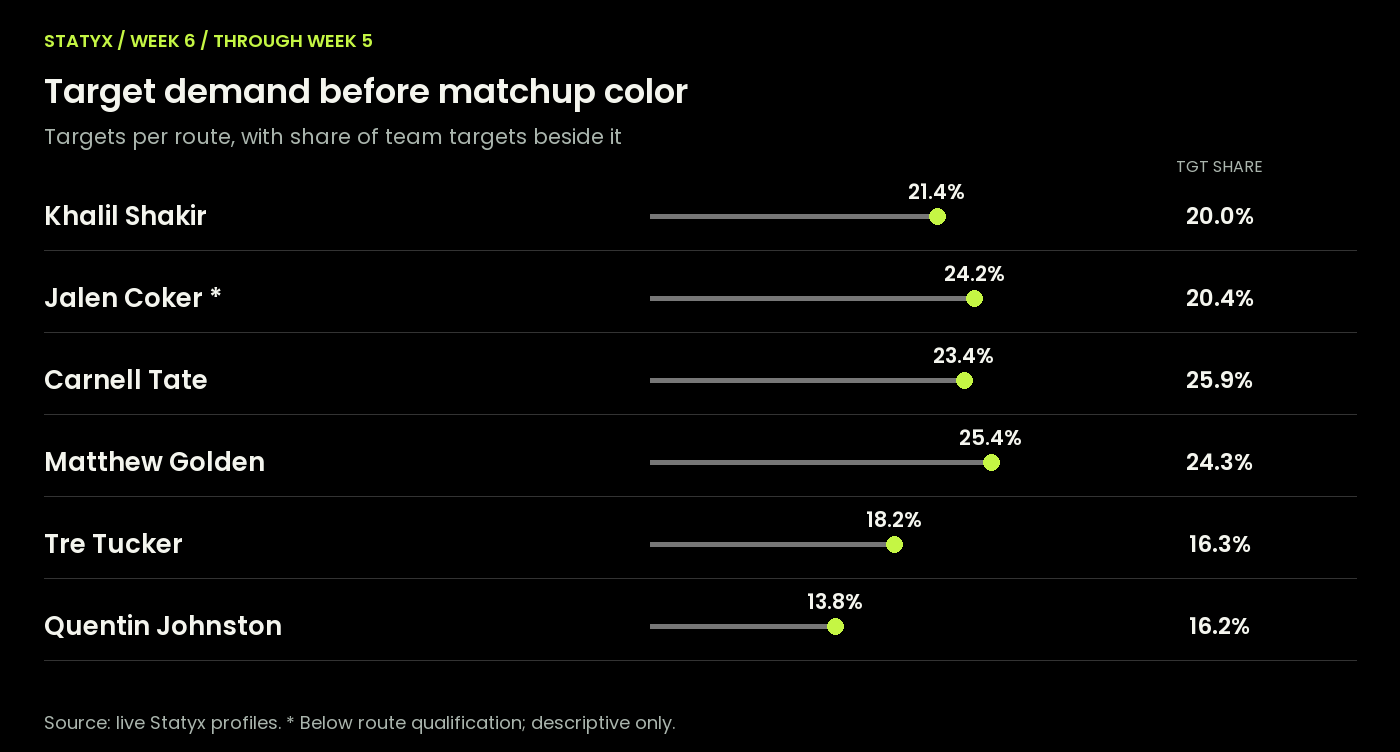
Shakir offers a shorter route to PPR scoring than the receivers who need repeated deep completions. He owns 20.0% of Buffalo's targets, averages 9.2 yards after the catch per reception and has a 6.5-yard average target depth. The Raiders' 32.3 receiver points allowed in the supplied chart and the fresh 53.5-point game total support using him as a flex.
DJ Moore missed Wednesday and Thursday; Joshua Palmer remained limited. That creates possible concentration, not a guaranteed target increase. There is also resistance inside the matchup: Route IQ has Las Vegas allowing 6.23 yards per target over 52 Cover 3 targets. Shakir is a sensible reception-led choice, not a claim that every coverage or every Buffalo receiver has an easy afternoon.
The call: Prefer Shakir to Johnston and to Golden while the Lambeau gust forecast persists.
Check: Moore DNP and Palmer limited are practice findings, not confirmed absences.
Jalen Coker CAR vs PHI
Start as flex
| Target share 20.4% | Air-yards share 24.4% | Targets / route * 24.2% | Opp. WR FPA 38.6 / game |
Coker's Friday clearance removes one uncertainty from an appealing receiver matchup. He has a 20.4% target share and 10.1 yards per target. Philadelphia's 38.6 receiver points allowed in the supplied chart fits a more specific Route IQ opening: Cover 3 accounts for 36.7% of the defense's classified usage, with 9.6 yards allowed per target over 65 targets. Coker has six catches for 80 yards on seven targets against that shell.
Seven targets is a small matchup sample. His overall route-based metrics also fail the profile's 100-route qualification, so treat the efficiency as promising evidence with limited support. Hurts' absence changes Philadelphia's offense, while Carolina's tackle and guard issues may hinder its own. The 39-point total keeps this a measured flex call. Clearance to play does not guarantee a full returning workload.
The call: Prefer Coker to Johnston; retain a normal flex expectation in this low-total game.
Check: No Friday injury designation. Carolina's offensive line and receiving competition still matter.
* Below the tool's qualification threshold; descriptive value only.
Carnell Tate TEN vs IND
Start as flex
| Target share 25.9% | Air-yards share 48.9% | Targets / route 23.4% | Opp. WR FPA 31.9 / game |
Tate's opportunity survives a mixed efficiency profile: 25.9% target share, 48.9% air-yards share and 7.4 targets per game. The Colts have allowed 31.9 receiver points per game in the supplied chart. Their Cover 3 has conceded 8.94 yards per target across 49 targets; Tate has caught 10 of 12 for 128 yards against that shell.
The opposing evidence belongs beside that opening. Indianapolis uses man on 43.2% of classified coverage, while Tate's man sample is four catches for 41 yards on eight targets across 31 routes. With Tennessee a seven-point underdog, there may be passing work, but the matchup will not always match his best split. Start him for the concentrated role, with ordinary flex expectations rather than treating air yards as banked production.
The call: Prefer Tate to Johnston; Shakir is the more conservative PPR choice.
Check: Indianapolis uses more man coverage than Tate's strongest split would prefer.
Matthew Golden GB vs DAL
Start only with wind plan
| Target share 24.3% | Air-yards share 38.1% | Targets / route 25.4% | Opp. WR FPA 35.5 / game |
Golden's role earns the consideration: 8.8 targets per game, a 24.3% target share and 38.1% of Green Bay's air yards. Dallas has allowed +0.394 EPA per dropback, while the supplied chart shows 35.5 receiver points allowed. Route IQ also has Golden catching 18 of 28 classified zone targets for 316 yards across 126 routes.
The forecast is improved from the first draft, but 13-14 mph sustained wind and 30-33 mph gusts still complicate a receiver with a 14.0-yard average target depth. A 53-point market total supports the game environment without removing that risk. He remains usable if the forecast eases or alternatives are weak; in a close PPR decision, take Shakir earlier rather than needing a late replacement.
The call: Prefer Shakir if the 30-33 mph gust forecast persists; Golden remains playable over Johnston.
Check: Make the comparison before Buffalo's 4:25 p.m. ET kickoff, four hours before Green Bay plays.
Tre Tucker LV vs BUF
Start as upside flex
| Target share 16.3% | Air-yards share 28.8% | Targets / route 18.2% | Opp. WR FPA 45.1 / game |
Tucker joins the board because Buffalo's receiver allowance is the clearest opportunity in the supplied chart: 45.1 PPR points per game to the whole position. Tucker has run routes on 80.2% of his own passing-play snaps, owns 28.8% of Raiders air yards and gains 9.8 yards per target. An indoor game with a 53.5 total gives his downfield role a workable setting.
The individual volume is less impressive than the matchup: a 16.3% target share and 5.6 targets per game. Bowers returned to full practice Thursday, so this recommendation does not assume his targets disappear; Jalen Nailor improved to limited participation. Tucker is a flex for a lineup seeking a larger-play outcome, with a lower floor than the defense's aggregate number might suggest.
The call: A ceiling-oriented alternative to Johnston; prefer Shakir when the lineup needs a steadier PPR role.
Check: Do not assume Brock Bowers is out: he practiced fully Thursday. Nailor's status remains relevant.
Quentin Johnston LAC vs KC
Sit
| Target share * 16.2% | Air-yards share * 22.5% | Targets / route 13.8% | Opp. WR FPA 21.0 / game |
Johnston has both an availability issue and a target-conversion problem. He remained limited with a chest injury in the two checked practices. His profile shows targets on 13.8% of routes, a 36.8% catch rate and 5.7 yards per target. The latter two are descriptive readings from fewer than 20 targets, not qualified league comparisons.
Kansas City has allowed 21.0 receiver points per game in the supplied chart over four games, and the live position table shows no receiving touchdowns allowed to wide receivers. Injuries elsewhere in the Chargers' receiver group could create work, but Joe Alt's consecutive missed practices add protection uncertainty. Los Angeles is an eight-point underdog. More possible attempts are insufficient to make Johnston a normal flex ahead of the alternatives here.
The call: Use Shakir, Coker or Tate; Tucker is the upside alternative.
Check: Chest injury: limited Wednesday and Thursday. Check the final designation before any deep-league use.
* Below the tool's qualification threshold; descriptive value only.
THE RB DECISIONS
Running backs
Kyren Williams LA vs ARI
Start
| Carries / game 14.0 | RYOE / carry 0.56 yd | YAC / carry 3.57 yd | Opp. RB FPA 19.9 / game |
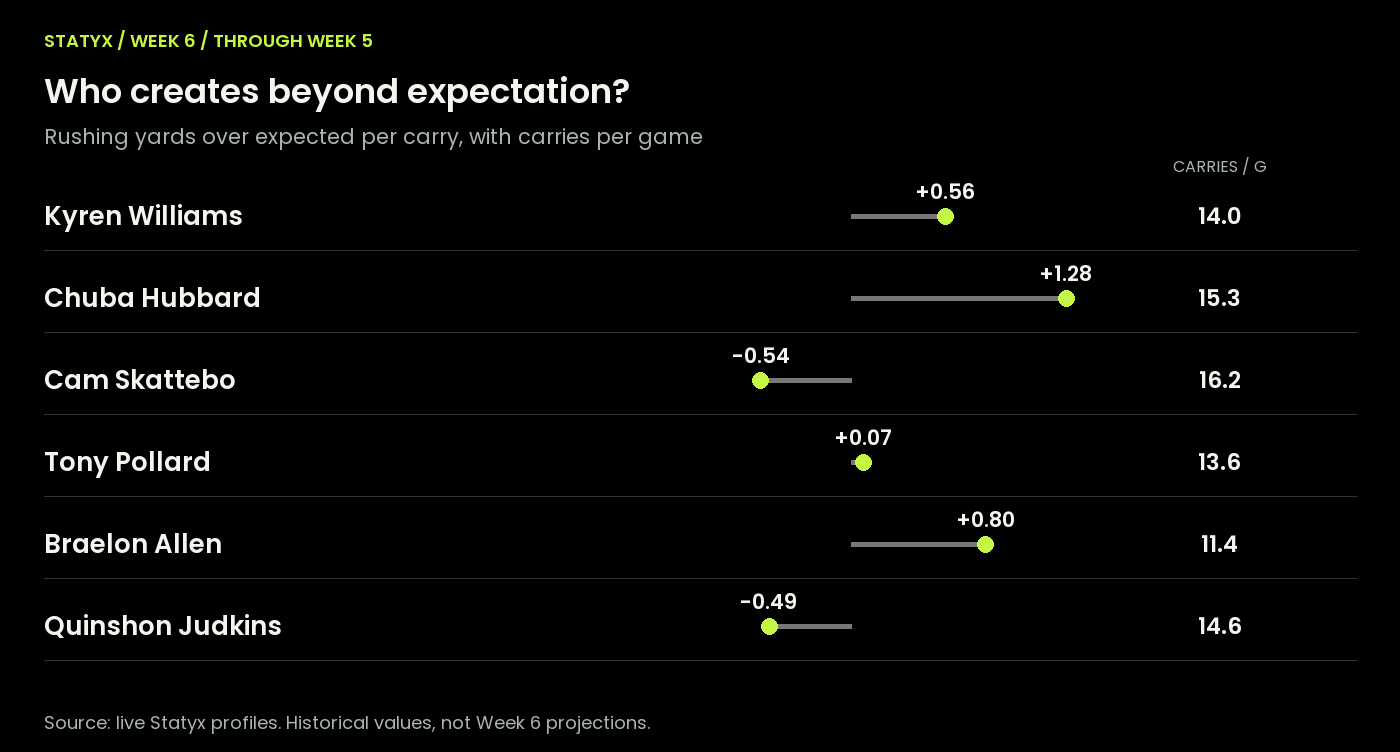
Williams stays in because the role and his own rushing quality are stronger than Arizona's middling backfield allowance suggests. He averages 14.0 carries and 6.6 targets per game, gains 3.57 yards after contact per attempt and produces +0.56 rushing yards over expected per carry. The supplied chart lists Arizona at 19.9 backfield points allowed.
That number is a useful brake on calling this a dream rushing matchup: Arizona has allowed -0.127 EPA per rush in the live team data. The Rams being 13.5-point favorites creates a plausible path to rushing work, while receiving usage supplies another scoring route. Start Williams for that combination, without assuming Los Angeles will need its usual passing volume or that a comfortable lead guarantees a full fourth-quarter workload.
The call: Keep Williams ahead of the marginal backs on this board.
Check: A favorable projected script supports the call; it does not guarantee every late carry belongs to Williams.
Chuba Hubbard CAR vs PHI
Start
| Carries / game 15.3 | RYOE / carry 1.28 yd | YAC / carry 2.92 yd | Opp. RB FPA 20.8 / game |
Hubbard gets a firmer workload case after Carolina ruled Dillon out. His existing profile already offers 15.3 carries per game, a 66.3% rush-attempt share and +1.28 rushing yards over expected per carry across 61 carries. Philadelphia's 20.8 backfield points allowed in the supplied chart is a workable matchup, while Rush IQ rates the opponent component average rather than exceptional.
McKee replacing Hurts changes the game environment, and the fresh line makes Carolina a 3.5-point favorite. It also carries only a 39-point total. Monroe Freeling is doubtful and Damien Lewis questionable, so do not turn fewer competing carries into an efficiency guarantee. Trevor Etienne's possible activation remains another variable. Hubbard stays an RB2 because of opportunity and creation, with the line and scoring environment limiting the upside.
The call: Prefer Hubbard to Judkins. Keep the workload upgrade measured while Carolina's line is unsettled.
Check: Dillon out; Freeling doubtful; Lewis questionable. Practice-window players still require activation.
Cam Skattebo NYG vs NO
Start
| Carries / game 16.2 | RYOE / carry -0.54 yd | YAC / carry 2.91 yd | Opp. RB FPA 31.1 / game |
Skattebo's 16.2 carries per game meet the most favorable backfield allowance among this article's opponents: New Orleans at 31.1 PPR points per game in the supplied chart. The live position table shows 667 rushing yards and 10 rushing touchdowns conceded to backs over five games. Rush IQ independently grades the Saints' run defense 32nd of 32, with a stabilizing five-game sample.
His own -0.54 rushing yards over expected per attempt stops this from becoming an efficiency endorsement. Both Giants tackles missed the checked practices, and Najee Harris' full participation means another back remains available. The near pick'em spread supports a competitive script, not exclusive work. Start Skattebo as an RB2 while recognizing that poor blocking could absorb some of the apparent defensive advantage.
The call: Use Skattebo over Judkins; do not ignore the Giants' tackle situation.
Check: Andrew Thomas and Jermaine Eluemunor missed Wednesday and Thursday. Najee Harris practiced fully.
Tony Pollard TEN vs IND
Start
| Carries / game 13.6 | RYOE / carry 0.07 yd | YAC / carry 2.65 yd | Opp. RB FPA 26.8 / game |
Pollard's Wednesday absence was rest, and he returned to full participation Thursday. His 63.0% rush-attempt share and 15.7 carries per game across the last three completed games support a usable role. Indianapolis has allowed +0.119 EPA per rush and 26.8 backfield PPR points per game in the supplied chart. Rush IQ ranks its run defense 31st, with the grade still stabilizing.
Tyjae Spears moved from limited work to a missed Thursday practice. An absence could concentrate work, but Tennessee's own preview also identifies Nick Singleton as a possible beneficiary; Pollard does not inherit every vacated touch automatically. The Titans are seven-point underdogs, and Pollard averages only 2.4 targets. Start him for the rushing matchup and established role, with less protection if Tennessee falls behind early.
The call: Prefer Pollard to Judkins; confirm the final Tennessee report before kickoff.
Check: Pollard full Thursday after Wednesday rest. Spears declined from limited to DNP; no absence assumed.
Braelon Allen NYJ vs NE
Start
| Carries / game 11.4 | RYOE / carry 0.80 yd | YAC / carry 3.30 yd | Opp. RB FPA 21.6 / game |
Allen's role condition has cleared: the Jets confirmed Hall will miss Week 6 with a quad injury. Allen's carry counts were 14 and 24 in Weeks 4 and 5, with two and four targets. Across the season he has generated +0.80 rushing yards over expected per carry and 3.30 yards after contact per attempt. The recent lead-back work now supports a direct RB2 or flex recommendation.
New England's 21.6 backfield points allowed in the supplied chart is adequate support, not a reason to assume a breakout. The Jets are 7.5-point underdogs, and Allen's receiving efficiency remains below the tool's 20-target qualification. Guard Dylan Parham is also ruled out. Those are reasons to keep expectations measured, while Hall's confirmed absence gives Allen a clearer opportunity than a speculative injury replacement.
The call: Use Allen as an RB2 or flex ahead of the unresolved Judkins option.
Check: Hall is officially out. Dylan Parham is also out, keeping an offensive-line downside in view.
Quinshon Judkins CLE vs BAL
Sit; monitor availability
| Carries / game 14.6 | RYOE / carry -0.49 yd | YAC / carry 2.56 yd | Opp. RB FPA 18.8 / game |
Fresh Statyx availability data and official Ravens reporting confirm Judkins returned to practice Friday; a final Browns game designation was not available in the checked team table. The team previously described an ankle tweak, while the MCP note uses foot. His 14.6 carries and 4.0 targets per game offer a real workload if cleared, but -0.49 rushing yards over expected per attempt and 3.03 yards per carry excluding breakaways show why volume alone is not enough.
Baltimore has allowed a successful rush on 34.7% of carries. Its 18.8 backfield points allowed in the supplied chart supports the caution. The Ravens' own quarterback uncertainty could change game flow, so a large Baltimore lead is not needed for this sit argument. Prefer the healthier or better-positioned alternatives; if Judkins is cleared and a deep roster needs his receiving work, recognize that as a constrained choice.
The call: Prefer Hubbard, Skattebo, Pollard or Allen.
Check: Lower-leg injury remains unresolved. Final report and inactive check are required.
THE TE DECISIONS
Tight ends
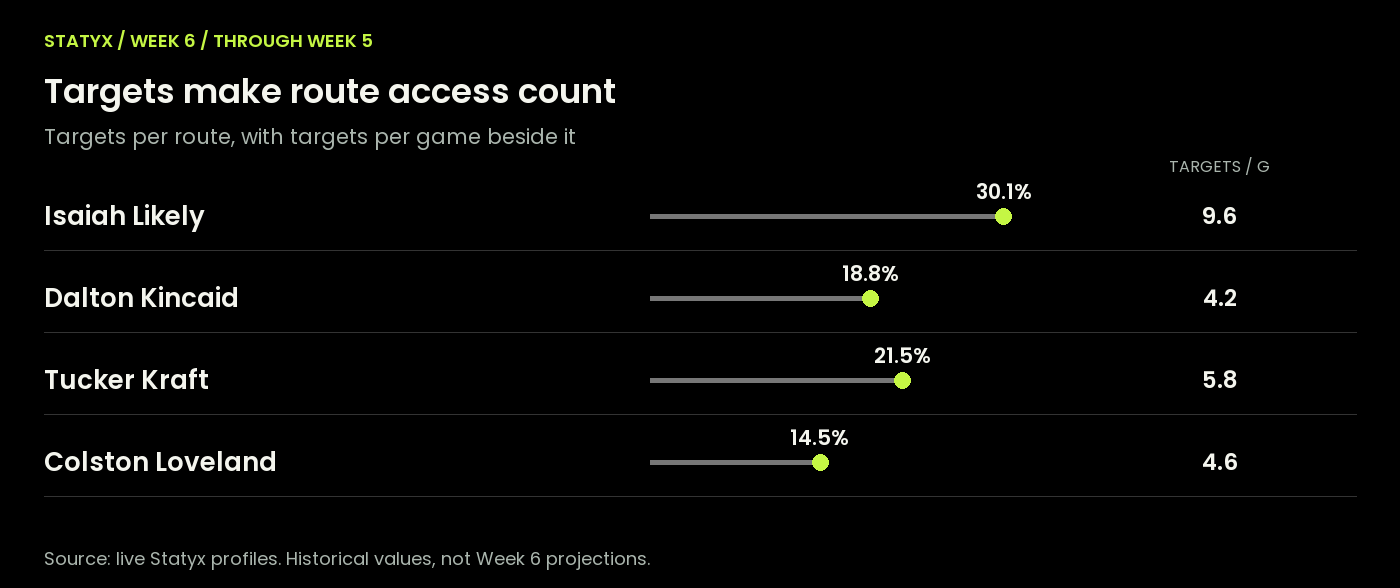
Isaiah Likely NYG vs NO
Start
| Targets / game 9.6 | Targets / route 30.1% | Route rate 83.4% | Opp. TE FPA 16.7 / game |
Likely's receiving role carries the start: 9.6 targets per game, a 29.4% target share and targets on 30.1% of routes. He also owns 44.4% of Giants red-zone targets. New Orleans has allowed 36 tight end catches on 46 targets, while the supplied chart shows 16.7 tight end PPR points allowed per game.
The foot listing needs context: he practiced fully in both checked sessions. The more substantial downside is the Giants' protection, with Thomas and Eluemunor missing both days. Likely's 5.9 yards per target also argues for a reception-led expectation rather than assuming explosive gains. Full practice is encouraging without substituting for final status; the established target volume keeps him ahead of the shakier TE options.
The call: Prefer Likely to Kraft and Loveland; his established target demand is the strongest TE role here.
Check: Foot listing with full Wednesday and Thursday participation. Monitor protection and final status.
Dalton Kincaid BUF vs LV
Start
| Targets / game 4.2 | Targets / route 18.8% | Route rate 67.1% | Opp. TE FPA 18.9 / game |
Kincaid offers a different path from Likely: less volume, more production per target. He averages 4.2 targets, but gains 13.2 yards per target and +2.40 yards after the catch above expectation. His 28.6% explosive target rate supports a ceiling case, and Las Vegas has allowed 18.9 tight end PPR points per game in the supplied chart.
A 67.1% route rate on his own passing-play snaps leaves him less secure than a full-time receiving role might suggest. Moore's consecutive absences and Palmer's limited work create potential upside, not a confirmed redistribution. Buffalo's 53.5-point game total and indoor setting are useful support. Start Kincaid without turning his season efficiency into a promise that modest target volume always produces a large score.
The call: Prefer Kincaid to Kraft while Lambeau gusts persist, and to Loveland.
Check: Moore and Palmer statuses can change target competition; the start does not require both to miss.
Tucker Kraft GB vs DAL
Start with weather check
| Targets / game 5.8 | Targets / route 21.5% | Route rate 68.5% | Opp. TE FPA 13.6 / game |
Kraft's 5.4-yard average target depth is less dependent on long throws than Golden's role. His targets are charted catchable 86.2% of the time, and he earns a target on 21.5% of routes. That supports a lower-end TE1 start, but Dallas's 13.6 tight end points allowed in the supplied chart is much less inviting than its receiver allowance.
The forecast still contains 30-33 mph gusts. Short targets can help preserve involvement, but wind can also disrupt drives and scoring chances. His 68.5% route rate is measured against his own passing-play snaps, not every Packers dropback. Keep Kraft usable when necessary, while preferring Likely or Kincaid earlier if the forecast holds; the high overall Dallas allowance does not make every position equally attractive.
The call: Use behind Likely and Kincaid if gusts persist; still prefer him to Loveland.
Check: Decide before the earlier TE alternatives lock. Shorter targets reduce one exposure to wind, not all of it.
Colston Loveland CHI vs ATL
Sit
| Targets / game 4.6 | Targets / route 14.5% | Route rate 77.2% | Opp. TE FPA 14.6 / game |
Loveland's route access is better than his target results. He runs a route on 77.2% of his passing-play snaps, but earns targets on only 14.5% of routes. The profile has 56.5% of targets catchable, 4.8 yards per target and no explosive targets. Atlanta's 14.6 tight end points allowed in the supplied chart is insufficient to rescue that production profile.
Williams practiced fully Friday and is officially questionable, an improvement from Wednesday's walkthrough estimate. The checked official report still did not establish who would start Sunday. That is uncertainty to carry, not proof a backup will play. Even if Williams starts, Loveland's current target quality and demand leave him behind the three usable tight ends above.
The call: Prefer Likely, Kincaid or Kraft.
Check: Caleb Williams practiced fully Friday and is questionable. The checked official source did not confirm the Sunday starter.
Resolve the conditions before the alternatives lock
Before Sunday's 1 p.m. ET games
Resolve Olave, Spears, Judkins and the Giants tackles. Hall is already ruled out, supporting Allen. Shough requires Olave available. Confirm Carolina activations and line availability.
Before Buffalo at 4:25 p.m. ET
Check Moore and Palmer. If Lambeau gusts remain near 30 mph, use Shakir ahead of Golden and Kincaid ahead of Kraft in close decisions. Do not leave an earlier alternative unused without a late fallback.
Before Sunday night at 8:20 p.m. ET
Recheck actual Lambeau conditions and Green Bay/Dallas inactives. A decision made here cannot recover a player whose game has already begun.
Before choosing a Monday quarterback
Purdy plays Monday at 8:15 p.m. ET. Recheck San Francisco's receiving group before Sunday alternatives lock; retain a Monday fallback if waiting for final information.
For more receiving matchup context, read our Week 6 man-versus-zone analysis. For the research workflow, explore the Statyx NFL Playbook.
Research your next lineup decision
Compare player usage, receiving matchups and rushing profiles in Statyx.
Research checked October 16, 2026. Recheck the stated injury and weather conditions before your lineup locks.
Published for research and entertainment purposes. Not betting advice.

Discussion
Sign in to join the discussion.
Loading comments…