NFL Week 5 WR Matchups: Man vs Zone
Week 5 receiving matchups explained with Statyx man and zone splits, coverage shells, target demand, injuries and three overlooked ceiling candidates.
Get the tools behind this post. Free Statyx account, no card needed.
Sign up free Statyx io
Cleveland gives Garrett Wilson plenty of man coverage to attack, but its main shells have defended receivers well. Minnesota gives Chris Olave almost the opposite test: overwhelming zone use, with openings in both Cover 3 and Cover 4. The useful question is where a receiver can earn a target and what happens after it arrives. Week 5 offers several good answers, plus a few matchups that look better at first glance than they do under inspection.
| Man reads | Zone reads | Ceiling candidates |
Man coverage: demand and resistance
Five receiving reads where man coverage matters. The defensive opening and the player response do not always agree.
Inspect the classified man samples
| Receiver / defense | Sample | Targets / route | Yards / route |
| Garrett Wilson CLE 61% man | 7 targets 16 routes | 43.8% | 4.31 |
| Malik Washington CIN 41% man | 3 targets 11 routes | 27.3% | 2.73 |
| Stefon Diggs NYG 45% man | 6 targets 16 routes | 37.5% | 2.25 |
| Zay Flowers ATL 36% man | 4 targets 10 routes | 40.0% | 7.90 |
| DK Metcalf IND 43% man | 10 targets 51 routes | 19.6% | 0.78 |
Statyx Route IQ, Weeks 1 to 3. Coverage target rates are calculated from the displayed raw counts.
Garrett Wilson vs Cleveland Browns
| Targets / route | Air yards share | First downs / target | Targets |
| 24.8% | 40.9% | 45.2% | 31 |
Cleveland's 61% man usage makes Wilson's target earning relevant. He drew seven targets on 16 classified man routes, catching all seven for 69 yards. That 43.8% target rate is an early signal, not a sustainable expectation. His broader role supports it: 24.8% targets per route through Week 4 and 40.9% of the Jets' air yards. If Adonai Mitchell's finger injury keeps him out, Wilson could absorb more of the available demand.
The defense is the restraint. Cleveland uses Cover 1 on 40% of labelled dropbacks and allows WRs 5.9 yards per target there. Its Cover 3 allowance is even tighter at 4.9. Wilson can earn looks without finding easy yards. Mitchell and Jets guard Dylan Parham were Wednesday DNP; a smaller target tree helps only if protection lets the quarterback deliver.
Malik Washington vs Cincinnati Bengals
| Targets / route | Air yards share | First downs / target | Targets |
| 25.0% | 30.8% | 25.0% | 28 |
Washington has earned targets on 25% of routes through Week 4, with 28 targets and 1.96 yards per route. Cincinnati uses man on 41% of classified dropbacks and Cover 1 on 30%. Its Cover 1 allowance of 8.7 yards per WR target offers an opening, but Washington has only one target and no catches in that shell. His broader man sample is also thin: three targets on 11 routes produced one catch for 30 yards. The role supports his inclusion; that single completion cannot establish reliable man coverage efficiency.
The matchup has another route to useful yardage. Cincinnati allows 6.70 yards after the catch per reception, ranked 31st in the Route IQ target area panel. Washington adds 1.16 yards after the catch above expectation per reception in the current core sample. Against zone, his classified sample contains 18 targets on 66 routes, with 11 catches for 122 yards; seven catches for 79 yards came on nine Cover 3 targets. Cincinnati uses Cover 3 on 22% of labelled dropbacks and permits WRs 6.3 yards per target there. That is an ordinary shell allowance, so the strongest argument combines target earning and production after catches rather than calling every coverage favorable.
Washington is not listed on the initial official Dolphins injury report. Chris Bell was limited and Caleb Douglas did not practice, which could narrow Miami's available receiver group if those limitations persist. Cincinnati safeties Bryan Cook and Kyle Dugger were DNP, with Jordan Battle limited. Those are preliminary practice statuses, not confirmed absences. Ja'Marr Chase and Tee Higgins also missed practice; if Cincinnati struggles to sustain offense without them, Miami could lean more on the run and leave Washington fewer receiving opportunities.
Stefon Diggs vs New York Giants
| Targets / route | Air yards share | First downs / target | Targets |
| 28.3% | 21.8% | 35.5% | 31 |
Diggs earned six targets on 16 man routes, compared with 11 on 44 zone routes. New York's 45% man rate could bring more of the former, while Cover 1 accounts for 25% of its labelled dropbacks. The Giants allow WRs 6.7 yards per target in Cover 1, an ordinary rather than generous result. Diggs' main appeal is access to the ball: his overall targets per route stand at 28.3%, even though receiving efficiency is only 1.60 yards per route.
This remains a conditional read. Diggs and Terry McLaurin missed Wednesday with hamstring injuries. Jayden Daniels was full with his elbow listing. A McLaurin absence could concentrate targets if Diggs plays, but neither absence nor a normal Diggs workload is established. New York's Cover 4 allowance of 4.3 yards per WR target also argues against turning the man fit into an unrestricted yardage ceiling.
Zay Flowers vs Atlanta Falcons
| Targets / route | Air yards share | First downs / target | Targets |
| 37.5% | 34.2% | 63.6% | 22 |
Flowers' classified man sample is only ten routes, but four targets produced three catches and 79 yards. Atlanta uses man 36% of the time and Cover 1 on 28% of labelled dropbacks. Its 3.7 yards allowed per WR target in Cover 1 is strong, which makes Flowers' individual production a reason to inspect the matchup rather than declare it soft. Atlanta's Cover 4 allowance is much looser at 7.9, and Flowers caught all three of his targets in that shell for 43 yards.
The receiving ceiling depends on who delivers the ball and how long the pocket holds. Lamar Jackson was Wednesday DNP with an ankle injury, Flowers limited with a foot issue, and Ronnie Stanley and Andrew Vorhees also DNP. Flowers can create against either coverage family, but the tiny man sample cannot establish that Tyler Huntley would reproduce the same explosive connections.
DK Metcalf vs Indianapolis Colts
| Targets / route | Air yards share | First downs / target | Targets |
| 18.9% | 37.7% | 33.3% | 33 |
Indianapolis uses man on 43% of classified dropbacks and gives up 10.6 yards per WR target in Cover 1, provisionally ranked 29th. That is a real defensive opening. Metcalf has not yet converted the corresponding opportunities: ten man targets across 51 routes produced four catches and 40 yards. Against Cover 1 specifically, eight targets yielded three catches and 31 yards.
His 37.7% air yards share means Pittsburgh still gives him a substantial share of the intended receiving distance. His 18.9% overall targets per route and 1.26 yards per route show why the matchup alone is insufficient. This is a possible efficiency rebound, not one of the cleanest receiving reads. A Pittsburgh lead could also reduce the number of attempts available to chase that rebound. Keep the favorable defensive allowance and the receiver's weak conversion in the same picture.
Zone coverage: the stronger connections
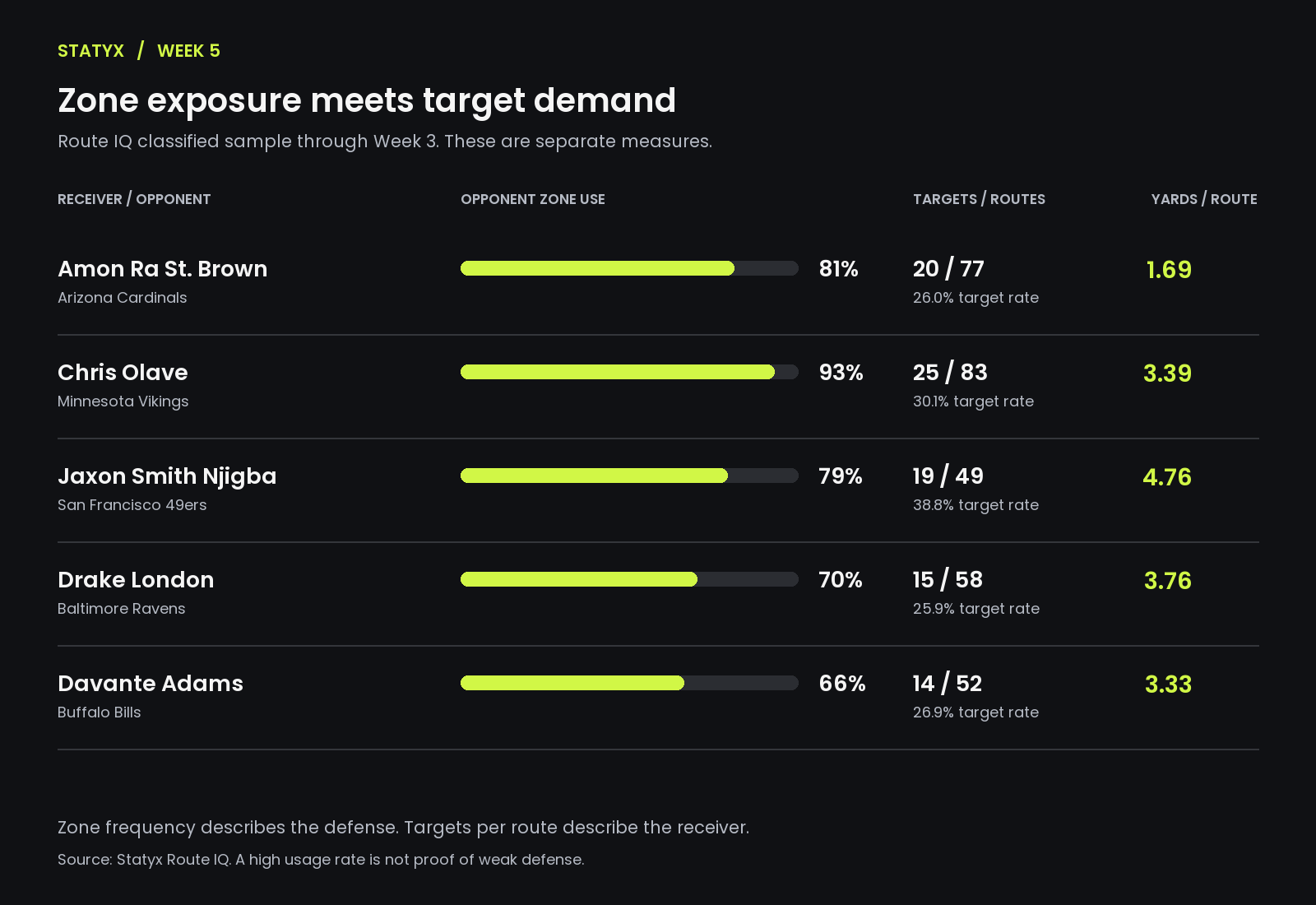
Inspect the classified zone samples
| Receiver / defense | Sample | Targets / route | Yards / route |
| Amon Ra St. Brown ARI 81% zone | 20 targets 77 routes | 26.0% | 1.69 |
| Chris Olave MIN 93% zone | 25 targets 83 routes | 30.1% | 3.39 |
| Jaxon Smith Njigba SF 79% zone | 19 targets 49 routes | 38.8% | 4.76 |
| Drake London BAL 70% zone | 15 targets 58 routes | 25.9% | 3.76 |
| Davante Adams BUF 66% zone | 14 targets 52 routes | 26.9% | 3.33 |
Statyx Route IQ, Weeks 1 to 3. Coverage target rates are calculated from the displayed raw counts.
Amon Ra St. Brown vs Arizona Cardinals
| Targets / route | Air yards share | First downs / target | Targets |
| 26.8% | 30.5% | 37.0% | 46 |
Arizona uses 81% zone. St. Brown has drawn 20 targets on 77 classified zone routes, catching 13 for 130 yards. His broader role supports the opportunity: 46 targets, 26.8% targets per route and a first down on 37.0% of targets through Week 4. The target demand is stronger than his modest zone yardage alone suggests.
The shells present different tests. Arizona uses Cover 4 on 27% of labelled dropbacks and allows WRs only 4.0 yards per target; St. Brown has two catches for 39 yards on six targets there. Cover 3 offers more room: Arizona uses it on 20% and allows 11.7 yards per WR target, provisionally ranked 32nd. St. Brown has ten catches for 88 yards on 14 Cover 3 targets. Frequent zone exposure supports his receiving role, but does not make every shell favorable.
St. Brown is not listed on the current official Lions report. Arizona safety Andrew Wingard was Wednesday DNP and Dadrion Taylor Demerson limited; neither absence is confirmed. An early Detroit lead could reduce passing volume. Direct weather exposure depends on State Farm Stadium's roof decision.
Chris Olave vs Minnesota Vikings
| Targets / route | Air yards share | First downs / target | Targets |
| 26.1% | 45.1% | 52.1% | 48 |
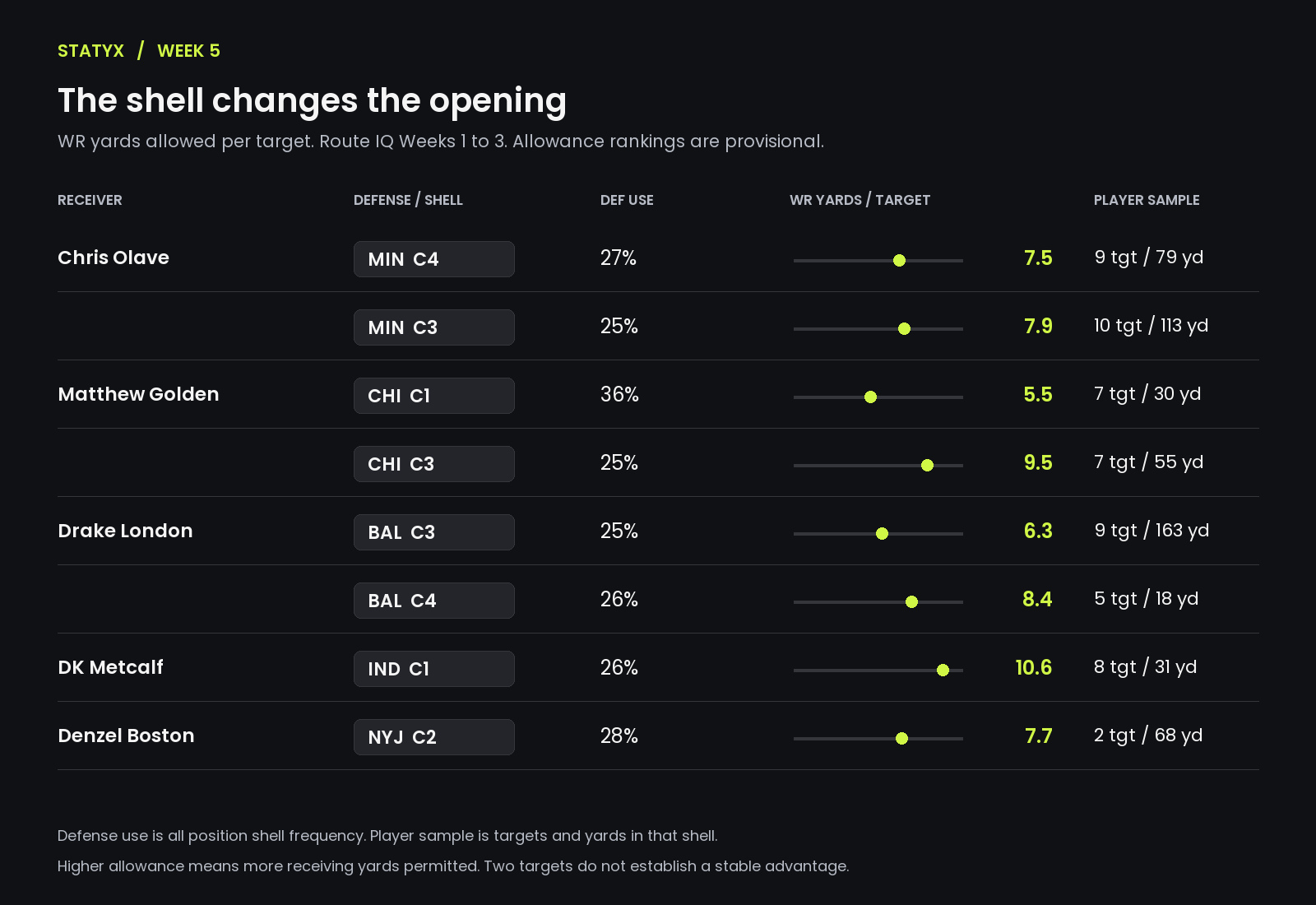
Minnesota's 93% zone rate is the clearest coverage exposure in this group. Olave earned 25 targets on 83 zone routes, catching 19 for 281 yards. The shell evidence supports the fit: nine Cover 4 targets produced 79 yards, while ten Cover 3 targets produced 113. Minnesota allows WRs 7.5 yards per target in Cover 4 and 7.9 in Cover 3, provisionally ranked 24th in each.
Those are meaningful route to target connections rather than a story built on one long catch. Olave owns 45.1% of New Orleans' air yards and converts 52.1% of targets into first downs through Week 4. His Wednesday DNP was rest; Tyler Shough was limited with a left hand injury. The Superdome removes direct rain and wind exposure, but it cannot remove a quarterback health constraint. That is the main condition on an otherwise well supported coverage case.
Jaxon Smith Njigba vs San Francisco 49ers
| Targets / route | Air yards share | First downs / target | Targets |
| 35.3% | 49.9% | 59.5% | 42 |
San Francisco uses zone on 79% of classified dropbacks. Smith Njigba has 19 targets and 233 yards on 49 zone routes, backed by 35.3% overall targets per route through Week 4. Against Cover 3, he caught seven of eight targets for 75 yards. San Francisco uses that shell 49% of the time and allows WRs 6.2 yards per target, so the advantage is his demand and conversion rather than a weak defense.
The separate safety sample is encouraging: targets arrived on 40.7% of his single high routes and 37.9% of his two high routes. San Francisco leans 57% single high, making him less dependent on one preferred look. His Wednesday absence was rest; Nick Bosa, Upton Stout and Marques Sigle had injury DNPs. Confirmed absences could help, but are not established. Seattle's Sunday forecast is sunny; game hour wind still needs the later hourly check.
Drake London vs Baltimore Ravens
| Targets / route | Air yards share | First downs / target | Targets |
| 24.7% | 40.5% | 60.0% | 25 |
Baltimore's 70% zone rate suits London's strongest classified sample: 15 targets on 58 routes, with 13 catches for 218 yards. His nine Cover 3 targets produced eight catches and 163 yards. Baltimore uses Cover 3 on 25% of labelled dropbacks and permits 6.3 yards per WR target. London has beaten that look before, but the opponent's allowance is fairly ordinary.
Cover 4 is the defensive opening. Baltimore uses it on 26% of labelled dropbacks and allows 8.4 yards per WR target, provisionally ranked 27th. London has only 18 yards on five Cover 4 targets, so that part of the case depends on improvement rather than proven domination. His 60% first down rate per target and 2.10 YAC above expectation support useful gains after ordinary catches. Jake Matthews' groin DNP and Baltimore's secondary health questions remain important. If Baltimore's offense struggles without Jackson, Atlanta may have less reason to keep throwing late.
Davante Adams vs Buffalo Bills
| Targets / route | Air yards share | First downs / target | Targets |
| 24.1% | 40.6% | 36.8% | 38 |
Adams earned 14 targets on 52 zone routes and turned them into 173 yards. Buffalo uses zone 66% of the time, with Cover 3 at 31% and Cover 4 at 25% of labelled dropbacks. His own Cover 3 response is useful: nine targets, five catches and 129 yards. Buffalo's 6.1 yards allowed per WR target in that shell is tough, so the case rests on Adams' ability to produce through resistance.
Buffalo allows a more moderate 6.8 yards per WR target in Cover 4, where Adams has just three targets for 21 yards. His 24.1% overall target rate and 2.47 yards per route provide a broader foundation. Puka Nacua's final availability and workload still affect the share available to Adams. Keep a Monday alternative if Adams becomes unavailable. SoFi's canopy reduces direct rain exposure, though the stadium is not a sealed dome. The Monday hourly forecast and final injury reports arrive after this Thursday draft.
Three overlooked receiving ceilings
Matthew Golden vs Chicago Bears
Chicago's 49% man rate makes Golden an imperfect headline man selection. The opportunity sits elsewhere: seven Cover 3 targets produced 55 yards and five Cover 2 targets produced 84. Chicago allows WRs 9.5 yards per target in Cover 3 and 9.2 in Cover 2, compared with 5.5 in Cover 1. Golden's 39.1% air yards share and four end zone targets keep the ceiling relevant. Christian Watson competes for those connections, and Green Bay's protection injuries matter. Sunday currently looks sunny, with hourly wind still to refresh. Five perfect Cover 2 catches are a small sample, not a forecast.
Denzel Boston vs New York Jets
Boston has seven catches for 158 yards on eight zone targets across 57 routes. New York plays 69% zone, and Cover 2 is its most frequent listed shell at 28%. Boston's two Cover 2 targets both became catches for 68 yards. That is the ceiling mechanism, but only two throws support it. The Jets allow 7.7 yards per WR target in that shell, an average result, while their Cover 3 allowance is a much tougher 4.1. Boston's 51.1% air yards share offers reach; his 16.3% overall target rate limits the floor. Jarvis Brownlee's concussion DNP is a personnel check, not a confirmed absence.
Isaac TeSlaa vs Arizona Cardinals
Arizona uses zone on 81% of classified dropbacks, but its shells are very different: 4.0 yards allowed per WR target in Cover 4 versus 11.7 in Cover 3. TeSlaa has four catches for 87 yards on five zone targets across 33 routes, including 26 yards on four Cover 3 targets. There is no qualified player sample in the displayed Cover 4 or Cover 6 rows. His overall 14.1% target rate and Detroit's competition make this a secondary receiving ceiling, not a steady volume expectation. Amon Ra St. Brown and Jameson Williams can absorb most of the available passes. An early Detroit lead would make the already narrow route to a big total narrower.
The opportunity behind the coverage
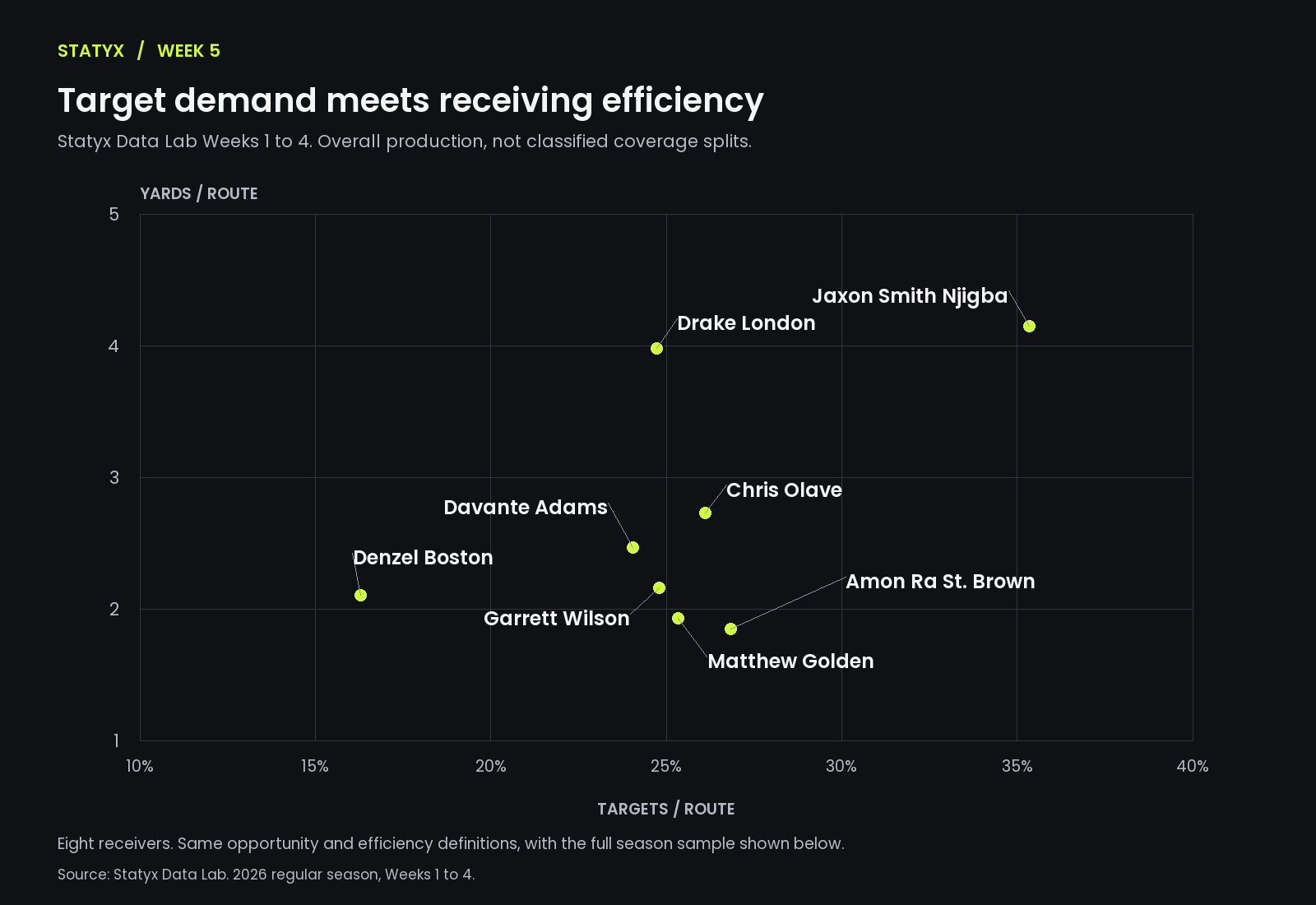
Smith Njigba combines strong target demand with receiving efficiency. St. Brown earns frequent targets, although his overall yards per route are more modest. London produces more yards per route than his target rate alone suggests. Golden earns targets at a similar rate to Wilson, but the shell comparison shows why the defensive path matters.
Inspect the underlying chart values
| Receiver | Targets / route | Yards / route | Targets |
| Amon Ra St. Brown | 26.8% | 1.85 | 46 |
| Chris Olave | 26.1% | 2.73 | 48 |
| Jaxon Smith Njigba | 35.3% | 4.15 | 42 |
| Drake London | 24.7% | 3.98 | 25 |
| Davante Adams | 24.1% | 2.47 | 38 |
| Garrett Wilson | 24.8% | 2.16 | 31 |
| Matthew Golden | 25.4% | 1.93 | 37 |
| Denzel Boston | 16.3% | 2.10 | 22 |
Weather worth revisiting
Nashville deserves a separate caution for receivers in Houston at Tennessee. The current NWS Sunday forecast carries a 50% shower chance and gusts up to 20 mph after heavy rain Saturday. Those conditions could reduce deep connection quality without automatically increasing underneath volume. Nico Collins' zone sample contains only five targets on 23 routes, so neither a reliable coverage edge nor a weather induced target boost is established. Outdoor forecasts for the London game, New York and Washington need an hourly refresh before kickoff.
Find your next receiving angle with Statyx
Explore the routes, coverage shells and target areas behind these matchups. Compare the player with the defense before setting your lineup.

Published for research and entertainment purposes. Not betting advice.


Discussion
Sign in to join the discussion.
Loading comments…