NFL Week 6 Man vs Zone: Where the Receiving Matchups Open Up
Week 6 coverage matchups, target demand and three receiving ceilings, researched with Statyx Route IQ and Data Lab.
Get the tools behind this post. Free Statyx account, no card needed.
Sign up free Statyx io
By Kaz
Drake London gets a defense that has allowed 16.85 yards per target on throws traveling at least ten yards. Jalen Coker gets frequent Cover 3 exposure against a Philadelphia defense allowing 9.60 yards per target in that shell. Michael Wilson gets plenty of potential passing volume, but a much harder route to efficient yards.
Those are three very different receiving situations. This week’s coverage board looks at the calls a defense makes, how a receiver has responded to them and whether the wider game gives that matchup room to matter.
Man reads · Zone reads · Ceiling candidatesOpponent coverage frequencies and shell allowances cover classified plays across positions. Receiver responses describe his own routes or targets. Shell, safety and Data Lab samples are separate. Small splits show possible responses, not expected receiving totals.
01 Man coverage: demand and resistance
Garrett Wilson vs New England Patriots
Strong target demand, tougher Cover 1 execution

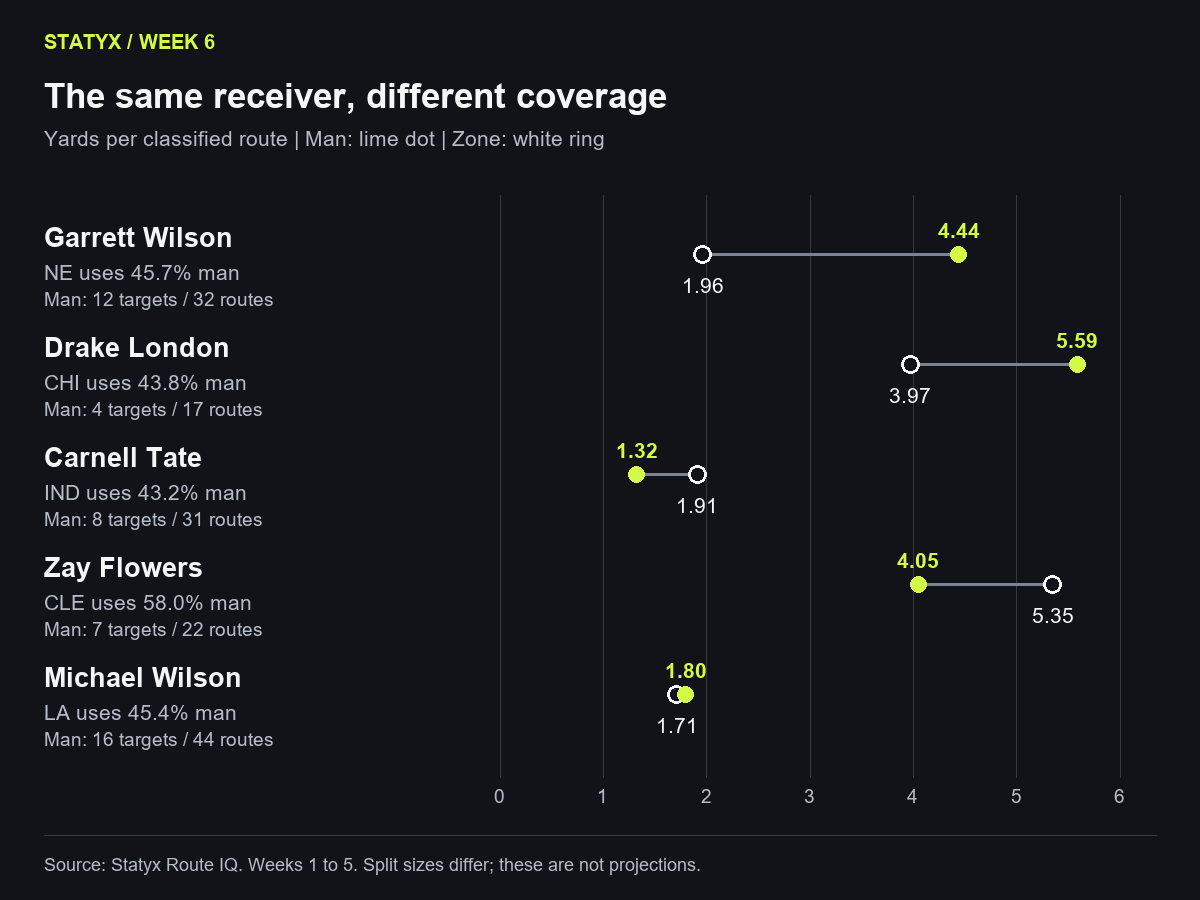
New England uses man on 45.7% of classified plays. Wilson has drawn 12 targets on 32 man routes, catching 11 for 142 yards. That is a 37.5% target rate in the split, backed by a much broader role: 42 overall targets and 43.2% of the Jets’ air yards through five games. The opportunity is substantial before making any injury assumptions.
The shells make the yardage case less straightforward. New England allows 5.63 yards per target in Cover 1, compared with 7.93 in Cover 3 and 9.44 in Cover 2. Wilson has seven catches for 88 yards on eight Cover 1 targets, but just 26 yards on six Cover 2 targets. A softer defensive allowance does not help equally in every part of his own sample.
Carlton Davis missed Wednesday with a neck injury; Christian Gonzalez was limited with a shoulder issue. Neither is a confirmed absence. Adonai Mitchell also missed the Jets’ walkthrough estimate, which could narrow the receiver group if he remains unavailable. New York is a substantial underdog, so sustained passing is plausible, although failed drives can still limit useful targets.
Drake London vs Chicago Bears
The stronger opening is inside Chicago’s zone calls

Chicago plays 43.8% man, but London’s strongest evidence sits in the other coverage family: 29 targets and 393 yards on 99 zone routes. Against man, all four targets on 17 routes became catches for 95 yards. Those four completions show a ceiling; the much larger zone sample provides the firmer receiving argument.
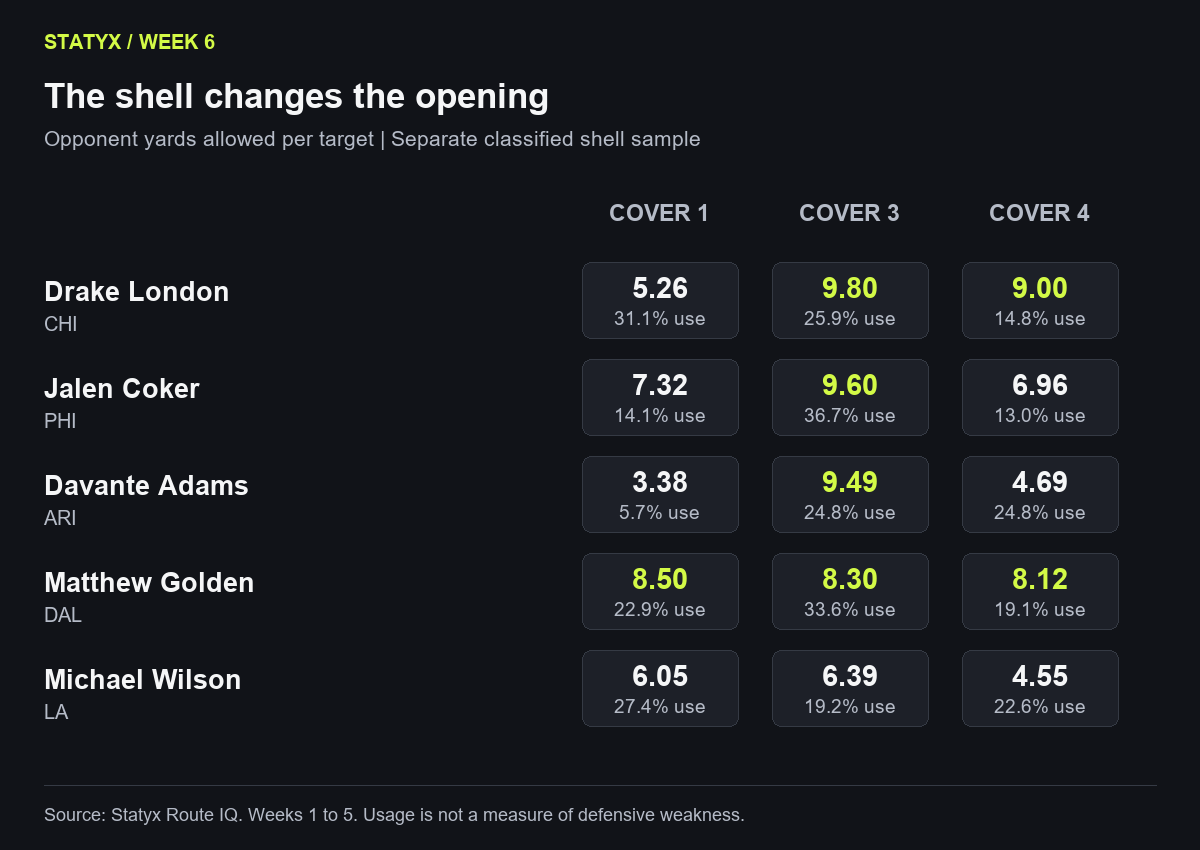
Chicago’s Cover 1 allowance is a tight 5.26 yards per target. Its Cover 3 allowance rises to 9.80, and London has 14 catches for 278 yards on 17 targets against that shell. His separate safety sample also shows 373 yards on 71 single high routes. Chicago uses single high looks 58.7% of the time, giving this matchup support beyond the broad man or zone label.
The wider defense allows 16.85 yards per target on throws traveling at least ten yards, the weakest result in that Route IQ comparison. London converts 61.1% of all targets into first downs and adds 2.11 yards after the catch above expectation per reception. Michael Penix and Jake Matthews practiced fully Wednesday. A competitive game would let Atlanta keep using a receiver whose efficiency already supports the matchup.
Carnell Tate vs Indianapolis Colts
Cover 3 is more useful than the man headline

Indianapolis uses man on 43.2% of classified plays, and Tate’s response has been modest: four catches for 41 yards on eight targets across 31 routes. His zone sample is stronger, with 15 catches for 168 yards on 20 targets. This is a selective shell matchup rather than a claim that he wins every type of coverage.
Cover 3 accounts for 28.8% of the Colts’ listed calls. Tate has caught ten of 12 targets for 128 yards against it, while Indianapolis allows 8.94 yards per target in that shell. The Colts also allow 6.33 yards after the catch per reception overall. Tate owns 48.9% of Tennessee’s air yards, so there is room for meaningful yardage if those connections arrive.
Indianapolis is favored by a touchdown, making a Tennessee catch up script plausible. That can create attempts without guaranteeing accurate delivery. His 1.78 overall yards per route and weaker man conversion keep this below the cleanest receiving fits. Lucas Oil Stadium’s roof decision needs checking, though the current outside forecast is mild.
Zay Flowers vs Cleveland Browns
A real man response, with a quarterback condition

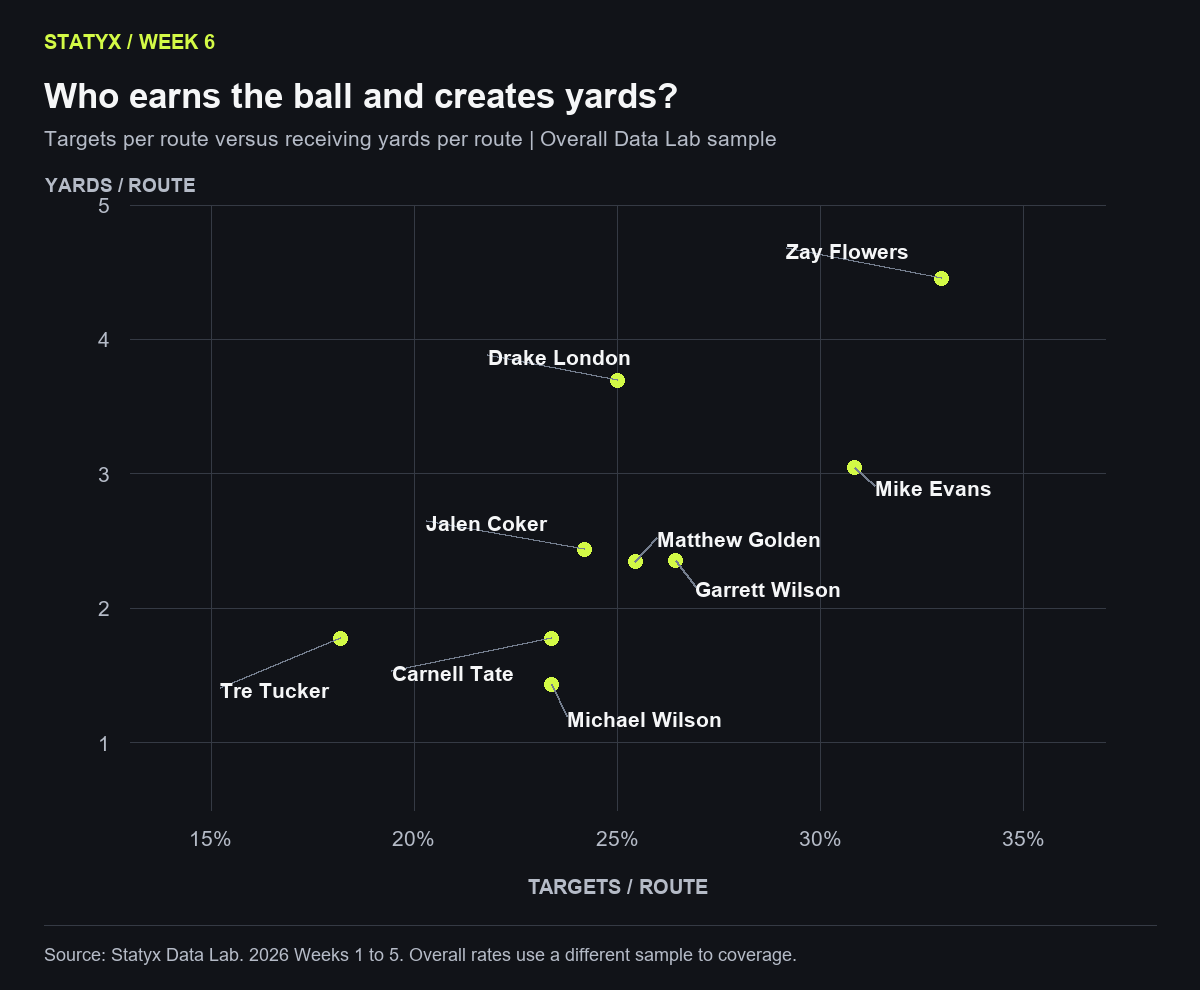
Cleveland’s 58.0% man rate is the highest among these five opponents. Flowers has seven targets on 22 man routes, producing five catches and 89 yards. His overall target rate is 33.0%, so the case for involvement extends well beyond those seven throws.
Cover 1 is Cleveland’s most frequent listed shell at 44.8%. Flowers has five catches for 98 yards on seven targets in that separate shell sample. The Browns allow 6.43 yards per target there, compared with much tighter results in Cover 3 and Cover 4. Flowers’ ability to earn the ball matters more than calling Cleveland an easy defense.
Lamar Jackson missed Wednesday with an ankle injury. That is the biggest condition on the receiving ceiling, alongside Baltimore’s multiple offensive line limitations. Flowers’ 4.45 overall yards per route describes what has happened; it cannot be carried unchanged into a different quarterback situation. Cleveland’s current forecast has sustained wind around 11 mph, with gusts near 15.
Michael Wilson vs Los Angeles Rams
Target volume meets a difficult yardage matchup

The Rams use man on 45.4% of classified plays. Wilson earns a target on 36.4% of his man routes, but the conversion has been poor: eight catches for 79 yards on 16 targets across 44 routes. Strong target demand and strong receiving efficiency are different things here.
Los Angeles allows 6.05 yards per target in Cover 1 and 4.55 in Cover 4. Wilson has nine catches for 90 yards on 15 Cover 1 targets and 42 yards on nine Cover 4 targets. Route IQ also places the Rams first in downfield prevention by yards allowed per target on throws of at least ten yards. This is a much tougher matchup than the likely passing volume suggests.
Arizona is a heavy underdog, which creates a path to more attempts while raising the risk of low quality catch up possessions. The Rams do allow 6.41 yards after the catch per reception, so Wilson’s more realistic opening may come after shorter completions. His overall 1.43 yards per route keeps the yardage ceiling speculative even with 51 targets.
02 Zone coverage: finding the right opening
Jaxon Smith Njigba vs Denver Broncos
Thursday: production against a weakened secondary

Denver’s 63.9% zone rate meets Smith Njigba’s best classified split: 26 targets, 22 catches and 334 yards across 75 routes. That is 4.45 yards per route against zone, compared with 1.79 against man. His 35.2% overall target share and 50.4% air yards share make the receiving demand difficult to dismiss.
Denver’s season defense has been strong in the relevant shells, allowing 5.33 yards per target in Cover 3 and 5.71 in Cover 4. But Patrick Surtain and Talanoa Hufanga are ruled out, with Riley Moss questionable. Those absences make the historical allowance less representative of Thursday’s personnel. Smith Njigba practiced fully on the final report and has no game designation. The current Denver forecast is dry with light wind.
Jalen Coker vs Philadelphia Eagles
A specific Cover 3 connection

Philadelphia uses zone on 71.1% of classified plays and Cover 3 on 36.7% of its listed calls. Coker has caught six of seven Cover 3 targets for 80 yards. His broader zone sample is ten catches for 164 yards on 12 targets across 47 routes. The sample is still modest, but the coverage exposure and player response point in the same direction.
Philadelphia allows 9.60 yards per target in Cover 3, while its Cover 6 allowance is only 3.43. That difference is why this is a Cover 3 argument rather than a blanket endorsement of zone. Coker’s 24.2% overall targets per route and 2.44 yards per route provide a useful foundation beyond the split. Coker and Bryce Young practiced fully Wednesday; Michael Carter II did not. The current Philadelphia forecast has light wind and little rain risk.
Keenan Allen vs Tennessee Titans
The reception case is stronger than the yardage ceiling

Tennessee’s 77.3% zone rate is the clearest fit for Allen’s coverage preference. He has 11 catches on 14 zone targets across 53 routes, compared with three catches for 12 yards on seven man targets. His overall 27.6% target rate supports a meaningful role when he runs a route.
The catch efficiency has not produced exceptional yardage. Seven Cover 3 targets yielded four catches for 24 yards; three Cover 4 targets yielded 24 more. Tennessee allows 7.85 yards per target in Cover 3, but its overall YAC allowance is a tight 4.17 per reception. Allen can remain useful through repeat catches without turning those catches into large gains. An early Indianapolis lead is the main volume risk in this matchup.
Davante Adams vs Arizona Cardinals
Cover 3 offers room, game flow can take it away

Arizona uses 78.1% zone, with Cover 3 and Cover 4 each accounting for 24.8% of its listed calls. The allowances are far apart: 9.49 yards per target in Cover 3, compared with 4.69 in Cover 4. Adams has nine catches for 156 yards on 16 Cover 3 targets, giving him a demonstrated response to the more generous shell.
His overall 22.2% targets per route and 2.17 yards per route support a receiving role without assuming that every Arizona zone snap is favorable. Puka Nacua’s availability and workload still matter to the distribution. The larger concern is game flow: Los Angeles is favored by 12.5 points. Adams could produce early, yet a comfortable lead would reduce the need for late passing. Arizona’s Andrew Wingard missed Wednesday; Budda Baker’s absence was listed as rest.
Mike Evans vs Washington Commanders
Monday: Cover 4 matters more than the zone total

Washington plays 69.9% zone and uses two high safety looks on 72.8% of its separate safety sample. Evans has 177 yards on 58 routes against two high looks, with 18 targets. His overall 30.8% targets per route and 64.7% first down rate per target show why he remains important even when the defense keeps help deep.
Cover 4 is the clearer opening. Washington allows 8.61 yards per target there, and Evans has four catches for 75 yards on six targets against the shell. Cover 3 is much tighter at 4.92 allowed. San Francisco being a substantial favorite could reduce second half attempts. The Monday game also means the first full practice report is still ahead of this Thursday draft; his recent rib issue needs that update before treating a normal workload as established.
03 Three receiving ceilings worth watching
Tre Tucker vs Buffalo Bills
An indoor ceiling with potential target concentration

Buffalo’s 68.8% zone rate meets a pronounced split: Tucker has 235 yards on 99 zone routes, compared with 26 yards on 31 man routes. Ten Cover 3 targets have produced seven catches for 116 yards, while all five Cover 4 targets became catches for 69 yards. He has 28.8% of Las Vegas’ air yards, but only an 18.2% overall target rate, so this remains a ceiling candidate rather than a dependable volume leader.
Jalen Nailor missed Wednesday with a concussion and Brock Bowers was limited with a knee injury. Confirmed limitations could concentrate targets, but that has not been established. Allegiant Stadium removes direct weather exposure. Buffalo’s fairly firm downfield allowance of 9.88 yards per target on throws of at least ten yards remains a restraint even in a game carrying a 53.5 point total.
Matthew Golden vs Dallas Cowboys
The coverage fits; the wind is a serious condition

Dallas plays 69.5% zone. Golden has 316 yards on 126 zone routes, including 126 yards on 12 Cover 3 targets and 101 on 11 Cover 4 targets. Dallas allows 8.30 and 8.12 yards per target in those shells. Golden’s 38.1% air yards share and 25.4% overall target rate provide both reach and involvement.
The current Lambeau forecast changes how aggressively to read that ceiling: sustained wind near 15 to 16 mph, with gusts reaching 34 to 37 mph during the game window. Deep connection quality deserves a real downgrade if that holds. Christian Watson also competes for these opportunities and has the stronger zone yardage rate. Golden belongs on the coverage shortlist, with the final wind forecast deciding how much of the vertical ceiling survives.
Parker Washington vs Houston Texans
London: a productive response against a resistant shell

Houston uses zone on 80.4% of classified plays, the highest rate among the featured zone opponents. Washington has 220 yards on 77 zone routes, with 14 catches on 20 targets. His Cover 3 response is nine catches for 157 yards on 13 targets, backed by a 41.4% overall air yards share.
Houston allows only 5.51 yards per target in Cover 3, so Washington’s prior production has to overcome a firm opponent. Jalen Pitre missed Wednesday with a shoulder injury; a confirmed absence could change the personnel around those windows. This game is at Wembley, where the Met Office currently shows sunny intervals and around a 20% to 30% daytime shower chance. Use the London forecast and refresh the hourly wind before kickoff.
Weather that can change the read
Lambeau is the main concern: the current forecast has gusts up to 37 mph. Kansas City also carries gusts around 20 to 22 mph, a reason to be careful with the Chargers’ deeper receiving opportunities. Denver, Philadelphia and MetLife currently have milder conditions. Outdoor forecasts and retractable roof decisions need a later check.
The Houston and Jacksonville game is at Wembley. Its Met Office forecast is the relevant one for Washington’s matchup.
STATYX
Find the opening before kickoff.
Explore Route IQ, coverage shells and the target demand behind every receiving matchup.
Start your 7 day trialPublished for research and entertainment purposes. Not betting advice.

Discussion
Sign in to join the discussion.
Loading comments…